

Like many others, I have been looking for where cracks in the financial system might appear catalyzed by the aggressive Federal Reserve rate hiking policy and balance sheet contraction. And while the housing market has been an obvious sacrificial lamb via much higher mortgage rates, at this point there doesn’t appear to be any of the carnage that we experienced between 2007 and 2011. Borrowers have much more equity so there should be nowhere the amount of distress that occurred during the subprime debacle. And throw in that the labor market has held up quite well as last week’s employment report reiterated, there have been no obvious cracks that could ripple through the economy and help bring about a recession and lead to a Fed pivot…until now.
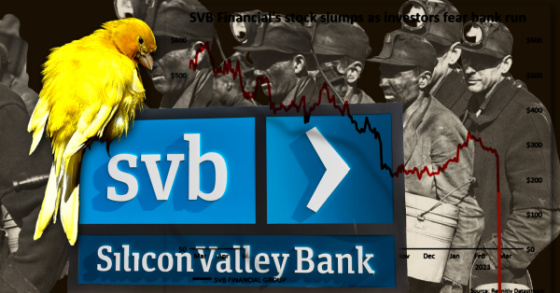
The canary in the coal mine finally showed up last week with the utter destruction of the stock price of Silicon Valley Bank and its shocking demise. This is what happened to SVB on Thursday after it announced that it was raising additional capital to help shore up its balance sheet created by losses from the sale of securities it sold that had much lower interest rates than those prevailing in the market today.

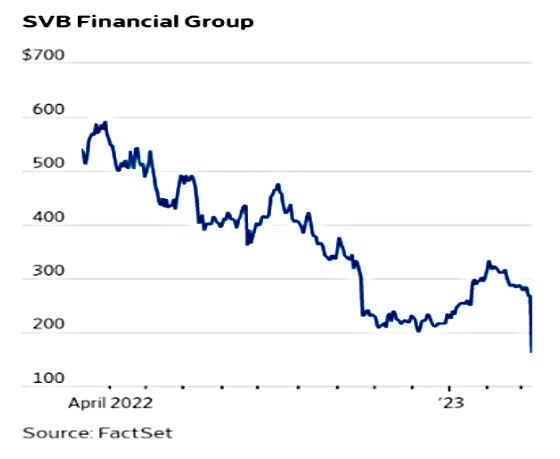
The SVB bombshell led to a major selloff in the banking sector.

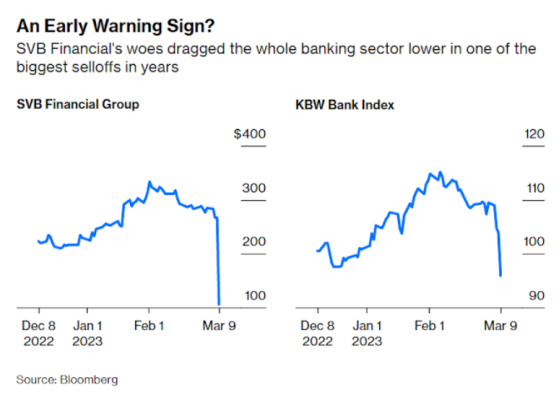
Banks big and small posted steep declines. PacWest Bancorp fell 25%, and First Republic Bank lost 17%. Charles Schwab Corp. fell 13%, while U.S. Bancorp lost 7%. America’s biggest bank, JPMorgan Chase & Co., fell 5.4%.
SVB’s downfall came from a confluence of macro forces impacting most banks and amplified by idiosyncratic factors brought on by SVB’s business model. When short-term interest rates were close to 0% SVB was able to invest in risk-free (creditwise), long-term Treasuries, and agency mortgage-backed securities and generate a profit because its cost of deposits were close to 0%. In addition, SVB specialized in lending to and gathering deposits from tech companies, especially early to mid-stage ones that were focused on growth and raising capital with profitability a secondary objective. This allowed the bank to generate profits from lending and gathering cheap deposits from companies that were raising money from venture capital firms and from public markets via IPOs.
All of this was fine as long as interest rates remained low, the yield curve steep, and tech companies could keep raising money to allow them to service their loans and keep deposits robust. Unfortunately for SVB, the Fed increased short-term rates aggressively such that the yield curve became extraordinarily inverted in that short-term rates have been much higher than long-term rates. This is not a recipe for banking profitability assuming they have to compete for deposits. Competing for deposits is not something that SVB had to do but this is no longer the case. Funding for tech companies has dried up, and many of them are burning through cash which is lowering deposits, and depositors now have many more options to earn a risk-free return. Add to this the huge increase of holdings of very low-interest Treasuries and mortgages that are now worth far less, and SVB found itself in a very difficult situation such that it needed to raise capital.
And here is what stuck out for me from the Wall Street Journal article linked above and is the reason I called this blog post Hiding in Plain Sight.
The Federal Deposit Insurance Corp. in February reported that U.S. banks’ unrealized losses on available-for-sale and held-to-maturity securities totaled $620 billion as of Dec. 31, up from $8 billion a year earlier before the Fed’s rate push began.
In part, U.S. banks are suffering the aftereffects of a Covid-era deposit boom that left them awash in cash that they needed to put to work. Domestic deposits at federally insured banks rose 38% from the end of 2019 to the end of 2021, FDIC data show. Over the same period, total loans rose 7%, leaving many institutions with large amounts of cash to deploy in securities as interest rates were near record lows.
U.S. commercial banks’ holdings of U.S. government securities surged 53% over the same period, to $4.58 trillion, according to Fed data.
Most of the unrealized investment losses in the banking system are at the largest lenders. In its annual report, Bank of America said the fair market value of its held-to-maturity debt securities was $524 billion as of Dec. 31, 2022, $109 billion less than the value it showed for them on its balance sheet.
So that was the macro side of the equation. Here are some painful specifics related to SVB.
SVB’s year-end balance sheet also showed $91.3 billion of securities that it classified as “held to maturity.” That label allows SVB to exclude paper losses on those holdings from both its earnings and equity.
In a footnote to its latest financial statements, SVB said the fair market value of those held-to-maturity securities was $76.2 billion, or $15.1 billion below their balance-sheet value. The fair-value gap at year-end was almost as large as SVB’s $16.3 billion of total equity.
Unfortunately, SVB’s attempt at raising new capital collapsed in the wake of the incredible publicity its problems attracted, the greater light shone on its precarious balance sheet, and the decision by very influential and successful venture investor Peter Thiel to have his portfolio companies pull money out of SVB.


The SVB debacle and possible contagion effects of depositors pulling money out of risky banks with a lot of low rates, long-term Treasuries, and mortgages or banks overall having to raise deposit rates to compete with alternatives may be the crack that finally requires the Fed to pause to avoid systemic problems. With banks harboring such significant paper losses on their Treasury and mortgage portfolios, one obvious solution is to start reversing course to help bring about lower long-term rates so that those securities regain some of their value.
In spite of a healthy jobs report and continued tough talk from Fed Chairman Jay Powell regarding keeping interest rates higher for longer, Treasury yields dropped across the board on Friday in the wake of SVB’s problems.
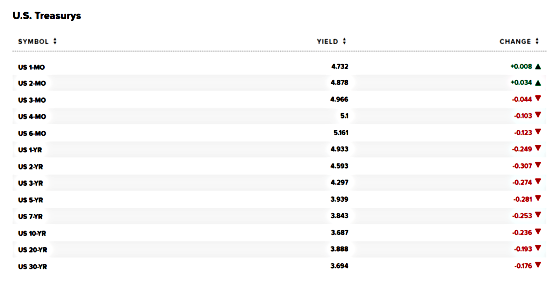
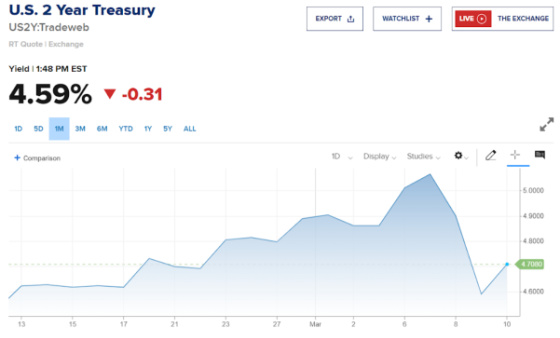
As I’ve written about before, the 2-year Treasury yield is one of the best barometers of where the Federal Funds Rate may peak. With the much hotter January jobs report and continued hawkish rhetoric from Fed officials, the 2-year yield breached its previous peak and exceeded 5% last week. Everything changed, however, with the SVB debacle. As this chart shows the yield dropped significantly and as of Friday it was below its previous peak in November.
And just as I was finishing up the blog, this news came out.

The more I go through life the more accurate and relevant I find Hemingway’s discussion about bankruptcy.
“How did you go bankrupt?' Two ways. Gradually, then suddenly.” ― Ernest HemingwayClick To TweetSVB’s collapse is yet another example of gradually and then suddenly.
Everything always looks more clear with the benefit of 20-20 hindsight but the light being shined on the substantial losses banks are sitting on in their Treasury and agency securities portfolios now makes it increasingly clear that the Fed cannot ignore this situation. Assuming no bailouts, then the most powerful lever the Fed has is to bring about much lower long-term rates to increase the value of those holdings.
I wonder what else is hiding in plain sight.

Leave a Reply