


There is an unmistakable, humbling weight to a match where, as it unfolds, you realize your opponent is simply better than you in every conceivable phase of the game.
It wasn’t just that I was losing points; it was the realization of total mastery across the board. His first serve was bigger; his second serve had more kick. His return of serve put me on the defensive immediately. His drop shots were feather-soft, his lobs pin-point, his overheads clinical. Whether it was decision-making, court coverage, forehand, backhand, or baseline consistency, he had an answer for everything I threw at him.
Sitting on the changeovers, watching the game count climb, a daunting thought set in: Maybe I will never be able to beat someone like this. It is a difficult realization for any competitive athlete to digest. When every weapon in your arsenal is matched and raised, you are forced to confront the limits of your current game. I felt like Moses wandering the desert for forty years and coming to terms with that he will never enter the Promised Land.
Yet, as my heart hammered in my chest and my lungs searched for oxygen, another thought competed for space in my mind—a recent study I’d been reading on Sprint Interval Training (SIT) and biological signaling. I know, my mind can go to very nerdy places, even while playing tennis.
While my tennis ego was taking a beating, my cellular machinery was experiencing something extraordinary.
The Molecular Cascade of High-Intensity Effort
We often hear that tennis is the premier sport for longevity. Copenhagen City Heart Study data famously showed that regular tennis players added an average of 9.7 years to their life expectancy—ranking higher than soccer, cycling, swimming, or running. But why?
The study I was reflecting on offers a profound biological explanation. It mapped the cellular communication highways in human blood following different types of exercise. The researchers found that brief, maximal-effort sprint intervals altered 714 circulating blood proteins almost immediately—with over 98% of them increasing—and released 212 proteins directly from stimulated muscle cells. By contrast, 90 minutes of steady-state cycling changed only 7 blood proteins and 9 muscle proteins at the same timepoint.
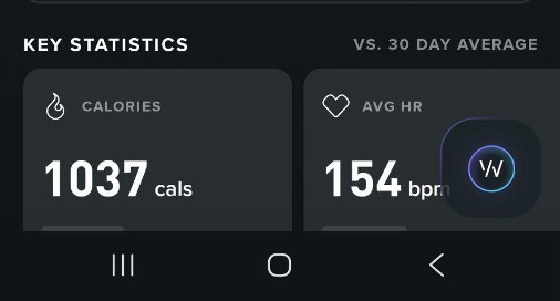
During my 66-minute match, my wearable tech painted a startling picture of this exact mechanism in real time:
- 83% in the Redline Zone: I spent 30 minutes in Zone 5 (164+BPM) and nearly 24 minutes in Zone 4 (151–163BPM).
- Massive Caloric Exertion: I burned 1,037 calories in just over an hour.
- Continuous High-Intensity Intervals: Because my opponent dictated such relentless depth and pace, my heart rate almost never dropped back down into Zone 2 or 3 (where I spent only 7% of the total time).
Here is my heart rate during the match.
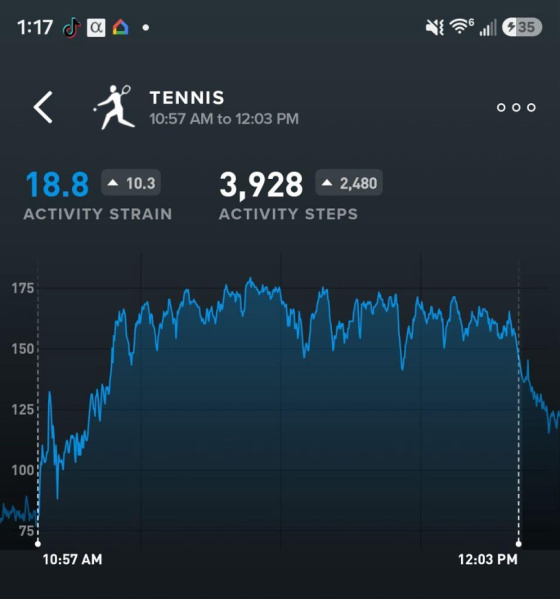
From a purely tactical perspective, spending nearly an hour in Zone 5 without adequate rest-to-work recovery is exhausting. But from a molecular perspective, I was triggering a massive, systemic “protein flood” across my entire body.
I’ve never played a match in which my heart rate averaged as high as it did last Thursday. And while heat was definitely a factor, we were also playing on clay, which requires more movement, as well as playing someone who was in extraordinary shape and required me to be constantly on the run.
Remodeling Fat and Protecting Against Metabolic Disease
The study went deeper into how this intense exercise plasma communicates with target tissues. When exposed to blood collected after sprint exercise, human fat cells underwent widespread gene remodeling, shifting the activity of 1,128 genes related to hormone sensitivity, fat breakdown, and nutrient sensing. Moderate-intensity exercise plasma shifted only 25 genes.
Crucially, when researchers cross-referenced these exercise-responsive signals against large-scale health databases tracking over 53,000 individuals, they uncovered a staggering pattern:
- Of 33 circulating proteins identified as directly protective against type 2 diabetes, obesity, and metabolic disorders, 32 were elevated by sprint-interval exercise.
- Only 3 of those protective proteins were elevated by moderate-intensity exercise.
When you are scrambling across the baseline, lunging for drop shots, and sprinting into the corners, your body surges with key metabolites like lactate, pyruvate, and Lac-Phe. You aren’t just playing a game; you are manufacturing a molecular shield against metabolic decline.
This is the hidden reason why tennis is the ultimate longevity tool. It isn’t just about movement; it is about the unpredictable, explosive interval nature of the sport. You sprint, decelerate, change direction, and recover, over and over again. It forces your cardiovascular and metabolic systems into high-gear interval protocols that standard steady-state cardio simply cannot replicate.
The Dual Ledger: Scorelines vs. Lifespan
Accepting a total defeat on the court requires a shift in perspective.
If I measure that 66-minute match purely by the scoreline, it was a complete loss. My opponent was superior in every category, and the gap felt vast. But if I measure it by my healthspan and lifespan ledger, it was an absolute triumph.
Every time he forced me into an extended rally, every time I had to sprint to cover a cross-court forehand, and every time my heart rate surged back into Zone 5, my body was upregulating insulin sensitivity, releasing tissue-protective proteins, and remodeling cellular biology for long-term health.
The next time you walk off the court after being completely outplayed, take a moment before you dwell on the errors. Look at the effort, respect the physiological cost, and remember: while your opponent may have taken the match, your body just won the long game.
We recently bought a Withings body scan machine. Here are the readouts for my Friday morning weigh-in.

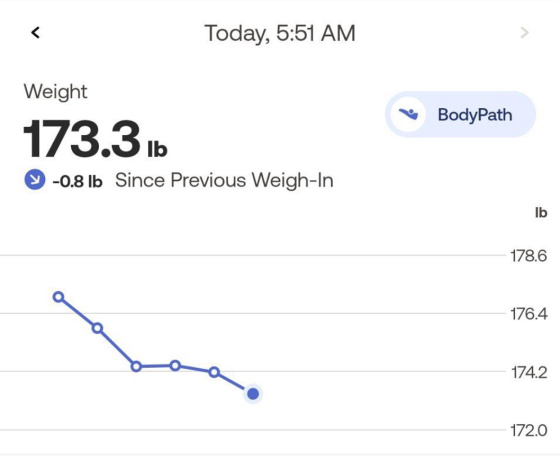
It has estimated that my Basal Metabolic Rate is approximately 2,000 calories, which means that without any movement I burn that many calories. Thus, if I don’t want to lose weight I need to consume 3,000 to 3,500 calories per day which is a challenge for me. As a result, I have continued to lose more weight (17 pounds now) as the graph above shows, but fortunately it’s mostly fat as my body fat percentage has continued to drop to below 10% now. My focus is now turning to weight management which means I need to take in more calories which will require more healthy fats.
And while I may have been the biggest loser on the court, I feel very much like the biggest winner from a metabolic perspective. Hopefully these off the court gains will start to carry over to my performance on the court. Either way, I feel so grateful to be able to play tennis and feeling the satisfaction of working hard, striving, and growing. And when you add in the incredible health benefits that accrue with playing the sport, I am one lucky guy.

Leave a Reply