

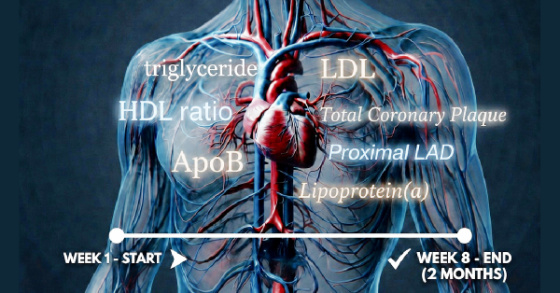
For most of my adult life, I assumed I was doing a pretty good job of protecting my heart. I exercise regularly, I don’t smoke, my blood pressure has generally been excellent, my resting heart rate is low, and I have remained physically active enough to play vigorous tennis well into my 60s. I have also generally considered myself to be a reasonably healthy eater, although I never had a particularly rigorous framework for evaluating whether the food choices I was making were actually optimal for cardiovascular health. So when I decided this summer to take a much deeper look at my cardiovascular health, I wasn’t expecting to discover anything that would fundamentally change my thinking. Instead, what began as an effort to better understand a few increasingly sophisticated cardiovascular biomarkers turned into a two-month investigation into what was actually happening inside my arteries—and whether I could change the trajectory.
The first clue came from following cardiologists and other cardiovascular specialists discussing heart disease on X. I became particularly interested in ApoB and lipoprotein(a), two measurements that don’t typically receive much attention during a conventional physical. ApoB is especially interesting because it provides an estimate of the number of atherogenic lipoprotein particles circulating in the blood—the potential “invaders” that can enter and become retained within the arterial wall. I decided to obtain a much more comprehensive baseline, using an 81-marker heart-health panel. Most of the results were quite good, but several caught my attention. My ApoB was 93, my triglycerides were 123, my glucose was 100, and my HDL was relatively low at 38. My LDL testing also revealed an unfavorable particle profile, including a high number of smaller LDL particles. None of these numbers suggested that I was facing an immediate crisis, but taken together they raised a much more interesting question: If these were the conditions under which my arteries had been living for years, how much damage had already been done?
Rather than simply worrying about the numbers, I decided to conduct an experiment. I used AI to analyze my blood work and examine my nutritional habits, including some of my habitual breakfast and smoothie choices. The process helped me identify several aspects of my diet that I thought were worth changing, particularly in terms of the composition and quantity of what I was consuming early in the day. I then made a radical change in my nutritional approach. Over approximately two months, I lost 17–18 pounds and reached less than 9% body fat. Some of the initial weight loss was almost certainly water and glycogen rather than fat, but the overall change in body composition was substantial. Just as importantly, I didn’t achieve this by becoming less active. My fitness remained extremely strong; I continue to exercise vigorously and recently completed a tennis session lasting more than an hour with an average heart rate of approximately 154 beats per minute. But despite the dramatic changes in my weight and diet, I still didn’t know whether I had actually changed the thing I cared about most: the number and metabolic characteristics of the potential invaders circulating in my bloodstream.
Before waiting for the next blood test, I decided to find out what had already happened inside my arteries. I underwent a coronary CT angiogram and had the images analyzed by Cleerly, an AI-based coronary imaging platform. The test cost approximately $950, but it provided something that a conventional cholesterol panel could never provide: an actual look at the accumulated consequences of my cardiovascular history. The results were simultaneously sobering and reassuring. There was definitely atherosclerosis. Cleerly measured approximately 237 mm³ of total coronary plaque, of which approximately 206 mm³ was classified as non-calcified and about 30 mm³ as calcified. But there was no severe obstruction. The greatest narrowing was 37% in the proximal LAD, an important coronary artery that is sometimes referred to colloquially as the “widow maker.” That description can make the finding sound frightening, but 37% is categorized as mild, non-obstructive disease. There were no moderate or severe stenoses anywhere in the report. My coronary calcium score was 80, which placed me at approximately the 40th percentile for men my age in the reference population used by the laboratory. In other words, I had accumulated measurable coronary disease, but I had not accumulated advanced obstructive disease. I had gone looking for the answer to the question, “How badly have I been losing this battle?” The answer was considerably more encouraging than I had feared: I had lost some ground, but the country had not been overrun.
The imaging also raised an interesting question about calcification. Only a relatively small portion of my total plaque was calcified, with most classified as non-calcified. At the same time, only about 0.6 mm³ of the total plaque was classified as low-density non-calcified plaque, a particular plaque characteristic associated with higher-risk features. I initially wanted to interpret the presence of calcium as evidence that the plaque was “healing,” but I’ve since learned that the science is considerably more nuanced. Calcification can be part of the evolution and remodeling of atherosclerotic plaque, and some forms of calcification may be associated with greater plaque stability, but a single scan cannot prove that the calcified portion of my plaque represents my body actively healing the non-calcified portion. What I can say is that I have established coronary plaque, but the imaging does not suggest that I have a large burden of obviously high-risk, low-density plaque or advanced obstruction. The scan is a snapshot of where I am today, not a movie showing exactly how I arrived there or where I am headed.
And that brings me to what I consider the most interesting part of the experiment. The objective of my nutritional intervention isn’t to make the existing plaque disappear. I’ve accepted its presence as part of my cardiovascular history. My objective is much simpler: reduce the number of potential invaders and improve the metabolic environment in which my arteries have to operate. ApoB is one of the most important measurements for the first part of that objective. If my new nutritional strategy has substantially reduced ApoB and LDL particle numbers, I will have evidence that I have reduced the number of atherogenic particles capable of contributing to future plaque progression. But I’m equally interested in what has happened to my triglycerides, glucose, and HDL. My original triglycerides were 123, my glucose was 100, and my HDL was only 38. I am hoping that the dramatic changes I’ve made in my nutrition, weight, and body composition will produce a substantial improvement in those numbers as well. In particular, I want to see whether my triglycerides have fallen meaningfully and my glucose has moved lower, while ideally seeing some improvement in HDL. The triglyceride-to-HDL ratio is another useful way for me to look at the metabolic picture, although I don’t regard it as a definitive measure of cardiovascular risk. Still, moving from a triglyceride level of 123 and HDL of 38 toward substantially lower triglycerides and a healthier HDL would represent a meaningful improvement in the metabolic profile I am trying to create.
This is what makes the next blood test so interesting to me. In a sense, I have created a natural N-of-1 experiment. I established a baseline, changed a major variable—my nutrition—and kept many of the other favorable variables relatively constant. I have maintained a high level of physical activity, continued not to smoke, and my blood pressure remains excellent. I then documented the anatomical consequences of my previous lifestyle with advanced coronary imaging. Now I am waiting for the biochemical results of the intervention. The next blood panel won’t tell me whether my existing plaque has disappeared, and I’m not expecting it to. It will tell me whether I have materially changed the conditions that contributed to plaque formation in the first place. If ApoB and LDL particle numbers have fallen substantially, while triglycerides and glucose have also improved and the rest of my metabolic profile remains favorable, I will have strong evidence that my new “defense doctrine” is doing what I hoped it would do. If those numbers haven’t improved, then I will have learned something equally valuable: perhaps diet and body composition alone aren’t sufficient to control my particular lipid biology, and I will need to consider what additional defenses make sense.
There is something oddly reassuring about discovering that you have a problem while there is still time to do something about its trajectory. My arteries aren’t pristine, and I don’t pretend otherwise. But neither are they severely obstructed. I’ve found an enemy inside the walls, I’ve learned that my previous defenses were not perfect, and I’ve now changed the defense doctrine. The most important thing I can do is not obsess over the plaque that has already accumulated, but reduce the factors that could allow it to advance. In military terms, I’m less interested in reclaiming territory that has already been occupied than I am in cutting off the supply lines and preventing further incursions.
And now the investigation continues. The next blood test will be my first real report from the battlefield after changing the strategy. Have I reduced the number of potential invaders? Have I improved the metabolic environment in which my arteries operate? And have I changed the trajectory of my cardiovascular risk? I don’t know the answers yet. That’s what makes this an experiment rather than a conclusion.
I’ve established where I am. I’ve changed what I can control. Now I’m waiting for the data to tell me whether it worked.

Leave a Reply