

For four decades—from Paul Volcker’s inflation-crushing rate peak in 1981 all the way to 2022—investors operated in a world defined by a single, unbreakable trend: long-term interest rates were moving down.
Throughout those 40 years, market doomsayers periodically screamed that the end was near.
“The debt burden is too high!” “Money printing will trigger runaway yields!” “The bond market vigilantes are coming!”
Year after year, decade after decade, those warnings proved wrong. Until, suddenly, they weren’t.
When the 40-year bond bull market finally broke in 2022, long-term interest rates didn’t just tick up—they surged with violent velocity. Credit spreads widened abruptly, global asset prices fractured, and the abrupt unwinding of the global Yen carry trade unleashed a cross-asset shockwave.
Why did a financial regime that took decades to build collapse so abruptly? To understand this shift, we have to stop looking at interest rates and exchange rates as standalone numbers and start viewing the financial system through the lens of systems thinking: Stocks and Flows.
1. The Anatomy of a Stock-and-Flow System

Donella Meadows, author of Thinking in Systems
In her seminal book Thinking in Systems, Donella Meadows wrote:
“A stock takes time to change, because flows take time to flow… Stocks usually change slowly. They can act as delays, lags, buffers, ballast, and sources of momentum in a system.”
To see how this applies to global markets, let’s identify the core Stocks and Flows powering the modern financial architecture:

- The Stock: The accumulated Volume of Global Sovereign & Corporate Debt (plus the trillions in leveraged positions built on ultra-cheap capital).
- The Flows: The annual Debt Issuance/Deficits (inflows adding to the stock) and the Capital Liquidation/Repatriation (outflows draining the stock).
- The Price Mechanism: Interest Rates, Credit Spreads, and Exchange Rates, which act as the system’s regulatory feedback valves.
2. The Great Ballast: Decades of Cheap Capital & The Yen Reservoir
Why were macro bears wrong for four decades? Because they focused purely on annual flows (e.g., annual deficit spending or budget announcements) while underestimating the vast absorbing capacity of global stock buffers.
Among the most powerful buffers in modern financial history was the Yen Carry Trade:
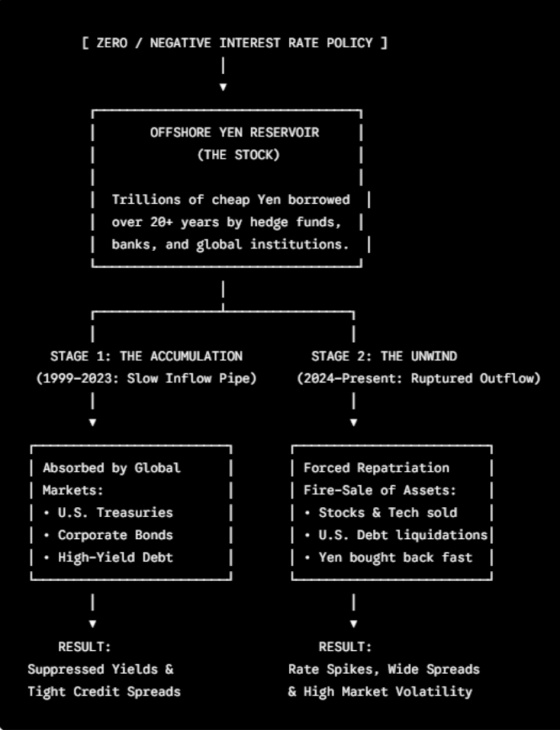
- The Mechanism: For over twenty years, the Bank of Japan maintained zero or negative interest rates alongside Yield Curve Control (YCC).
- Building the Stock: Global investors, hedge funds, and institutions borrowed cheap, zero-yield Japanese Yen in massive volumes and recycled those funds into higher-yielding global assets—U.S. Treasuries, tech stocks, Mexican Pesos, and corporate debt.
- The Ballast: This created an enormous, subterranean stock of offshore leveraged capital that continuously absorbed global debt issuance, artificially suppressing interest rates and credit spreads worldwide.
Combined with aging Western demographics, globalization, and central bank Quantitative Easing (QE), this vast liquidity pool cushioned the financial system against shocks for decades. To the market, it seemed like debt levels and low interest rates could coexist forever.
3. The Tipping Point: When a Buffer Becomes Violent Momentum
A fundamental rule of systems dynamics is that a buffer absorbs stress quietly until it reaches capacity or reverses—at which point the system shifts instantly from stability to instability.
In recent years, the stock-and-flow dynamic hit a critical threshold:
- The Debt Stock Reached Saturation: Global national and corporate debt hit record levels. The sheer volume meant that even minor rate increases created massive interest burden spikes.
- The Inflows Overheated: Unprecedented post-pandemic fiscal deficits flooded the market with fresh debt flows.
- The Bank of Japan Flipped the Valve: As Japanese inflation accelerated, the BOJ ended YCC and raised rates.
When the interest rate differential between Japan and the rest of the world narrowed, the Yen appreciated sharply. Suddenly, the leveraged carry trade became a burning theatre with a narrow exit door:
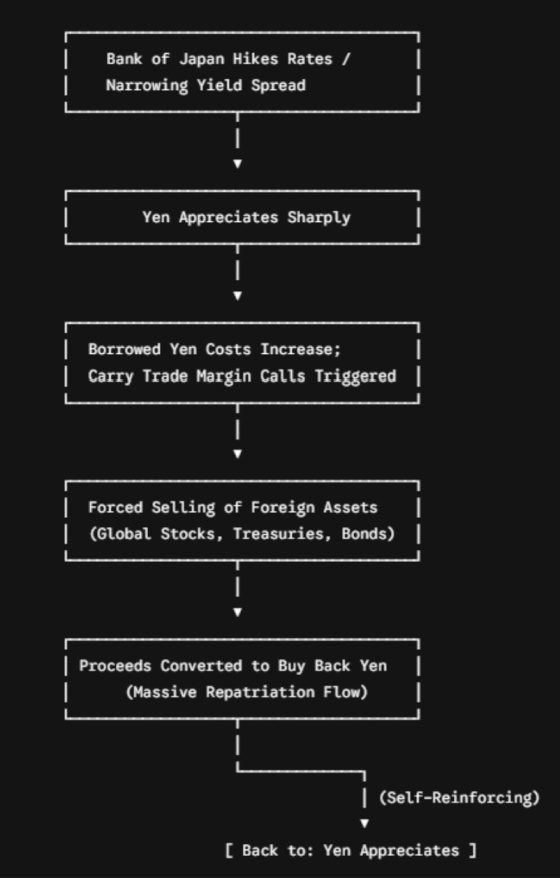
What had been a quiet stock of cheap capital suddenly transformed into a raging outward flow: investors were forced to sell global assets at lightning speed to buy back Yen and pay down their loans.
4. The Refinancing Wall and Credit Spread Explosion
When the Yen carry trade unwound alongside rising benchmark yields, the global refinancing engine seized up simultaneously:
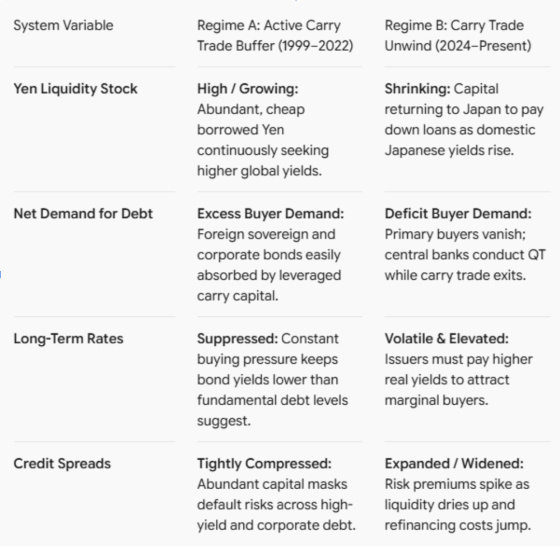
Sovereign Yields Jumped: With central banks engaging in Quantitative Tightening (QT) and Japanese investors pulling money back home, the largest net buyers of sovereign bonds vanished. Governments had to issue vastly more debt at higher rates just to service their existing stock of debt (a self-reinforcing feedback loop).
Credit Spreads Exploded: Corporations that relied on cheap global liquidity faced a double shock: higher benchmark rates and widening credit risk premiums. As the flow of cheap offshore capital dried up, default risks surged, sending credit spreads spiking.
Conclusion: The New Macro Regime
The belief that “interest rates will stay low forever” mistook a delayed system response for a permanent law. The system wasn’t immune to economic gravity; it was simply living off a massive, accumulated stock of cheap liquidity.
Now that the 40-year disinflationary ballast is depleted and the Yen carry reservoir has begun to drain, we have entered a volatile new macro regime:
- Flows dominate instantly: Markets can no longer absorb relentless debt issuance without demanding immediate, higher risk premiums.
- Leverage unwinds violently: When a multi-trillion-dollar stock of carry trade leverage turns into an outflow, asset prices reprice in days, not years.
- Volatility is the new baseline: Without central bank buffers to suppress feedback loops, yields, spreads, and exchange rates will oscillate wider and faster.
As Donella Meadows observed, systems appear calm right up until their internal buffers run out. For global fixed income and foreign exchange markets, forty years of stored leverage just met its reckoning.

Leave a Reply