

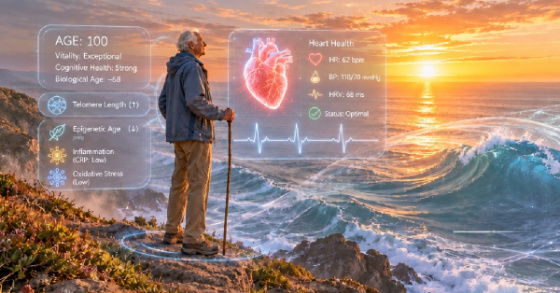
If you spend any time in the multifamily real estate business right now, you know the environment is anything but tranquil. Between stubbornly elevated interest rates, tightening capital markets, cost pressures, and the relentless blocking-and-tackling required to manage debt maturities and operating margins, this is one of the more demanding cycles our industry has navigated in years. When you are responsible for stewarding capital, teams, and communities through choppy waters, stress isn’t a theoretical concept—it’s an operational reality.
Yet stepping back from the daily noise invites a larger question: What is the point of navigating a difficult market cycle successfully if we erode our own biological capital in the process?
If the goal is not merely to survive the next quarter, but to live a vibrant, cognitively sharp, physically capable life into our 90s and beyond—to become healthy centenarians—we have to accept a fundamental truth: storms are permanent features of the landscape. Over a century of living, there will always be macro cycles, business headwinds, personal losses, and unexpected friction. Those who make it to 100 in good health don’t get there by avoiding stress. They get there because they learn how to metabolize it without letting it take up permanent residence in their nervous system, their blood vessels, or their cells.
First, a Reality Check on the Odds: What the Statistics Say
Before talking about biology, it helps to look at the base rates. Reaching 100 is still statistically rare—though the trajectory is moving upward.
According to the U.S. Census Bureau, centenarians accounted for roughly 2.4 out of every 10,000 Americans (about 80,139 people, or ~0.024%) in the 2020 Census, up from 1.73 per 10,000 in 2010, with Pew Research projecting the U.S. centenarian population to roughly quadruple over the coming decades as larger cohorts age. Reaching 110 or beyond (a “supercentenarian”) is orders of magnitude rarer—roughly 1 in 1,000 centenarians (or roughly 1 in 1–2 million in broader population estimates) reaches that mark.
Demographically, two patterns stand out:
- The Sex Gap: Women make up roughly 78% to 85% of centenarians (about 78.8% in the 2020 U.S. Census), though male centenarian growth has been climbing. Interestingly, researchers like Dr. Thomas Perls at the New England Centenarian Study note a paradox: while far fewer men reach 100, the men who do get there often show higher functional independence and lower rates of cognitive impairment than many of their female peers.
- Healthspan vs. Lifespan: Not every centenarian arrives at 100 in peak shape. Longevity researchers often group centenarians into “escapers” (around 15% in New England Centenarian Study data, who reach 100 with no clinically demonstrable major age-related disease), “delayers” (around 43%, whose first major age-related disease doesn’t appear until age 80 or later), and “survivors” (those diagnosed earlier who still manage to outlive the odds).
Those numbers are humbling—and clarifying. You can’t control every macro cycle or actuarial table, which makes controlling what is inside your own physiological lane all the more worthwhile.
The Biology of Stress: Why Unchecked Friction Ages Us
In the short term, stress is adaptive. A surge of adrenaline and cortisol sharpens focus and mobilizes energy to solve an immediate problem. The trouble begins when an acute business challenge turns into chronic, low-grade activation—what physiologists call allostatic load.
When the body’s threat-response system stays switched on week after week, the cost shows up directly in our bloodwork and cellular machinery:
- Cortisol and Glucose Drift: Cortisol’s primary metabolic job is to liberate glucose into the bloodstream so you can fight or flee. Under chronic psychological strain, sustained cortisol signaling nudges fasting blood sugar upward and blunts peripheral insulin sensitivity—even in people who eat well and exercise.
- Inflammatory Acceleration (“Inflammaging”): Chronic sympathetic arousal elevates pro-inflammatory cytokines and high-sensitivity C-reactive protein (hs-CRP). Over decades, this simmering inflammation stresses the vascular endothelium—the delicate inner lining of our blood vessels—and accelerates cellular wear.
- Epigenetic and Telomeric Wear: Prolonged, unrecovered psychological strain is consistently associated with accelerated biological aging markers and poorer recovery capacity.
In short, how we process a tough real estate cycle isn’t just a leadership question—it’s a metabolic one.
Using Real Blood Markers as a Compass (Not a Scorecard)
Longitudinal research—such as the Swedish AMORIS cohort (tracking over 44,000 people for up to 35 years) and the SWISS100 project—shows that centenarians aren’t necessarily mutants in midlife. Rather, they avoid the gradual upward drift into metabolic, inflammatory, and vascular dysfunction starting in their 60s.
Looking at my own recent bloodwork is a helpful reminder that even in a demanding season, several key markers can sit squarely in a healthy, protective zone—while a couple of others serve as useful early-warning gauges rather than reasons for alarm:
- Fasting Insulin & Triglyceride-to-HDL Ratio (Strong Metabolic Signal): A fasting insulin of 4.5 µIU/mL paired with triglycerides at 56 mg/dL, HDL at 44 mg/dL, and a triglyceride-to-HDL ratio of ~1.27 reflects high insulin sensitivity and clean lipid clearance—the exact opposite of the metabolic drift that drives cardiometabolic disease.
- Lipoprotein Particle Shift & ApoB (Moving in the Right Direction): Shifting from LDL Pattern B to Pattern A, bringing LDL particle number down to 1,087 nmol/L, and landing ApoB at 87 mg/dL (with Lp(a) < 10 nmol/L) shows a much lower atherogenic particle burden than seeing high particle counts alongside elevated triglycerides.
- Systemic Inflammation & Cellular Turnover: An hs-CRP of 0.4 mg/L and RDW of 12.1% point to a very quiet baseline inflammatory tone and steady red blood cell renewal—key pillars of resisting “inflammaging.”
- Omega-3 Status: An OmegaCheck of 7.9% (above the 5.5% optimal threshold) supports cell membrane fluidity, resolution of inflammation, and cardiovascular resilience.
- Where the Compass Points to Tune Up: Even with strong insulin and inflammation numbers, fasting glucose at 103 mg/dL (a classic reminder to watch morning cortisol/dawn dynamics, sleep, and carbohydrate timing), homocysteine at 16.5 µmol/L (pointing toward B-vitamin/methylation support), and kidney filtration markers (Cystatin C of 1.15 mg/L, eGFR ~64) show that longevity is an ongoing calibration, not a finished trophy.
Temperament and Aspirational Goals for the Long Haul
Psychologists studying centenarians—including in the Georgia Centenarian Study and the Longevity Genes Project—consistently find that exceptional agers tend to score low in neuroticism (less prone to getting stuck in anxious rumination) and high in conscientiousness and positive outlook. They face real hardships, but they don’t let external volatility permanently hijack their inner equilibrium.
Translating that into aspirational goals for navigating life’s roller coaster comes down to five practical commitments:
- Underwrite Your Nervous System Like a Portfolio: Treat emotional regulation and recovery with the same discipline you bring to risk management. Separate sharp, decisive problem-solving during market hours from late-night rumination, and build daily off-ramps that downshift your nervous system.
- Protect Metabolic Flexibility When Stress Spikes: High-pressure seasons tempt us to sacrifice sleep, over-rely on quick energy or alcohol, and let routines slip. Keeping nutrition clean, whole-food, and steady acts as a buffer against stress hormones.
- Train Both Aerobic Capacity and Muscle: Aerobic work builds the mitochondrial engine that handles physiological stress; strength training preserves muscle mass as a metabolic sink and functional safeguard for decades ahead.
- Track Biomarkers to Catch Drift Early: Periodic bloodwork and recovery tracking give you objective feedback—showing what’s working and where subtle stress or nutritional gaps are creeping in—long before symptoms show up.
- Anchor Life in Purpose, Connection, and Joy: Across longevity research, isolation and chronic cynicism corrode health, while meaningful work, curiosity, warmth, and shared experiences sustain it. Navigating tough cycles is far more sustainable when you’re building a life you actually enjoy living along the way.
Navigating Storms Without Eroding the Hull
Markets will always cycle, and life will always bring its share of turbulence. The real aspiration isn’t living a stress-free life—it’s refusing to let the storms break the vessel while you’re sailing through them.
Beyond the blood markers, the training protocols, and the actuarial tables lies a quieter truth that longevity science can only point toward. As the 19th-century Swiss philosopher and diarist Henri-Frédéric Amiel wrote:
“The whole secret of remaining young in spite of years, and even of gray hairs, is to cherish enthusiasm in one’s self by poetry, by contemplation, by charity—that is, in fewer words, by the maintenance of harmony in the soul. When everything is in its right place within us, we ourselves are in equilibrium with the whole work of God. Deep and grave enthusiasm for the eternal beauty and the eternal order, reason touched with emotion and a serene tenderness of heart—these surely are the foundations of wisdom.”

Leave a Reply