

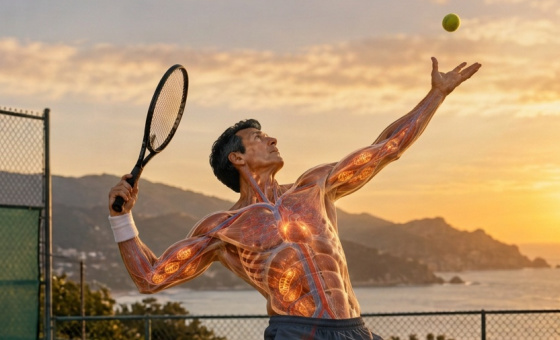
In real estate, when you walk into a property that requires a repositioning, your first instinct is often to look at the macro structures—the roof, the foundation, the main electrical service. You ask whether the primary systems are capable of delivering power and capacity to the rest of the building.
For decades, exercise science treated the human aging process with the exact same framework.
The conventional narrative around aerobic decline centered on central delivery: your heart beats slower, stroke volume contracts, and the central pump simply delivers less oxygenated blood to the periphery. It was clean, intuitive, and centered entirely on the heart.
However, a compelling study summary on aerobic aging and the Fick equation turns that assumption on its head:
VO2 Max = Cardiac Output x a – vO2 Difference
To understand what this equation actually means for healthspan, we have to decode its core components:
- VO2 Max (Maximum Oxygen Uptake): This is the maximum rate (measured in milliliters of oxygen per kilogram of body weight per minute) at which your body can pull in, deliver, and consume oxygen during all-out physical effort. Think of it as the horsepower rating of your engine. In medicine and longevity research, VO2 max is widely recognized as one of the single strongest predictors of overall lifespan and functional independence as we age.
- Cardiac Output (Central Pump): The volume of blood your heart pumps per minute.
- Arteriovenous Oxygen Difference / a-vO2 Difference (Peripheral Extraction): The difference in oxygen content between the arteries carrying fresh blood to your muscles and the veins returning it. In simple terms, it measures how much oxygen your working muscles successfully pull out of the blood as it passes through.
While central cardiac limitation dominates in our 20s (accounting for ~77% of VO2 max constraint), by late middle age, nearly half (44%) of aerobic decline originates in the periphery—not in the central pump, but in the skeletal muscle tissue itself. Between ages 20 and 70, VO2 max drops 46%, but cardiac output only falls 31%. The widening gap is driven by a steep loss in oxygen extraction at the cellular level. Said differently, even though your heart is still delivering a generous supply of blood, your aging muscles are increasingly failing to pull the oxygen out of it.
The Four Silent Bottlenecks inside Muscle Tissue
As we age, four underlying biological shifts quietly degrade our muscles’ ability to use the oxygen delivered by the heart:
- Loss of Type II Muscle Fibers (Sarcopenia): Age-related muscle loss preferentially strips away fast-twitch “Type II” muscle fibers. Unlike slow-twitch endurance fibers, Type II fibers are rich in energy generators and explosive strength. Losing them sacrifices both physical power and oxygen-processing capacity.
- Decline in Mitochondrial Density & Function: Mitochondria are the microscopic “cellular power plants” inside your muscle cells that convert oxygen and nutrients into ATP (usable cellular energy). Mitochondrial density refers to how many of these power plants you have packed into your muscle cells. As we age without intervention, mitochondria become fewer, smaller, and less efficient.
- Capillary Rarefaction (Vascular Thinning): Capillaries are the microscopic blood vessels threading directly through muscle tissue. They are the final delivery lanes of your circulatory system. “Rarefaction” is the gradual loss or thinning of these micro-vessels. With fewer capillaries, oxygen has to travel a much longer physical distance to reach the muscle cell, creating a severe delivery bottleneck.
- Interstitial Obstruction: Changes in the space between capillaries and muscle cells further slow down the final transfer of oxygen.
The encouraging takeaway? While central heart rate declines deterministically with age, the peripheral machinery remains remarkably malleable and responsive to targeted exercise well into our seventh and eighth decades.
Going Behind the Physiological Drywall
Recently, in my essay My Most Successful Remodel, I detailed what happened when I took a deep, diagnostic look “behind the drywall” of my own metabolism.
By making targeted choices around clean whole proteins, healthy fats, and eliminating refined carbohydrates, the internal transformation was immediate:
- Weight & Composition: A 24 lb weight loss, bringing my visceral fat score down to a minimal 2.7.
- Lipid Quality: A shift to Pattern A buoyant LDL particles, accompanied by a 41% drop in total LDL particle count (1,839 →\→ 1,087).
- Metabolic Efficiency: Fasting insulin dropped to 4.5 µIU/mL, HOMA-IR fell to 1.1, and hs-CRP plummeted from 1.1 to 0.4 mg/L.
Removing metabolic friction and clearing the vascular plumbing set the stage. But fixing the internal infrastructure is only half the equation—you also have to stress the engine to expand its working ceiling.
The Data: A 10% Expansion in Aerobic Capacity
The exercise science summary emphasizes that triggering peripheral muscle adaptations requires high-intensity metabolic stress—specifically High-Intensity Interval Training (HIIT) and Sprint Interval Training (SIT).
Over the past six months, my Whoop VO2 max data provided a front-row seat to this exact adaptation:
- June–July: 42mL/kg/min (+2%)
- August: 43mL/kg/min (+2%)
- Late Summer Peak: 46mL/kg/min (+7%)
- Current Baseline: 44–46mL/kg/min (+10% overall vs. prior 6 months)
In longevity terms, maintaining a VO2 max in the mid-40s places an individual in the upper tier for functional capacity. It acts as a deep physiological reserve, ensuring that daily physical demands consume only a small fraction of total capacity.
The Copenhagen Study: Why Tennis Tops the Longevity Charts
For years, public health researchers have evaluated longitudinal data to see which activities translate into extended lifespan. The landmark Copenhagen City Heart Study—which tracked thousands of participants over 25 years—revealed a striking hierarchy among sports. While jogging added roughly 3.2 years of life expectancy and swimming added 3.4 years, tennis ranked at the very top, adding an extraordinary 9.7 years of life expectancy.
- Tennis: +9.7 Years
- Badminton: +6.2 Years
- Soccer: +4.7 Years
- Cycling: +3.7 Years
- Swimming: +3.4 Years
- Jogging: +3.2 Years
Conventionally, scientists attributed this longevity dividend primarily to the social interaction and psychological community inherent in racquet sports. While human connection is essential, the research on peripheral aerobic aging provides the missing biological explanation for why tennis is such a potent longevity engine:
- Triggers Mitochondrial Biogenesis (HIIT/SIT): Mitochondrial biogenesis is the biological process by which your cells build new, higher-performing mitochondria. Tennis is inherently built on explosive 4-to-10-second rallies followed by brief rest. This natural sprint interval structure creates the exact metabolic surge required to trigger mitochondrial biogenesis, increase cellular power density, and preserve Type II muscle fibers.
- Promotes Capillary Growth: Capillary growth (angiogenesis) is the process of weaving new micro-vessels throughout muscle tissue. While explosive sprints trigger mitochondrial expansion, long tennis matches (60 to 90+ minutes) blend those intervals across sustained time-under-tension. This extended volume signals the body to build higher capillary density, shortening the diffusion distance oxygen must travel to fuel muscle cells.
- Decadal Adherence (“Tempus Probat Omnia“): The ultimate variable in long-term longevity is consistency across decades. Tennis combines physical exertion, dynamic strategy, and social connection—making it an engaging sport that people eagerly sustain into their 70s and 80s.
Time Proves All
In our 2026 Annual Investor Report at CWS, we highlighted the theme Tempus Probat Omnia—Time Proves All.
Whether evaluating a real estate asset or a physiological protocol, short-term metrics are merely an initial signal. The true test is compounding over time.
By pairing nutritional precision with the cellular stress of tennis, we aren’t just playing a sport—we are actively upgrading our cellular infrastructure. By continually optimizing both our central cardiac pump and our peripheral muscle extraction, we ensure that our capacity to live, move, and perform expands right alongside our years.

Leave a Reply