
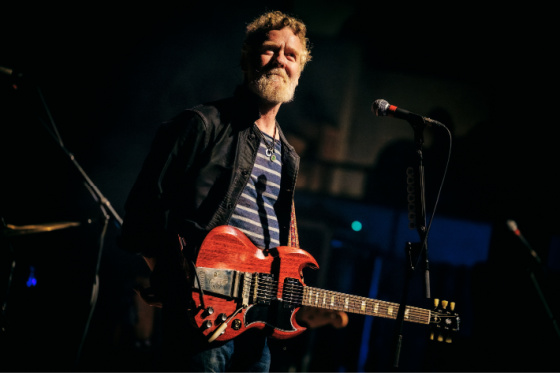
Last week brought the heartbreaking news that Glen Hansard had died in a motorcycle accident at the age of 56. Like millions of others, I first came to know his work through Once and the timeless song “Falling Slowly.” What made both the film and the song so memorable was their authenticity. Neither relied upon special effects, spectacle, or artifice. They resonated because they felt honest. The emotions were real, the characters were flawed, and the music seemed to come from a place of genuine humanity.
The tributes that followed Hansard’s death painted a similar picture. Friends and fellow musicians spoke not only about his artistry but about his generosity, humility, and kindness. He seemed to be one of those rare people whose reputation as a human being was every bit as impressive as his reputation as a musician. His friendship with Eddie Vedder reflected that quality. By all accounts, theirs was not a relationship built around celebrity but around shared values, mutual admiration, and a love of music.
Like many unexpected tragedies, his passing left me reflecting on decision-making and risk. None of us knows the exact circumstances surrounding the accident, nor should we pretend to. But every untimely loss reminds us that reality does not negotiate with our hopes. Reality is indifferent to what we wish would happen. It simply is.
That thought happened to intersect with something I have been wrestling with professionally. We recently placed a ten-year fixed-rate loan under application. Over the next several weeks, we have flexibility regarding when to lock the underlying Treasury yield. On one level, this is simply a financial decision. On another level, it is a fascinating exercise in human psychology.
The reality is that it would benefit us enormously if long-term interest rates moved lower before we locked. Naturally, that creates a temptation to believe they will.
What makes that temptation particularly dangerous is that our desires often disguise themselves as predictions. We begin with a preference and gradually convince ourselves it is a forecast.
Behavioral economists have a term for this: wishful thinking. Investors have been fighting it for as long as markets have existed.
Since mid-2022, long-term interest rates have repeatedly demonstrated an inconvenient tendency. They often fall slowly and rise rapidly. Just when markets become convinced that inflation has been defeated, that economic growth is weakening, or that lower rates are right around the corner, some new data point emerges, and yields move sharply higher. The trend has repeatedly punished people who interpreted what they hoped would happen as evidence of what was likely to happen.
As I thought about our pending rate-lock decision, I became concerned about exactly that trap. Not because I believed I knew where rates were headed, but because I recognized how easy it would be to rationalize a decision based more on desire than discipline.
In years past, I probably would have responded by building another spreadsheet. I would have downloaded data, created scenarios, and attempted to produce enough analysis to feel confident in whatever conclusion I ultimately reached.
This time I did something different.
I turned to artificial intelligence.
Not because I wanted a prediction. AI cannot tell me where the ten-year Treasury will trade thirty days from now any more than a Wall Street strategist can. Instead, I wanted something far more useful: a framework.
What I found particularly valuable was that AI did not attempt to forecast the future. Instead, it forced me to think in terms of reaction functions. If inflation surprises to the upside, what is likely to happen? If labor markets weaken materially, what are the implications? If growth remains resilient while government borrowing requirements remain elevated, how might bond investors respond?
In other words, the exercise shifted my focus away from prediction and toward preparation.
That distinction matters.
Most significant mistakes do not occur because we lack intelligence. They occur because we allow our biases to distort our interpretation of reality. We selectively embrace information that confirms what we already want to believe and discount information that challenges our preferred narrative.
Investors do it.
Business leaders do it.
Governments do it.
Individuals do it.
The older I get, the more convinced I become that good decision-making is often less about intelligence and more about humility. It requires acknowledging the possibility that we are wrong. It requires actively searching for evidence that contradicts our assumptions. It requires building processes and frameworks that help protect us from ourselves.
That, at least for me, is one of the most interesting applications of artificial intelligence. Its greatest value may not be in supplying answers. Its greatest value may be in helping us ask better questions. It can expose assumptions, identify alternative outcomes, and illuminate risks that we might otherwise ignore. It cannot eliminate uncertainty, but it can help us approach uncertainty more honestly.
Life works much the same way.
Most of us are carrying around assumptions about the future that may or may not prove correct. We assume we have more time. We assume tomorrow will arrive. We assume that opportunities, relationships, and health will remain available to us indefinitely.
Then reality occasionally reminds us otherwise.
Hansard’s death last week was one of those reminders. Not because motorcycles are inherently dangerous, nor because every tragedy contains a specific lesson. Rather, because unexpected events force us to confront a truth we spend much of our lives trying to avoid: reality does not owe us the outcome we prefer.
Whether we are evaluating an investment, managing our health, nurturing a relationship, or deciding when to lock a loan, the challenge is remarkably similar. We must try to see the world not as we wish it to be, but as it actually is.
That is easier said than done.
Hope is valuable. Optimism is valuable. Vision is valuable. But hope is not a strategy, optimism is not a forecast, and desire is not analysis.
Last week I found myself thinking about that paradox while listening once again to “Falling Slowly.” The title seemed strangely appropriate, though perhaps for a reason its writers never intended. Some things in life really do fall slowly.
Assumptions. Trends. Markets. Confidence.
But they often rise rapidly.
The best decisions may be the ones made by people who understand the difference and have the discipline to recognize reality before reality recognizes them.
Glen Hansard was born on April 21, 1970, in Dublin, Ireland, and died on July 29, 2026, in Dublin, Ireland (at age 56)

Wise words. I enjoyed this one – thanks.