


I was watching the new Rafael Nadal documentary on Netflix when something his Uncle Toni said stopped me:
“Talent is built in calm. Character is built in the storm.”Click To Tweet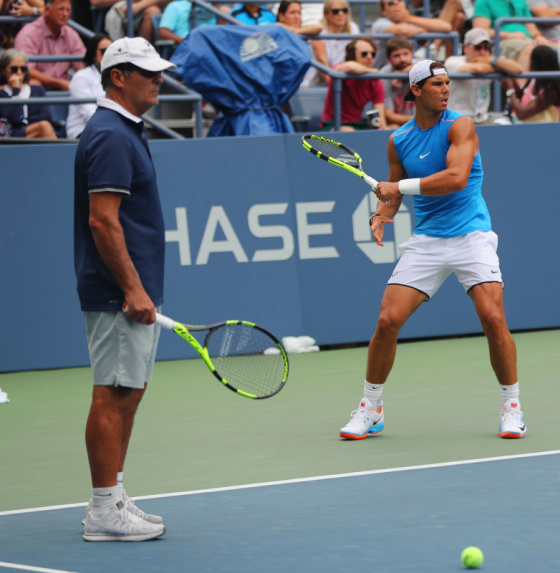
Toni Nadal and Rafael Nadal
That line followed me onto the court.
Because despite all the matches I’ve played, despite knowing—intellectually—that it’s “just a match,” I still felt the familiar surge: the tightening chest, the restless legs, the quickened breath. My WHOOP later told the objective story—an elevated heart rate—but I didn’t need a device to know I was in it.
The storm had arrived.
And here’s the paradox: part of me judged it (“Why am I nervous?”), while another part recognized it (“Of course I am.”). That tension—between resistance and acceptance—used to be where I got stuck.
But this time, something shifted.
From Control to Conversation
Instead of pushing the nerves away, I gave them a name:
Storm.
Not an enemy. More like a visiting force, powerful, unpredictable, but potentially useful.
I started talking to it:
- Why are you here?
- What are you trying to show me?
- How can we work together?
There’s something profound that happens when you stop saying “I am anxious” and start saying “Storm is here.”
The feeling becomes externalized.
It gains shape.
And paradoxically, it loosens its grip.
The Federalization of the Mind
Over time, I’ve come to think of the mind less as a singular voice and more as a federation—different parts, different energies, all showing up at once.
On a tennis court, they all arrive.
Instead of trying to silence one of them, I gave it a seat at the table.
Storm wasn’t banished.
Storm was invited in.
At 5–1, the Storm Returns
In my semifinal, I won the first set 6–4 and went up 5–1 in the second.
It looked like control.
But the storm doesn’t always show up when you’re behind. Sometimes it waits until the finish line is in sight.
He held: 5–2.
Then, for the first time all match, he broke me: 5–3.
Now the energy shifts.
He holds again: 5–4.
What felt inevitable suddenly feels fragile. I’m serving to close a match that ten minutes earlier looked like it might end 6–1.
This is where the storm gathers force—doubt, urgency, awareness.
But instead of pushing it away, I stayed in conversation:
Storm, you’re here. Let’s finish this together.
I didn’t need to be perfectly calm.
I just needed to stay present.
And I held.
6–4.
The Final: From Dialogue to Embodiment
The final brought a different kind of storm.
It wasn’t just nerves—it was heat, stamina, and sustained focus.
Before I even got to the court, I tried something intentional. I drove to the match with no A/C, no ventilation—just heat. The idea was simple: arrive already uncomfortable so that stepping outside would feel easier.
I wasn’t avoiding the suck.
I was embracing it early.
Maybe I was channeling Rafa—the idea that the beauty isn’t in avoiding suffering, but in being shaped by it.
Another Kind of Match
The match unfolded in waves.
He broke me early to go up 3–2. I broke back and eventually won the first set 6–4.
In the second, he raised his level. I got a bit less bold, a bit less focused. He took it 6–3.
Now we’re in a 10-point decider.
He jumps out to a 5–2 lead.
This is where stories usually go one way.
But something shifted.
Not because I started talking to Storm again in the same way. In fact, I felt less need to. The dialogue had quieted.
Instead, I leaned in.
I played more boldly. More freely. Less concerned with outcome, more committed to action.
And point by point, it turned.
8–5.
10–7.
What Changed
In the semifinal, I needed to talk to Storm.
In the final, I didn’t need to introduce myself anymore.
I just played.
Maybe that’s what happens when something moves from concept to experience—from idea to embodiment.
Storm didn’t disappear.
I just didn’t need to negotiate with it as much.
Character in the Storm
Uncle Toni was right.
Talent may be shaped in calm conditions.
But character shows up when:
- You’re serving at 5–4 after losing three games in a row
- You’re down 5–2 in a match tiebreak
- You’re physically uncomfortable and mentally stretched
Character isn’t the absence of those moments.
It’s what emerges inside them.
The Next Storm
I’ve already signed up for another tournament.
Which means this isn’t a finished story.
It’s a practice.
A willingness to go back into the arena knowing the storm will be there—mental, physical, or both.
But something has shifted.
Not in the elimination of nerves.
Not even in needing to name them every time.
But in becoming someone who can:
stand in it,
move through it,
and when the moment calls—
storm back.
Lessons for Life and Business
What happened on the court has more carryover than I expected.
Because the storms we face in business aren’t that different:
- Capital markets tightening
- Deals not going as planned
- Investors asking hard, necessary questions
- Long stretches where outcomes feel uncertain
Different arena. Same inner experience.
Here’s what I’m taking with me:
1. Name the Storm (Don’t Become It)
In the semifinal, giving my nerves a name created distance.
In business, this is equally powerful.
Instead of saying:
- “This deal is a problem.”
Try: - “We’re facing a storm here—what exactly is it?”
When you name it, you:
- Reduce emotional flooding
- Create clarity
- Invite problem-solving instead of reaction
Leaders don’t eliminate uncertainty.
They define it clearly enough to engage with it.
2. Dialogue First… Then Embodiment
At first, I needed to talk to Storm—ask questions, slow things down, regain perspective.
But by the finals, that dialogue faded. It had become internalized.
In leadership, it’s the same progression:
- Early: conscious framing, discussion, alignment
- Later: instinctive execution under pressure
You don’t skip the dialogue phase.
But the goal is to eventually act with clarity without needing to constantly re-process it.
3. Pressure Reveals, It Doesn’t Create
Down 5–2 in the tiebreak, I didn’t suddenly manufacture courage.
I accessed it.
Uncle Toni was right:
Character is revealed in the storm.
In investing and leadership:
- Tough markets don’t build discipline from scratch
- They reveal whether it was ever there
That’s why preparation in calm periods matters so much.
Because when pressure hits, you don’t rise to the occasion…
You fall to the level of your preparation and identity.
4. Don’t Protect the Lead—Play to Win
At 5–1 and again in the second set, I got a little less bold.
It’s a natural instinct—protect what you have.
But what changed the outcome was a return to assertive, forward play.
In business, this shows up as:
- Getting conservative at the wrong time
- Avoiding necessary decisions
- Managing optics instead of driving outcomes
Sometimes the riskiest move is:
trying not to lose.
The better move:
stay committed to the strategy that got you there—adjusted, but not abandoned.
5. Expand Your Capacity for Discomfort
Driving to the match in heat wasn’t about toughness for its own sake.
It was about expanding my baseline.
So that:
- What used to feel hard… feels normal
- What used to feel overwhelming… feels manageable
In business:
- Tough cycles are not anomalies
- They are part of the game
The more you pre-expose yourself to difficulty:
- Hard conversations
- Stress testing assumptions
- Scenario planning
…the less reactive you become when those scenarios arrive.
6. Play the Long Game (Even Inside the Moment)
Matches swing. Markets swing. People swing.
In both cases, the key is remembering:
- A bad stretch isn’t the full story
- A good stretch isn’t permanent
At 5–4… at 5–2 down… the temptation is to define the outcome too early.
The discipline is to stay:
Point by point. Decision by decision.
That’s how comebacks happen.
Closing Thought
Whether it’s a tennis match or a challenging investment cycle, the question is rarely:
Can you avoid the storm?
It’s:
Can you recognize it, relate to it, and ultimately perform inside it?
Because over time, success doesn’t come from removing uncertainty.
It comes from becoming someone who can:
- sit with it
- move through it
- and when necessary—
storm back.

Leave a Reply