

“Now that you don’t have to be perfect, you can be good.” — East of Eden
During the past year, my Audible and reading queue have undergone an unexpected transformation. For most of my adult life, my reading has been dominated by nonfiction—investing, psychology, philosophy, autobiographies, history, leadership, and business. I have always believed that if I was going to invest time in reading, I might as well learn something practical in the process. Lately, however, I have found myself drawn to novels. Donna Tartt’s The Goldfinch. The Secret History. Currently, John Steinbeck’s East of Eden. And now Theo of Golden. At first, I viewed this shift as little more than a desire for entertainment or perhaps a break from the intense analytical thinking that occupies so much of my professional life. I am beginning to suspect that something deeper is happening.
What has surprised me most is not merely how much I am enjoying these books, but why I am enjoying them. Fiction seems capable of exploring dimensions of human experience that are difficult to access through even the best nonfiction. A philosopher can explain jealousy. A psychologist can describe attachment. A theologian can debate free will. But a novelist can make us live inside those experiences. Rather than telling us what courage, grief, temptation, resentment, love, or redemption are, fiction invites us to inhabit them. It transforms ideas into lived experiences. Instead of presenting conclusions, it presents people. Instead of teaching lessons, it creates conditions under which lessons emerge naturally. The result is often more powerful and far more enduring.
As I’ve listened to East of Eden, I have been struck repeatedly by Steinbeck’s extraordinary ability to notice life. His descriptions move effortlessly from physical appearance to gesture, from gesture to psychology, from psychology to philosophy. He can describe a person’s face, a landscape, a conversation, or even a moment of silence in a way that reveals something universal about the human condition. Reading him has been both inspiring and somewhat unsettling because it has forced me to confront a long-standing tendency of my own. My mind naturally gravitates toward patterns, analogies, concepts, and overarching themes. I am often more interested in extracting meaning from an experience than fully observing the experience itself.
When I first noticed this difference between Steinbeck’s gifts and my own, I found myself slipping into what Zen practitioners call the comparative mind. I thought,
“I will never be able to write like that.”
Fortunately, a better thought eventually arrived:
“Perhaps the goal isn’t to write like Steinbeck. Perhaps the goal is to learn how Steinbeck takes in what he sees and processes it.”
The distinction is important.
Comparison focuses on deficiency.
Curiosity focuses on possibility.
The comparative mind asks, “Why am I not like him?” The developmental mind asks, “What is he seeing that I have not yet learned to see?”
That shift in perspective opened something up for me. I began to realize that I was not actually envious of Steinbeck’s talent. I was admiring a mode of consciousness. He seemed capable of slowing down enough to absorb reality before interpreting it. He lingers where I often leap. He observes where I often analyze. His writing made me wonder if there are thousands of details, gestures, expressions, and moments passing unnoticed in my own life because I am so eager to understand what things mean.
As I reflect on this, I realize that much of my life has been lived through the lens of what I think of as The Witness. Not the detached observer who stands outside life, but the fascinated observer who creates environments in which life unfolds. Looking back, I can see this tendency everywhere. It exists in my business career. It exists in my fascination with psychology, human behavior, and leadership. It exists in my love of gathering people together. And perhaps nowhere is it more visible than in The TenniSphere.
For years I have thought of The TenniSphere primarily as a tennis court, a gathering place, a social venue, and a sanctuary. More recently, I have begun to realize that it is also a laboratory. Friends gather. Conversations emerge. Relationships develop. Tensions surface. Personalities reveal themselves. A tennis match becomes a study in competitiveness, confidence, resilience, ego, grace, frustration, and redemption. A dinner conversation becomes a study in curiosity, insecurity, status, vulnerability, humor, and connection. For someone endlessly fascinated by human nature, this is deeply rewarding.
Yet there is also a hidden cost.
The Witness often stands close enough to understand but one step too far away to fully belong.
The Witness creates the party but does not always join it.
The Witness facilitates intimacy while maintaining a degree of distance from intimacy itself.
The Witness studies life while sometimes forgetting to simply live it.
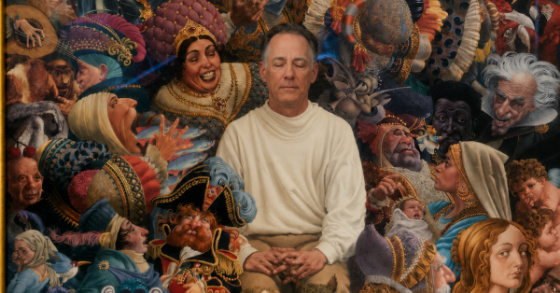
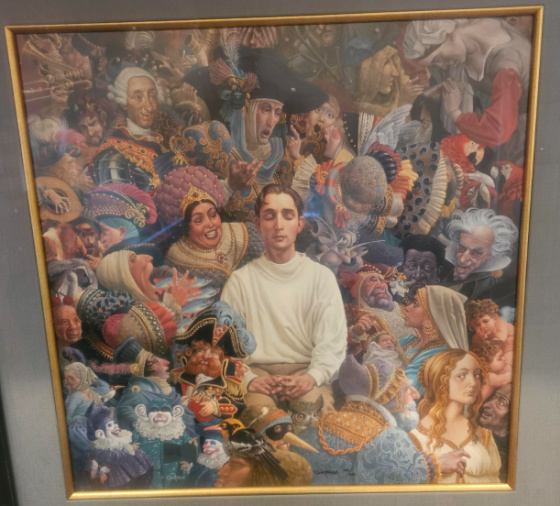
Perhaps that is why a painting hanging in my office resonates so strongly with me. It depicts a serene central figure seated amid a chaotic crowd of fascinating characters. The figure is surrounded but somehow separate. Immersed but distinct. Connected yet solitary. When I first purchased the artwork, I doubt I fully understood why it spoke to me. Today, it feels obvious. It is not a picture of isolation. It is a picture of witnessing., albeit from a consciousness perspective versus physically watching. I apologize for the odd angle but this vantage point avoided glare reflecting back off of the picture.
This is the original:
What fascinates me is that this same archetype appears throughout my life in different forms. Part of me resembles Rick Blaine in Casablanca—the proprietor who creates the environment where relationships, conversations, and dramas unfold. Part of me resembles a host who enjoys bringing interesting people together and then quietly observing what emerges. I enjoy being a catalyst. I enjoy creating the conditions under which people connect. Yet there are times when the role of observer can feel lonely. Not because people are absent, but because the observer is always standing slightly apart from the experience itself.
As these thoughts have been unfolding, I encountered what may be the central philosophical insight of East of Eden. Deep within the novel, Steinbeck focuses on a single Hebrew word from the Cain and Abel story in Genesis: timshel, which he interprets as “Thou mayest.”
Not “thou shalt.”
Not “you must.”
Not “you will.”
But “you may.”
Steinbeck’s character Lee calls it “perhaps the most important word in the world.”
Why? Because if God says, “You shall,” then destiny is predetermined. If God says, “You must,” then life becomes an obligation. But if God says, “You may,” then human beings are endowed with something both glorious and terrifying: choice.
The way is open.
The responsibility is ours.
The burden and privilege of authorship fall back upon the individual.
Whether Steinbeck’s interpretation satisfies every Hebrew scholar is almost beside the point. Philosophically, it is quite powerful. The message is that we are not merely products of our inheritance. We are not prisoners of our past. We are not condemned to repeat the patterns we have received. There remains something within us capable of choosing.
This idea resonates deeply with me because it sits at the intersection of so many subjects that have occupied my attention for years: Jung‘s concept of individuation, Joseph Campbell’s hero’s journey, Charlie Munger‘s emphasis on character, and my own reflections about vitality, growth, and becoming. At its core, timshel is not merely about morality. It is about authorship. It asks a question that every thoughtful person eventually confronts: To what extent am I the product of my conditioning, and to what extent am I a participant in my own becoming?
But perhaps what strikes me most is how beautifully fiction delivers this insight.
A philosopher might write an entire book on free will.
Steinbeck gives us Cal Trask.
A psychologist might explain the struggle between nature and nurture.
Steinbeck allows us to feel it.
That is the unique power of fiction. It doesn’t merely communicate ideas. It incarnates them.
And that brings me back to why fiction has captured my attention so completely. I no longer believe I am reading these novels to escape thinking. In fact, I suspect the opposite is true. Fiction may be developing aspects of my mind that decades of investing, analysis, and philosophical inquiry have left relatively underdeveloped. It encourages me to notice before I interpret. To witness before I analyze. To experience before I explain.
More importantly, it reminds me that understanding life and living life are not the same thing.
The Witness in me will probably never disappear. Nor should it. It has served me well. It has informed countless investment decisions, inspired much of my writing, and deepened my appreciation for the endless complexity of human nature. It has allowed me to build businesses, communities, relationships, and places like The TenniSphere. It has encouraged me to study people and search for patterns that unite seemingly unrelated experiences.
But perhaps the lesson I am receiving from Steinbeck is that the Witness occasionally needs to step out from behind the notebook.
To join the conversation.
To become less interested in analyzing the story and more willing to become one of its characters.
Perhaps that is the deeper gift fiction offers. It reminds us that understanding life and living life are not the same thing, and that no matter how long we have spent observing the story, we remain free to become one of its authors.
Or, as Steinbeck might say:
Thou mayest.

Leave a Reply