


Last week, I made my annual pilgrimage to London to meet with some of our insurance carriers and prospective ones as well. We have approximately 15 different companies providing us with different layers of coverage. We have a primary layer that covers first losses after deductibles and then secondary/excess layers. Multiple companies are in each layer, so no one company provides the entirety of our coverage. Typically, the most one company will insure an individual layer is 15% of that tranche.
Last year, when I was in London, I wrote about how the reinsurance market was in disarray because of the huge losses these carriers incurred from Hurricane Ian in Florida and other large catastrophic losses. Capacity exited the market, which left our carriers needing to retain more of the risk, which meant having to retain or attract high-cost capital as well as pay much higher premiums for their reinsurance. These costs were passed on to apartment owners and other real estate and business classes as well, leaving us with higher-cost insurance and increased deductibles.
This year, the market is more stable as reinsurance capacity has improved, but it is still very challenging nonetheless. With risk-free rates in the 5%+ range, there is less incentive for outside capital to invest in reinsurance or anything else without compelling returns. This is at a time when the demand for reinsurance is growing significantly due to higher inflation, more natural disasters, and overall volatility.
As a result, despite strong profitability in 2023, reinsurers expect it to still be what’s known as a “hard market” in 2024. This means that demand exceeds supply quite materially. Swiss Re is one of the world’s largest reinsurers. This is what they had to say about the market in September.
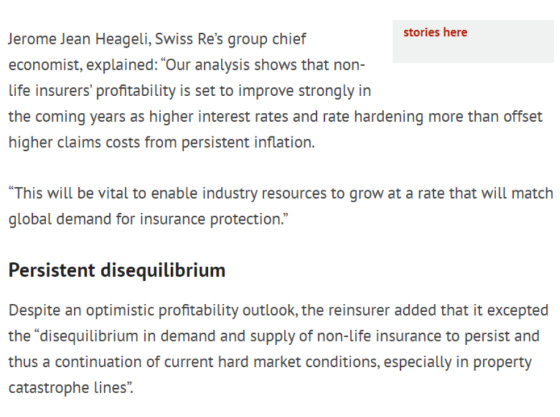
The significant supply and demand imbalance between the growth of industry capital and the need for coverage particularly struck me. The cumulative gap is quite eye-opening.
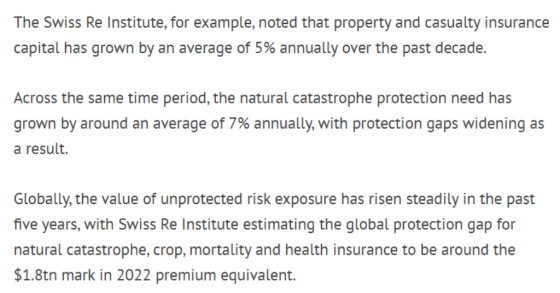
Given all of this, we expect substantial premium increases again and higher deductibles, particularly for freeze-related events. Insurers were shocked by how significant their losses were from the Texas freeze caused by Uri in 2021 and Elliott in 2022, which was much more widespread. This risk was not something their models factored in, so they didn’t price it into their premiums. The first time it happened, they chalked it up to a very rare event, so while they now needed to price it in, they thought it might be a one-in-every-10 to 20-year event. They did not expect a second, and more damaging one, to happen so quickly after the first. This was a big wake-up call that this risk needs to be priced in a way that reflects that the frequency is much more significant and has the potential for great severity (economic cost).
“People calculate too much and think too little.” ~ Charlie MungerClick To TweetI think someone should write a book called When Models Go Bad or Why Do Bad Things Happen To Good Models? I think you get the drift. Not everything can be modeled accurately which has led Charlie Munger to say that “People calculate too much and think too little.” Bad models blew up Long-Term Capital and led to overconfidence that weak lending standards for single-family borrowers would not come back to haunt lenders because home prices never went down. Well, their models never factored in what would happen if the market was flooded with mis-priced loans that magnified the buying power of home purchasers but also gave them very little margin of safety if they had to move or could no longer afford to pay the mortgage due to job losses or impaired health.
The subprime crisis was a classic case of George Soros’ Reflexivity, which posits that various actors can influence the data they’re using to make capital allocation decisions. For example, loan losses for single-family mortgages can be very low, resulting in lenders becoming more aggressive in making more loans because they perceive a favorable risk-reward relationship. What they often fail to factor in, however, is that their liberal lending standards can push home prices, which strengthens collateral values and results in homeowners having more equity that they have the incentive to protect. More lending ensues, which further improves the loan loss statistics, or at least keeps them stable, which leads to more lending, higher home prices, etc., until something changes and the house of cards collapses.
Soros says that a great deal of money can be made riding the wave of a false premise because people concoct all sorts of rationalizations to justify paying such high prices that can lead to stratospheric valuations. The key is to know that the wave is based on a false premise (e.g., home prices never go down), ride it, and get off of it before being subsumed by the tsunami that occurs after some piece of powerful disconfirming evidence is disseminated and causes investors to question the validity of their investment thesis, or there is a break somewhere else in the system that leads to investors either wanting to get out before the herd or having to due to liquidity issues. Obviously, recognizing the false premise, riding the wave, and getting out in time is a lot easier said than done. The point is that relying on models can lead to overconfidence and false premises that can result in asset values going way beyond equilibrium.
Back to insurance. We renew our coverage on December 31st, so we will see what happens at that time. I’m not optimistic that our renewal will result in anything other than a 25%+ increase in premiums and retaining more of the risk.
What was constantly reiterated to us by the underwriters, however, was how much they appreciated us taking the time and incurring the expense to fly to London to meet them in person. The carriers are very relationship-oriented and ideally want to keep renewing business with customers they have gotten to know that have a strong risk management program and long-term mentality when it comes to relationships and property ownership. They particularly like when owners continually reinvest in their assets and prioritize safety and asset preservation. CWS checks all of these boxes, and they all told us that. Thus, when it comes time to access insurance in what is a very difficult market for buyers, they will always prioritize those companies with whom they have been doing business, especially if they have met them in person and like how they run their business.
We had a very large insurable claim related to the Uri freeze and, unfortunately, another large one caused by winter storm Elliott, although only about ⅓ of Uri’s, even though more properties were affected. Our head of Asset Management, Casey Miller, provided the underwriters with whom we met a very detailed explanation of what we learned from both freezes, the actions we have taken to strengthen our properties to withstand future freezes better, and the plans we have in place to prepare for such conditions when they arise. They were impressed, and all of them said that they are in the business of insuring risks and paying claims, so things will inevitably happen that will result in them losing money in any one year. What they want to see, however, are organizations that take these risks very seriously, learn from them, and put plans in place to be better prepared in the future and to be willing to make prudent investments in building strength and resilience. Casey told the underwriters that we have collectively spent $5 million this year for insulation and other mitigation efforts at our properties. They obviously appreciated hearing this.
I’ll sign off with a couple of personal anecdotes from the trip. Prior to London, Heather and I spent two days in Amsterdam.
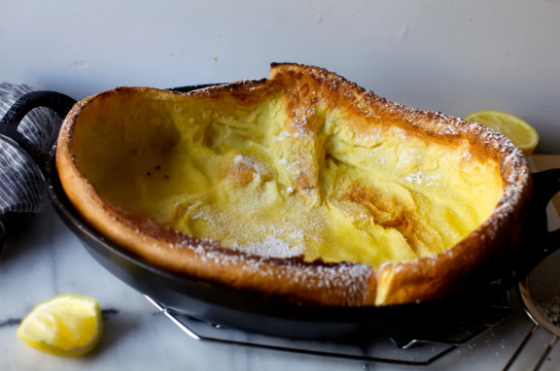
At home, I often go to a local breakfast restaurant specializing in pancakes. My favorite is the Dutch Baby, which looks like this.
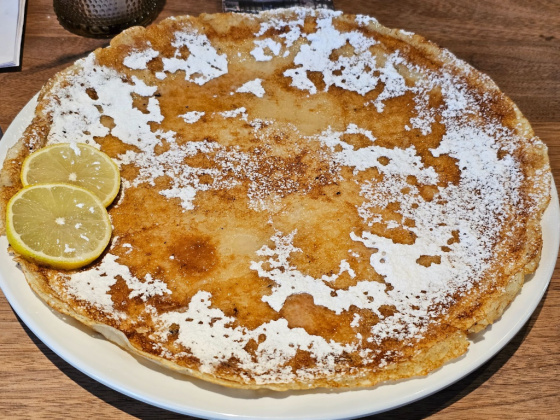
I order it every time I frequent the restaurant. I have never deviated. When walking around Amsterdam, we saw a number of Dutch pancake restaurants. I was obviously excited to experience and savor a Dutch Baby in Holland. When looking at the menus, I could see they had a wide variety of pancakes but no Dutch Baby specified. I assumed they served them, but it was called something different. When it came time to order, I showed the waiter a picture of a Dutch Baby on my phone and asked if they served it. To my surprise, he said he didn’t think so but would check with the cooks. The restaurant was very small, so we could see him going to the kitchen and asking them. The three of them shook their heads, and I heard one say, “Denmark.” I had to laugh. I thought we were in the birthplace of the Dutch Baby, and it turns out that it’s not here, and maybe never has been, and that it could actually be in Denmark. I learn something every time I travel overseas. For what it’s worth, this is what I ordered, and it was delicious. It was a lemon pancake.
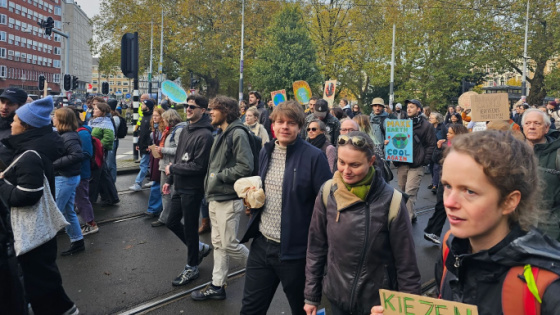
While we were enjoying our meal, we started hearing a lot of noise and quite a bit of commotion outside the restaurant. I turned around and looked out the window and saw a huge number of people starting to march. I had to go out and see and take videos and photos. It turned out that it was an anti-fossil fuel rally, and, as I learned later, it was led by the darling of the environmental movement Greta Thunberg. I’ll refrain from commenting, although if you heard some of what I said while taking my videos, you would know what I think about that movement. Here are a couple of pictures.

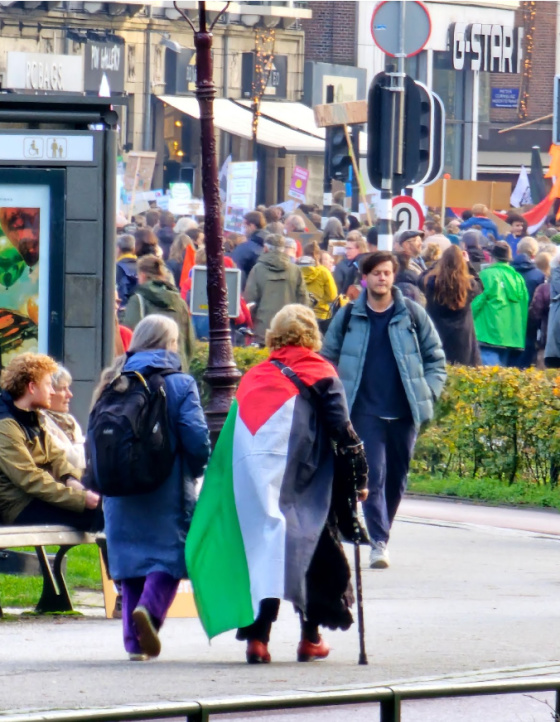
And, of course, since birds of a feather flock together, there was naturally a big Pro-Palestine contingent.
At least there were a couple of joyful, funny participants as well. We saw these two characters right outside of the restaurant.

I hope you have a wonderful Thanksgiving!

Leave a Reply