

Remembering Who You Are
Reflections on Mick Jagger, Norman Lear, Tennis, and the Hidden Importance of Memory
The other night we hosted a live ball session at The TenniSphere with a group that included a lot of younger players. At one point I put on some Rolling Stones music and found myself doing a little arithmetic in my head.
I realized that I am now closer in age to Mick Jagger than many of the players on the court are to me.
That was a strange moment.
For most of my life, Mick Jagger represented youth, rebellion, energy, and motion. He was part of the soundtrack of a generation that still feels remarkably close to me. Yet somehow he is now 83 years old, and I am much closer to him chronologically than to many of the people running around the tennis court.
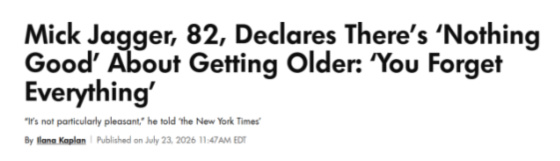
The next day I happened to read an interview with Jagger in People. What surprised me wasn’t that he was still performing. What surprised me was that he sounded like the rest of us. He talked about the frustrations of aging. He said he hates getting old. He complained about not remembering things. In other words, Mick Jagger sounds a lot like an ordinary 83-year-old*.
Except, of course, he isn’t.
Most 83-year-olds aren’t spending two hours a night performing in stadiums. Most aren’t maintaining the conditioning necessary to move with the energy he displays. There is a fascinating paradox at work. Publicly, he appears remarkably young. Privately, he experiences many of the same frustrations that accompany aging.
Perhaps that is the point. Maybe successful aging isn’t the absence of struggle. Maybe successful aging is continuing to engage despite the struggle.
I was reminded of another observation from Norman Lear, who lived to be 101. When asked how old he felt, Lear famously said that he felt as old as the person he was talking to.
I love that answer.
Part of what keeps me energized about tennis isn’t simply the exercise. It’s the people. Many of the players who come through The TenniSphere are decades younger than me. Spending time with them pulls me forward. Their energy is contagious. Their perspectives are fresh. Their ambitions and enthusiasm create a bridge between generations.
Lear understood something important: age is not merely biological. It is relational. We become partly shaped by the people around us.
The more I thought about these observations, however, the more I realized there was another thread connecting them. The issue isn’t merely physical aging. It’s memory.
Recently I listened to Rick Rubin interview a memory expert on his podcast. They discussed techniques that memory champions use to accomplish what appears impossible. They create stories. They construct vivid mental images. They develop outrageous associations that allow information to become memorable.
What fascinated me was the implication that memory isn’t simply something we either possess or lose. It is a faculty that can be exercised, strengthened, and cultivated.
That matters because memory is far more important than remembering where you left your car keys.
Memory is what makes you you.
It is the thread connecting your past self, your present self, and your future self. It allows you to recognize patterns. It helps you draw lessons from experience. It enables wisdom to accumulate rather than evaporate.
Without memory, life becomes a collection of disconnected moments. With memory, life becomes a story.
I see evidence of this every day on the tennis court. The most common memory lapse isn’t forgetting a birthday or a name. It’s forgetting the score.
Players will stop in the middle of a game and ask, “Are we at 30-all or was it 40-30?”
Three points later, the score has vanished. Even after one point in the most extreme cases.
It’s a small thing, but it’s also revealing. Staying mentally present requires effort. Remembering requires attention. Attention itself is becoming increasingly scarce in a world filled with constant distractions.
Perhaps this helps explain another observation I’ve had about some of the most productive and creative older people.
They keep working.
Bob Dylan continues touring. Warren Buffett continues reading and investing. Mick Jagger continues performing. Norman Lear continued creating deep into his later decades. Whether consciously or unconsciously, they are placing demands on their minds. They are forcing memory systems to stay active. They remain engaged in pursuits that require continual learning, adaptation, and recall.
Dylan once noted,
“A folk singer is only as good as his memory, and my memory is going”.
By keeping a massive, constantly rotating repertoire of traditional folk, blues, and his own catalog active in his mind, he continually exercises his cognitive recall. [1, 2, 3]
The old saying tells us to “use it or lose it.”
There may be more truth in that phrase than we realize.
I’ve also become intrigued by the idea that memory isn’t a fixed archive. The stories we tell ourselves about the past often change as our present circumstances change. The same event can seem tragic at one stage of life and profoundly meaningful at another. Memory is not just retrieval. It is interpretation.
In that sense, aging gives us an opportunity.
As the years accumulate, we can either allow our memories to fade into disconnected fragments, or we can continually revisit them, reinterpret them, and weave them into a richer narrative.
The goal isn’t simply to remember more. The goal is to remember better.
Watching Mick Jagger perform at 83 doesn’t inspire me because he appears ageless. It inspires me because he isn’t ageless. He feels the friction. He experiences the aches. He struggles with memory like everyone else.
And then he gets up and performs anyway. In fact, if his experience performing is anything like mine playing tennis, he probably finds that his ailments are discomforts go dormant during that performance flow state. It’s the same with me when I often come on to the court feeling stiff and contending with pain, but once I get into the flow of the game and react instinctively to following the ball and chasing after it, I somehow find that my ailments magically subside for that period of time.
Maybe that’s what successful aging looks like. Not denying the passage of time. Not pretending to be young (except for having a very young wife and nine-year-old son at 83). But staying physically active, mentally engaged, intellectually curious, and relationally connected for as long as possible.
Because while our bodies inevitably change, memory remains one of the primary ways we preserve our identity.
The challenge is not merely to live longer.
The challenge is to remain recognizably ourselves throughout the journey.
And that requires remembering who we are.
I think the strongest title might actually be:
“Remembering Who You Are”
with a subtitle:
Reflections on Mick Jagger, Norman Lear, Tennis, and the Hidden Importance of Memory
It’s more emotionally resonant than an “aging” title because the piece ultimately lands on identity rather than longevity.
* Mick Jagger’s 83rd birthday is July 26, 2026

Leave a Reply