

Besides following news on X, every so often, I am exposed to some real gems when reading threads on that platform. I have learned a lot from some great writers there who are able to take important and complex subjects and break them down into coherent and well thought out threads. I follow @Lorwen108. She is a PhD, clinical psychologist and is a person whose posts I have come to enjoy and from which I have gained valuable insights. She recently wrote a post on perfectionism that will be the subject of this blog post.
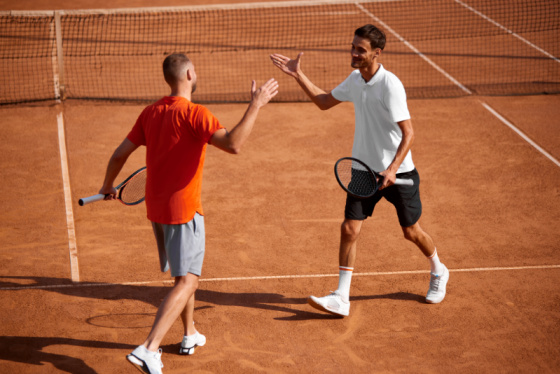
Since I built my tennis court I have played a lot more doubles than singles. And, yet, I love the workout and challenge singles entails. I have also been more cautious] since having back surgery as singles is definitely more taxing on my back. Nevertheless, when local tournaments hit my radar I will sign up for them to play singles if they don’t conflict with my schedule. One of those took place a short while ago. Rather than going into my match cold turkey I thought it would be helpful to have played at least one singles match ahead of time. It’s a very different game than doubles so if I don’t get some practice in I will be at a huge disadvantage.
Heather and I are members of Indian Wells Tennis Garden. We went out to our home in the desert prior to the tournament and while there I had a singles match arranged with someone who was visiting from Canada. I met him at the court, we chatted for a bit, and I came to learn he is a bit of a tennis nut as well. It was also clear that he had been playing a lot more singles than I. We warmed up and I could tell he was a good player.
Singles tennis is very challenging mentally and emotionally because it’s all on you and the physical aspect of it requires more grit and toughness to battle through when you are very tired. In the past I would definitely experience emotional ups and downs but have made a concerted effort to stay focused and positive, no matter the set of circumstances. Of course this is far easier said than done but overall I have made good strides in this area.
I will take input and absorb whatever I can while out in the world to help me improve my patience and emotional control so that I can perform better on the court. I will also apply what I have learned and experienced on the court to do the same off of it. For example, when we were in Oman recently we ordered two lovely rugs from a store we visited.
Here is the guy we bought it from with him standing on one of the rugs.

Here is a better shot of the second rug.

The two rugs were not inexpensive so we were of course concerned that, not only would they be shipped to us, but that we would ultimately receive them. For some odd reason my contact at the store messaged me on WhatsApp and said that the two rugs needed to be sent to two separate addresses. I complied with his request for the second address and a couple of weeks later one arrived, which we took in our possession, while the second went undelivered because no one was home to sign for it. I ultimately had to go to the post office to get it after a few unsuccessful delivery attempts.
The representative helping me looked up my information and to my shock and dismay the system showed that it was returned to the sender because they tried to deliver it to us a few times to no avail. Now, I admittedly was close to blowing a gasket but I remembered my experiences on the court and how important it is not to let one bad shot or disappointing outcome derail me and sabotage the entire match. I said to her there’s no way it would be sent back to Oman. She asked if I wanted to speak to a manager and I said absolutely I would. He came out, saw the ticket that I had, and told me to wait while he looked for the box. He came back after some time saying he was having difficulty finding it. I kept telling myself that it had to be there and to stay calm. Finally someone else came out with the box and the case was closed. I did ask why the manager couldn’t find it and he said that he didn’t know where to look.
Back to the match. A few days prior I had come across the post by Lorwen Harris Nagle about perfectionism.
Off the tennis court, while I try to pursue excellence, I would not say that I’m a perfectionist. Unlike the person who does the audio-visual work at my house whose projects have a much more definitive way of measuring the quality of the final product and who carries out his work as a craftsman and is a perfectionist, my work is far more cerebral and not as black and white.
There are many ways to skin the cat so perfectionism can be counter productive because it’s hard to define what perfect outcomes are. There is no way to write a perfect blog and I can keep re-reading my drafts and revising continuously but at some point the return on the additional time invested is quite low and I have to say it’s good enough, it communicates what I intended, and it’s time to just put it out there.
When it comes to playing tennis, however, I do have perfectionist tendencies that can be very counterproductive as I can be quite self-critical. There are times I expect certain outcomes that probabilistically are not going to happen consistently. Roger Federer said in a commencement speech at Dartmouth that he only won 54% of his points. This of course means that he lost 46%, which is not a small percentage. And yet, by consistently winning more points than he lost he was able to have one of the greatest winning percentages in tennis history. He won 1,252 matches and only lost 275 for an 82% winning percentage that resulted in 103 tournament wins, including 20 majors. He could not have been as successful as he was without the ability to let go of his mistakes and disappointments and to put all of his focus on the next point. He could not have produced those kinds of results by being a perfectionist. Why do I make such a bold claim? It’s because of how influenced I was by Nagle’s thread about perfectionism.
Her premise is that perfectionism isn’t about getting it right. It’s about protection, which begs the question, protection from what? It is a defense mechanism to flee from shame, failure, and fear of abandonment. I must admit that I was a bit taken aback when I first read that struggling to find the connection. But as I read on and thought more deeply about my own experience with perfectionist tendencies or desires on the court it started to make sense to me. She asserts that perfectionists aren’t being pushed by their vision, but rather, being pulled by their fear. They are fearful about looking bad, being seen as imposters, being less than, disappointing others, and being abandoned if they’re not perfect. This is a pretty heavy burden to carry.
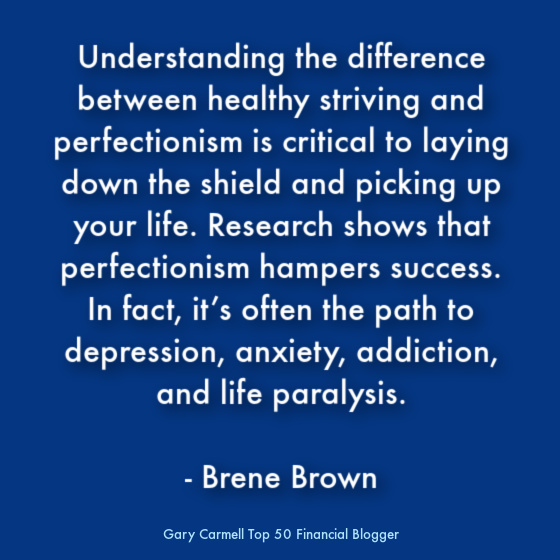
And while people might think that when perfectionists achieve what they set out to accomplish that they would feel great joy and a sense of satisfaction this couldn’t be further from the truth. Nagle says that success brings relief and even hollowness at times versus joy. This is because perfectionists are escaping a threat at the expense of pursuing meaning. At its extreme perfectionism can have some very dark consequences as this quote from Brene Brown shows.
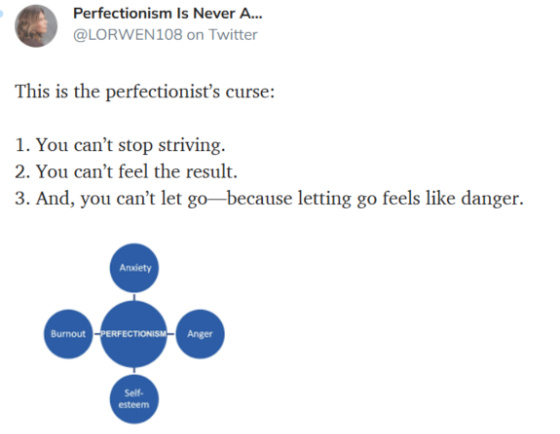
A lot of self-sabotaging behaviors come from self-obsession of which perfectionists have a tendency to be just that. Such a narrow outlook blinds people to seeing the world through the prism of great opportunities and possibilities. This narrowing of one’s perspective is often a result of perfectionism being a form of nervous system management that can be trauma based. As a result, it can create an unhealthy, negative feedback loop as shown below.
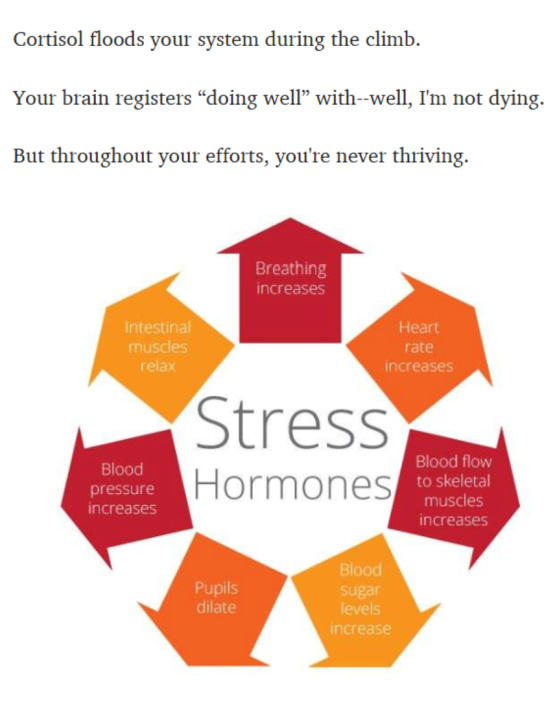
Here is a diagram of the physiological response experienced by perfectionists.
I have seen this on the court from people I have played against and some professional players as well. When they make an error or their opponents hit a winner they often have a very negative, self-critical reaction that can show up via their body language, facial expressions, and vocalizations. And when they do hit a great serve, hit a winner, or cause an error by their opponent their reaction is rarely one of joy or satisfaction. Rather, it was as if those outcomes were expected so why should they be self-congratulatory. It is more akin to relief, which is consistent with what Nagle asserts.
As I started internalizing these lessons I made a commitment to myself when I walked on the court to start the match with the gentleman from Canada that I have nothing to fear, there’s nothing shameful that come about from losing, and that there is so much opportunity to learn and grow if I can play intelligently and courageously. And while I will make my share of mistakes when I go for it, it sure feels more satisfying taking chances and missing than playing it safe and being overly cautious, even if I do win the match. I will grow and improve much more with the former approach than I will with the latter.
That mindset was extremely helpful. I was much more calm as I was telling myself there was nothing to fear and everything to gain from playing with courage, focus, intelligence, effort, and acceptance. I found myself enjoying the match as I was not so outcome oriented. And it really showed because in the first set, the Canadian just crushed me. I didn’t get any points off of his first two serves. He won the first set 6-1. Rather than getting down on myself I told myself that he was playing out of his mind and if he plays a little worse and I play a bit better, then the match can be much closer, which is what happened. He ended up winning the second set 7-5. Since we still had some time remaining we decided to play a 10-point tie-break, which he won 13 to 11 and then we wrapped it up with a seven point tie-break which I won 7-3.
I left the court quite satisfied about my mental approach to our match and how I was looking at it more as an opportunity to grow and learn from my setbacks and mistakes, and that perfectionism was not only impossible but extremely harmful.
It was now time for my tournament match. I played someone approximately 25 years younger. We had a very tough first set that he won 7-5 and then he beat me 6-1. He was incredibly impressed by my conditioning, speed, return of serve, and consistency. He was huffing and puffing and sweating up a storm which I was really glad I could make him work that hard. In the end, he dominated the net, he was clearly more experienced in playing singles, and he was very much aided by his youth. He went on to lose in the semifinals to the eventual champion. Overall I was quite satisfied with my effort and performance and I have Ms. Nagle to thank for that.
Perfectionism is overrated.

Leave a Reply