

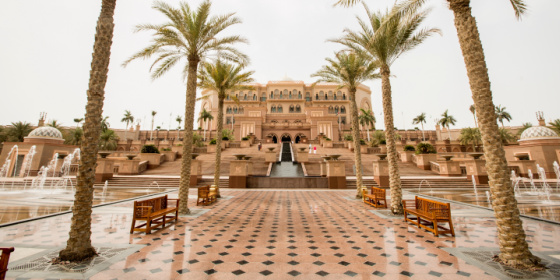
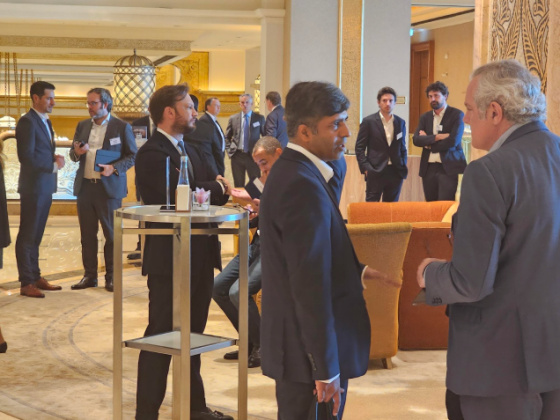
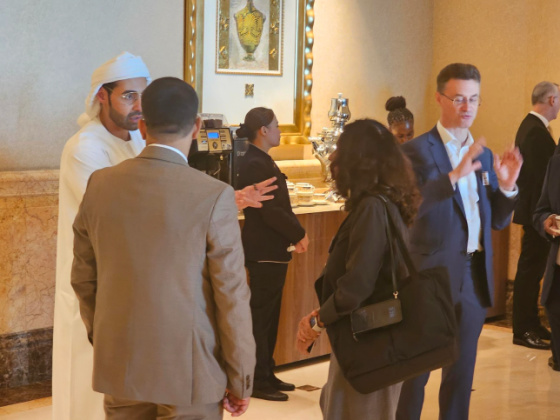
Last week I was in Abu Dhabi for a one-day conference, and then Heather and I went to Oman for a few days. There were approximately 150 people at the conference, with a strong representation from the Abu Dhabi sovereign wealth and pension funds. It’s becoming increasingly clear that the UAE has developed unstoppable momentum in terms of attracting family offices, hedge funds, real estate investment firms, asset managers, and wealth managers such that it is on the road to rivaling New York and London as a global center for capital. Here are a few pictures from the conference.
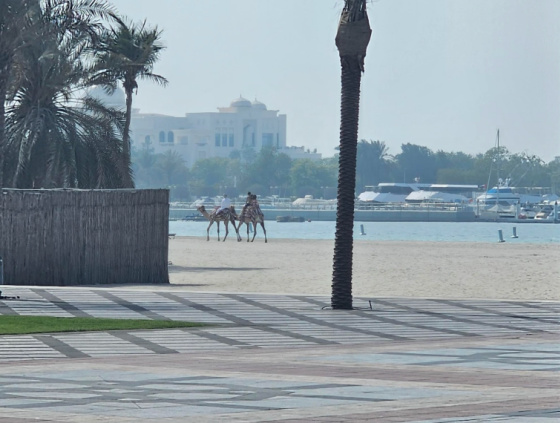
It’s not every conference where you can go outside on a break and see camels on the beach.
We went to a steak restaurant in The Abu Dhabi Edition where we were staying. The service was quite extraordinary. I had never been offered a selection of steak knives at a restaurant before.

One of the panelists said that the flow of managers coming to Abu Dhabi on a regular basis has grown exponentially during his 11 years there. The ecosystem is growing quite significantly and it is reaching critical mass in terms of investment professionals, attorneys, accountants, and other support services, along with the large number of high quality hotels and apartments. The Abu Dhabi Investment Authority (ADIA) only has one office so teams need to be in the field a lot. On the other hand, when managers come to Abu Dhabi it is extremely valuable because of how efficient it is to have groups come through one after the other versus the teams always having to be on the road.
Here are some of my takeaways from the conference.
Participants emphasized that It’s important not to overreact to Trump’s tariffs as real estate could be a good entry point after the last three years of value compression and now experiencing a nascent recovery. With that being said it is important to review underwriting assumptions as the world has become a more volatile place and historically safe haven assets like Treasuries are not acting as such, along with the U.S. dollar.
There is no indication that Gulf investors are pulling back from the United States. The U.S. has positive long-term trends and is considered essential to a growth portfolio. You can scale businesses in the United States so much more easily than in Europe due to the volume of capital, its efficiency, and how risk-taking is rewarded and failure is just a setback, whereas in Europe there is a lot of shame around a business not succeeding.
In the United States we use the catch all term “housing” to cover single-family, multi-family, and build to rent communities. In Europe and the Middle East it’s referred to as the living sector. The living sector is still perceived as a safe haven asset class because people will always need a place to live.
The big funds have very long duration liabilities so they can take a very long-term view with their assets and capital continues to accumulate that needs to be deployed. With that being said, they are also experiencing lower distributions and longer exits so their reinvestment capital is less than anticipated. They believe it’s very important to show their investment committees they are being quite discerning and only deploying capital in extremely compelling strategies and opportunities.
Because their mandate allows them to invest in just about anything in terms of public securities and private assets, real estate has a high bar to meet in terms of opportunity cost. A panelist is constructive on lending to developers early in the process and has a bias towards housing tied to luxury, middle income, and manufactured housing. It’s critical to pay close attention to expenses. Examples were cited of expense growth far greater than expected. These were insurance costs in Florida and wages in California.
Data centers received some attention as well which is not surprising given the enormous growth in the sector in a short period of time. Only 2.5 years ago there was very little debt available for data center development while today it’s possible to get 85% loan-to-cost for hyperscale centers with triple net leases. Someone asked the question as to whether the location makes a big difference for a data center. One of the participants said it does if it’s for cloud storage due to the need for very low latency whereas A.I. is less location specific.
Infrastructure investors are now crossing over into real estate via data centers. They think in 20 year time horizons and are pleased with a 6% unlevered IRR. Data center investors need 10-20 year horizons as well. One panelist thought that colocation data centers are priced too high while powered shell centers with a firm like AWS occupying it with a long-term lease offer compelling value.
There is a focus on structuring for downside protection by investing higher in the capital stack via preferred equity and credit. There is also an interest in buying secondaries in which limited partners in funds are seeking liquidity which can often be purchased at a discount by someone with a longer time horizon.
And while credit is perceived to offer a compelling risk-reward relationship, it can only provide so much multiple, which one of the panelists was focused on. It can also lead to capital coming back at what may not always be optimal times which necessitates managing maturities very carefully.
One of the panelists thought that the credit play would be in the late innings by now but with the tariff volatility credit spreads have widened which has lengthened the opportunity in that space for another year or two. Right now there are equity-like returns in credit but it has a short lifespan.
Ultimately equity capital will have to be deployed if one is seeking strong multiples over a long period of time. It’s also the most effective way to be in a position to effect change as well as to develop very strong, long-term relationships with great sponsors.
Uncertainty is the opportunity on the equity side. One participant said that whatever cards you’re playing now are not the ones you’re going to be playing in five years. The question he is wrestling with is how do you make a high conviction bet that will pay off regardless of the outcome? This individual was bullish on Eastern Europe as it is underbanked and is currently not very liquid so having liquidity can be rewarded.
One of the panelists has turned very cautious on the construction sector in the wake of tariffs and trade disruption. He really wants to understand guaranteed maximum pricing contracts as well as force majeure clauses. Another panelist absolutely won’t look at development as he has more of a risk-off mindset. He is emphasizing core plus assets that have durable income streams with some sort of tail wind behind them. With a world this volatile he is targeting the most liquid, mature markets and sectors.
Europe repriced much more quickly than the U.S. after the 2021-22 bubble which has made it a better investment than United States real estate. Cap rates are similar but borrowing costs have been about 1.50% lower in Europe. This works better for a core investor.
One of the panelists said that Europeans should be thankful for what Donald Trump has done. It’s now positioned for much more positivity. It has established more diverse energy sources, there is a good chance of a major defense spending pivot, and he sees Germany as a very uniquely positive opportunity from an investment standpoint. The U.K. is much tougher due to its tax policies and becoming less hospitable to capital and triggering capital flight. With that being said it is still the finance capital of Europe and by far offers the best protection to creditors. One investor lamented that he is still trying to foreclose on a defaulting borrower in France after nine years while another said that lender rights can be enforced within 24 hours in the U.K. without involving the courts. The rule of law is everything when it comes to debt.
One of the panelists is becoming more and more interested in India. Each time he visits there he is more impressed. I sat next to someone from India at lunch who went to college in the United States. He was a top five tennis player in India and lived in the United States for a number of years. He moved back and said that, while one can argue that India has been too slow to invest in infrastructure and become more investor friendly, there is no question it is making incredible strides. He said that Blackstone has bought up virtually every major industrial building in the major markets along with a big investment in office buildings. There is no question that India has tremendous momentum and a lot going for it, particularly as countries look to diversify away from China.
One of the speakers is a big bull on China due to its growth prospects. Another one said that Mexico is virtually uninvestable for his fund due to a lack of a tax treaty. On the other hand, another person was very bullish on industrial development in Mexico where development yields are 9.5% to 10.5% and sale cap rates are 7%. In addition, they have dollar leases for greater than 10 years.
There didn’t seem to be too much interest in Latin America due to a lack of sale liquidity.
Overall there is a continued interest in what someone labeled as beds and sheds, a combination of residential housing (“beds”) and warehousing or logistics space (“sheds”).
In summary, the large Abu Dhabi funds are more cautious but in no way freezing investments in the United States. They are being more selective. Europe is looking more interesting. From my perspective what is more challenging about the conditions we’re facing now is that in previous downturns they were a result of distorted capital allocation and policy decisions that took a long time to play out into a recession or near depression. This includes the S&L debacle, the change in tax laws in the 1980s, the dot com bubble, and Great Financial Crisis. And while the Covid economic collapse happened virtually overnight, the policy response was massive so that it was short lived.
Today the recession risk we are facing is 100% due to Trump seeking to upend the global trading system virtually overnight. This was completely avoidable so it’s hard to plan around such mercurial decision making. With that being said, most people felt that somehow, someway it would work out and while the world may be brought to the brink, Trump will pull it back because he’s not that foolish and his ego is too big to cause massive economic problems that he cannot deflect to others. As I have come to say more and more as I get older, only time will tell.
We ended the trip in Oman which is a lovely country and such friendly people as well. Here I am after having arrived in the country’s beautiful airport.

I did learned a real time anecdote while Heather and I were part of a brief tour of the Grand Mosque, which is quite extraordinary. This gentleman is a mergers and acquisitions lawyer in London with a very large global firm. I asked him if business had slowed down thinking more about the last couple of years in the wake of interest rates having gone so high so quickly. He shook off the past couple of years and said over the past month everything has frozen as no one wants to do anything until there is more certainty about global trade and the impact on the world economy. That one minute interaction may have been the most valuable real time one I heard, even more so than what I learned in Abu Dhabi.


Leave a Reply