

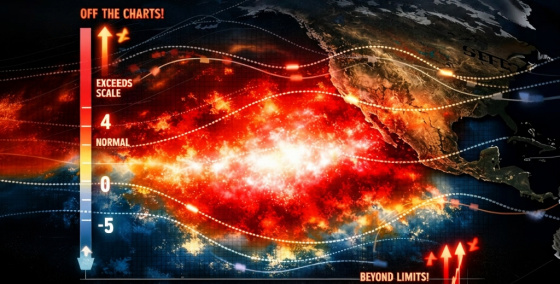
Meteorologists are currently staring at climate models with a sense of profound unease. Recent projections from the National Oceanic and Atmospheric Administration (NOAA) suggest that Pacific sea surface temperatures are not just rising; they are threatening to move “off the charts”. Some models predict temperature increases exceeding 7.2 degrees Fahrenheit (4 degrees Celsius) above average by the fall of 2026—a level of warming that would signify one of the most powerful El Niño events in recorded history.
As we prepare for this potential “super” El Niño, the historical benchmark most cited by climate scientists is the catastrophic event of 1877–78. While our modern world is vastly better prepared than the late 19th century, the economic and investment implications of a record-breaking weather event are significant, particularly given our already strained global supply chains and geopolitical instability.
The Ghost of 1877: A Global Holocaust
To understand why “super” El Niño is a term used with such gravity, we must look at what happened in 1877. That year marked the onset of what historians and scientists call the Great Drought, a multiyear climate catastrophe that triggered the Global Famine.
The scale of the disaster was staggering:
- Human Toll: Total fatalities likely exceeded 50 million people, roughly 3% of the global population at the time.
- Regional Devastation: The “Monsoon Asia” region experienced the most intense drought in at least 800 years. In northern China alone, the famine claimed between 9.5 and 13 million lives.
- Atmospheric Interplay: The 1877–78 event was not caused by El Niño alone. It was fueled by an “extraordinary combination” of a record-breaking El Niño, a record-strong Indian Ocean Dipole, and record warmth in the North Atlantic.
Crucially for students of political economy, the 1877 famine was not merely a natural disaster. In India, under British colonial rule, agricultural losses were exacerbated by tax policies and the export of grain. While millions starved, the colonial government oversaw the export of a record 320,000 tons of wheat to England. This historical context reminds us that while weather provides the trigger, it is the underlying economic and political infrastructure that determines the severity of the fallout.
2026: Projections vs. Reality
Fast forward to today. The current warming in the tropical Pacific is already drawing direct comparisons to the 1877 peak. NOAA’s ensemble forecasts show several models shooting over the top of the Y-axis, prompting one observer to joke that we are “gonna need a bigger chart”.
However, there is a fundamental question of statistical significance. Modern scientists analyzing the 1877 data note that while the event was unquestionably powerful, the lack of widespread 19th-century instrumentation makes its exact magnitude hard to pin down compared to the precisely measured events of 1982/83, 1997/98, and 2015/16. When uncertainties are accounted for, the upcoming 2026 event could potentially rival or exceed any event on record.
Are We Better Prepared?
The short answer is yes—but with caveats. In 1877, a lack of transportation infrastructure meant that grain could not reach isolated regions like Shanxi, China, where starving peasants were reduced to eating their own homes. Today, we have a highly connected global food trade network.
Furthermore, our ability to predict these events has transformed drought management from a reactive “hydroillogical cycle” of panic to a proactive planning process. Governments now have the tools to manage food crises before they reach the point of mass mortality.
However, our connectivity is a double-edged sword. While it allows for relief, it also means that a localized crop failure can trigger global inflationary shocks.
The Investment and Economic Angle: “El Chunao”
For investors, a super El Niño is a macro-risk factor that demands attention across several asset classes. The 2015–16 super El Niño is estimated to have cost the global economy approximately $3.9 trillion. If 2026 mimics or exceeds that magnitude, we could see similar losses.
1. The Inflationary Impulse and Agriculture
El Niño typically produces asymmetric impacts on global crops. We can expect:
- Downward Pressure: Drought conditions in Asia and Australia are likely to reduce corn, rice, and wheat production. India is particularly vulnerable, with warm winters potentially devastating wheat yields.
- Upward Pressure: Enhanced precipitation in the Americas can actually boost soybean production, though extreme flooding remains a risk for harvest logistics.
- The Bottom Line: Investors should watch for a “monsoon and mandates” effect, where agricultural outcomes sway political sentiments and economic stability in emerging markets.
2. Supply Chain Destabilization
The projected El Niño is likely to coincide with existing geopolitical upheaval. Trade restrictions in the Middle East have already driven transpacific container rates 40% above pre-crisis levels. A super El Niño threatens to further strain these links by restricting exports of critical materials like urea and phosphorus fertilizers.
3. Energy and Infrastructure
Higher temperatures will put immense pressure on electricity grids and health infrastructure. Investors in utilities and healthcare should account for the increased demand and operational strain that a record-breaking warm year (potentially making 2027 the warmest year on record) would bring.
Conclusion
We are not facing a repeat of the “Victorian Holocausts” of 1877. The sociopolitical factors that allowed 50 million people to perish simply do not exist in the same way today. However, we are entering uncharted territory in terms of atmospheric heat.
The “super” El Niño of 2026 is coming in hot. For the economy, this translates to heightened volatility in commodities, renewed inflationary pressure on food, and a stress test for global supply chains that are already brittle. As the models continue to bleed off the top of the charts, the prudent move is to prepare for weather impacts and economic instability that may persist long after the Pacific waters cool.

Leave a Reply