


Harmony and me
We’re pretty good company
-Elton John and Bernie Taupen
One of the greatest investors of all time and brilliant minds passed away last week. Jim Simons was an extraordinary mathematician and code breaker who worked for the NSA, was a professor, a chain smoker, and the founder of Renaissance Technologies, which was one of the first quantitative investment firms. Simons had the ability to attract incredible mathematicians and scientists to his firm and have them work together in extraordinarily effective ways. The Renaissance Technology’s Medallion Fund generated over $100 billion in profits since its inception and never had a down year (before fees).
I’m still trying to get my head around how astounding the Medallion Fund’s returns have been.
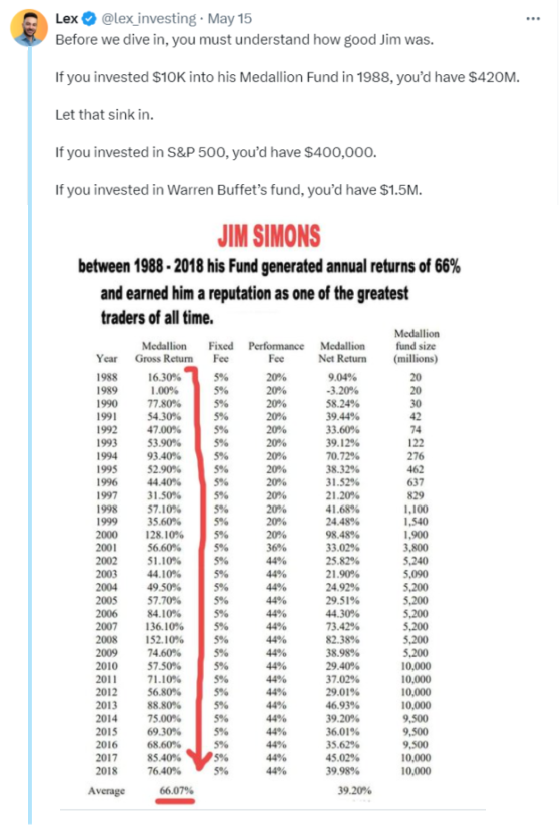
You’ll notice that the fund has never exceeded $10 billion because Simons believed that if the fund got too big then it would not be able to be as effective in generating such outsized returns. The fund stopped taking outside money in 1993 and is essentially owned by Renaissance employees. Needless to say, if you have been fortunate enough to be hired by Renaissance and have been there for five or more years there is a very high probability that you are a multi-millionaire.
In summing up his life Simons said, “I did a lot of math, I made a lot of money, and I gave almost all of it away.” That’s a pretty simple recap of an extraordinary life.
If you want to learn more about Simons and Renaissance Technologies I highly recommend listening to the Acquired podcast about them. From this and other material I have read since his passing, I loved how one of his core tenets was to be guided by beauty. Of course this led me down the rabbit hole of what makes something beautiful.
Greg Zuckerman wrote a book about Simons and he said that this notion of seeking beauty and being guided by it ran throughout all aspects of Simons’ life. Beauty could come in many forms. It could be discovering a math theorem, finding anomalies in the market that could be codified such that it could make money, a team of people collaborating effectively, having a well organized work area, discovering something new, and perhaps the most beautiful thing Simons helped create, generating 66% annual returns before fees. Just like there will never be another Mona Lisa, there will probably never be a track record like that produced by the Medallion Fund, Simon’s grand creation, his magnum opus.
As I thought more about beauty and reflected on those objects and experiences I have found beautiful, most of them have had an expansionary impact on me. They have had the ability to create awe or wonder and have also been able to create a feeling of serenity and calm and reinforce how I’m just a smaller cog in the great wheel of life and nature and that’s ok. I feel more alive, curious, and wondrous after having come in contact with beautiful objects, environments, playing with and observing animals, and having deep interactions with others where I have felt fully expressed and heard and I could offer the same in return. There is also often an aesthetically pleasing component to beautiful experiences in which the sum is far more powerful than the individual parts. If I were to summarize all of this I would say for me there is a deep connection between beauty and harmony.
So what is harmony? The simple definition is:
A consistent, orderly, or pleasing arrangement of parts; congruity
When there is harmony disparate parts are working together such that it has the potential to produce something beautiful whether it be music, a building, a work of art, poetry, great writing, a team producing extraordinary results, nature, a relationship, etc. I also find great harmony in everyday responsibilities such as having my financial world organized so that I can easily access important information when needed and feel in control of my finances. On the opposite end of the spectrum I felt an incredible amount of dis-ease during the construction of my tennis court and casita because checks were flying out the door and it was extremely difficult to plan for the timing and amounts given how complex the project was. When I finally made an attempt to do some forecasting I felt a release of some of the pressure, although I would not say I felt any sense of harmony, just less disharmonious.
I asked my friendly A.I. assistant Claude how harmony relates to beauty and here is the answer it produced.
Harmony plays a crucial role in contributing to our perception of beauty in various domains. Here are some ways in which harmony contributes to beauty:
- Visual harmony: In art, architecture, and design, harmony is achieved through the balanced and pleasing arrangement of elements like colors, shapes, lines, and textures. A harmonious composition creates a sense of unity, order, and cohesiveness, which is often perceived as visually appealing and aesthetically pleasing.
- Musical harmony: In music, harmony refers to the combination of different notes played simultaneously, creating chords and chord progressions. Harmonic relationships between notes and chords can evoke emotions and create a sense of consonance, which is often experienced as beautiful and pleasing to the ear.
- Natural harmony: In nature, harmony is found in the balance and interconnectedness of various elements, such as the proportions of a seashell, the patterns in a butterfly’s wings, or the symmetry of a flower. This harmony is often perceived as beautiful and awe-inspiring, reflecting the intricate order and complexity of the natural world.
- Harmony in relationships: In human interactions and relationships, harmony is achieved through mutual understanding, respect, and cooperation. A harmonious relationship, whether personal or professional, is often perceived as beautiful because it creates a sense of balance, trust, and emotional fulfillment.
- Harmony in literature and poetry: In written works, harmony can be achieved through the skillful use of language, rhythm, and metaphor. A harmonious literary piece can evoke a sense of beauty through the seamless flow of words, the balance of ideas, and the resonance of imagery.
In essence, harmony contributes to beauty by creating a sense of balance, order, and unity, whether in visual arts, music, nature, relationships, or literature. When elements are harmoniously arranged or combined, they tend to be perceived as aesthetically pleasing, evoking a sense of beauty and appreciation in the observer or listener.
As I thought more about both being guided by beauty and finding it, I tried to put this into practice, including on the tennis court. I had a couple of interesting insights that came out of this focus. The first is that it really helped when I made a concerted effort to do my part to create harmony as the catalyst for experiencing beauty. This does not mean just accept things as they are and that everything will work out just fine. Rather, it means that if I’m feeling disharmonious then something is amiss and needs to be addressed so that balance can be regained. There are times in which productive conflict is the right course of action in order to re-establish harmony. And in the long run this will create growth and beauty.
If I’m feeling too lackadaisical on the court or my office is cluttered and this is creating disharmony, then I need to take action and become more energetic and aggressive on the court and start organizing my office off of it. If team members or people with whom I have relationships are taking actions that I think are sub-optimal then I believe it’s my responsibility to bring up my concerns at the appropriate time. Of course the same should be the case when it comes to my behaviors. I have blindspots and shortcomings like everyone else and the only way I can continue to grow and improve and contribute to creating beauty is if I’m aware of how I am falling short.
The pendulum can swing too far in the other direction as well. For example, if I am getting upset on the court and disharmony is resulting from my frustrations and self-criticism then I need to take counter action and work on calming myself down and cultivating more self-respect and care. At all times I am trying to create lucidity when competing and this can only come about when my inner world is in a harmonious state. And when this occurs then it truly is a thing of beauty because to be in the flow state is so powerful and results in that incredible feeling of aliveness.
From a practical perspective I put this into action last week when I was playing a singles match with Michael, who I affectionately refer to as my nemesis. He is incredibly athletic and determined and we always have stupendous battles that test our resolve, will, and conditioning. I was up 5-3 in the first set and he was serving down 0-40. This means that I only had to win one of the next three points to win the set. As hard as it is to admit this he came back to not only win that game but the set 7-5. He was relentless and his ability to return very well placed shots and always stay in the game while making so few errors was devastatingly effective. He ended up winning the next set 6-2. It was a two-hour battle but he clearly prevailed. To add insult to injury this loss took place on my new court that I affectionately call The Eleven.
After Michael came back to win the first set and take the first two games of the second set I initially told myself that I was on an epic losing streak. I then thought about the opportunity to both find beauty and to be guided by it. This immediately shifted my self-talk to telling myself “No, you’re not on an epic losing streak, you’re on an epic learning streak!” I was actually very proud of myself for not only coming up with that but truly believing it as well. I really felt like I was learning so much from the experience that could only help me as I continue to play and compete both on and off the court. I will be able to test this out as I’m playing in a tournament this week so it will be interesting to see if I can continue with this mental approach.
From a CWS perspective I felt great harmony, and beauty, between 2010 and 2021 when our view of the economy, fiscal policy, and the Fed’s reaction function led to the correct belief that rates would stay low, the yield curve steep, and that floating rate loans would not only offer a lower cost of funds, but more prepayment flexibility and offer an ideal recession hedge. This worked beautifully until there was a phase change and the amount of pressure in the system grew exponentially via huge injections of fiscal and monetary stimulus and the supply chain disruptions that changed the Fed’s reaction function 180 degrees to fighting inflation 100% and worrying about the economy second. We are now having to deal with the challenges from missing this phase change and the disharmony this created.
We have our work cut out for us to adjust to this new environment given our floating rate loan exposure. I feel like in this realm that I have started to transition to viewing this as an epic learning experience and there are some silver linings that I hope will help make us stronger as we come out the other side. This will be the subject of a future post.
I will end this missive by recommending that each and everyone of us try to find the beauty in most situations and to make a concerted effort to be guided by beauty as Jim Simons was. And while we will never produce the staggering returns that his Medallion Fund did during his lifetime, we have it in our power to work on painting our own masterpieces by doing what we can to establish harmony in all that we do.
R.I.P. Jim Simons
April 25, 1938 – May 10, 2024

Leave a Reply