

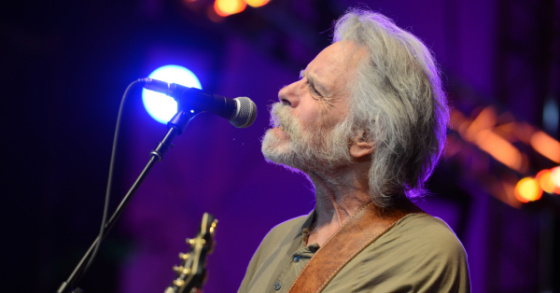
I wasn’t in the most elevated of moods when I learned Bob Weir had passed away. I had just come off the tennis court after losing a mixed doubles tournament match — one of those aggravating defeats where the mind lingers on a few points you should have put away and how, somehow, you didn’t. I picked up my phone, still sweaty, frustrated, and in no shape for anything transcendent, and saw the texts. Then the headlines.
Bob Weir, gone.
I froze. That small crack in the universe you feel when a giant leaves it — that’s what hit me first. I told Heather, and she immediately teared up. No explanation necessary. The Dead had been a force in both of our lives, and in the lives of millions of others. This wasn’t the death of a musician. This was the passing of someone whose life braided itself into the American psyche, leaving tie-dyed DNA in its fabric. If your departure can light up the Empire State Building in psychedelic colors, you have lived a life that mattered.
And Bob Weir did.
“I Was Sixteen…”: The Flash of a Stage Light That Became a Lifelong Compass
I’ve written about the Grateful Dead many times on my blog and in my life because they have been one of the most influential forces shaping who I became. My first show was at age 16 in Chicago. Like many teenagers, I entered that arena without any expectation other than the vague hope of being transported. I knew Jerry Garcia was the mythical wizard of the whole enterprise — that was already cultural canon by the mid‑80s. But as I watched the band onstage, what initially pulled me in was Bob Weir.
He was theatrical, kinetic, stylish in a way that wasn’t trying to be stylish. To a 16-year-old uninitiated in the rituals of live music, Weir’s presence felt electrifying. He moved differently. He held himself differently. He had a kind of young‑shaman charisma — a confidence wrapped in curiosity, as if he himself was wondering what might happen next.
It was only later, as I attended more shows and grew in my own musical understanding, that I began to recognize the deeper hierarchy of cosmic influence. Jerry’s brilliance, spontaneity, and otherworldly connection to something larger revealed itself slowly but unmistakably. And as that happened, I found myself sometimes frustrated with Bob’s showmanship. It felt distracting — like he was pulling focus rather than channeling the same energy Jerry was accessing.
But maturity allows for revision, and experience offers context.
I later learned that as Jerry’s heroin addiction deepened, Bob felt a responsibility — maybe even a duty — to keep the audience engaged, to keep the energy alive. He filled the space Jerry could no longer fill, redirecting the crowd’s focus not to hide Jerry’s struggle but to preserve the sacred reciprocity that defined a Grateful Dead show. It wasn’t vanity; it was devotion.
That knowledge changed everything for me.
The Night Everything Changed: December 31, 1963
Bob Weir’s origin story would feel like myth if it weren’t true. On New Year’s Eve going into 1964, 16‑year‑old Bob — the same age I was at my first show — wandered into a Palo Alto music shop and heard a banjo being played in a back room. It was Jerry Garcia, then 21, then primarily a bluegrass picker, planning to give a lesson to a student who never showed up.
Instead, Bob wandered in.
And the world shifted.
That moment, as improbable as it seems, launched one of the most enduring, innovative, improvisational, and culturally transformative musical partnerships in American history. They didn’t invent improvisation, but they reinvented what it could mean. They didn’t invent freedom, but they embodied it in a way that made audiences believe it was attainable.
For Bob, meeting Jerry was not just a turning point — it was an awakening. He got on the bus as a kid and spent the rest of his days refusing to get off, even as the scenery changed, even as the bus itself passed through storm after storm, ecstasy after ecstasy.
Craftsmanship, Spontaneity, and the Magic Between the Notes
From the Dead, I learned two seemingly opposing truths that somehow found perfect reconciliation in the band’s existence:
- The power of craftsmanship — the discipline, the repetition, the musical architecture that gives form to chaos.
- The necessity of spontaneity — the courage to leap into the unknown without fear or expectation.
Bob Weir embodied both.
His rhythm guitar playing was famously unconventional. He didn’t strum; he carved. He’d invert chords, syncopate against the grain, layer texture rather than play straight accompaniment. He built soundscapes for others to explore, shaping the air itself.
In a culture that often idolizes the lead guitarist — the one out front, melting faces — Bob was the master craftsman working in the shadows, designing the scaffolding that allowed Jerry to fly.
Jerry was lightning.
Bob was the weather system that made lightning possible.
The Life That Came Full Circle
Bob’s life began in the Bay Area. He met Jerry in the Bay Area. He returned there, again and again, even as the Dead grew from local weirdos to national icons to global cultural phenomenon. And in the end, he exited in the same region where it all began.
There’s a certain poetic symmetry to a life that arcs like that.
He started as a kid captivated by the power and potential of music and by the promise of a life lived through serendipity — following his muse wherever it called him. And he ended as a wise, weathered, utterly singular figure whose counsel was sought not for celebrity but for substance. Bob had lived enough, lost enough, learned enough to become a kind of American sage.
He was weathered in the best way — like a coastline shaped by tide and time.
A Shockwave of Loss, A Universe of Gratitude
When Heather cried upon hearing the news, it reminded me that grief is always communal, even when it strikes individually. Bob Weir meant something different to each person who heard him, saw him, or grew up with his music as part of the architecture of their lives. For some, he was the cowboy poet. For others, the rhythmic architect. For many, he was the beating heart that kept the band alive across decades, addictions, deaths, rebirths, and reinventions.
And even for those who were more tethered to Jerry’s gravitational pull — myself included — Bob was indispensable. You cannot imagine the Grateful Dead without him because his musical DNA is embedded in every measure, every jam, every show, every era.
His passing is not just the loss of a musician. It’s the loss of a cultural constant. A North Star for several generations. A reminder that joy, wonder, risk, adventure, and artistic devotion are not luxuries — they are necessities.
If the Empire State Building Goes Tie‑Dye…
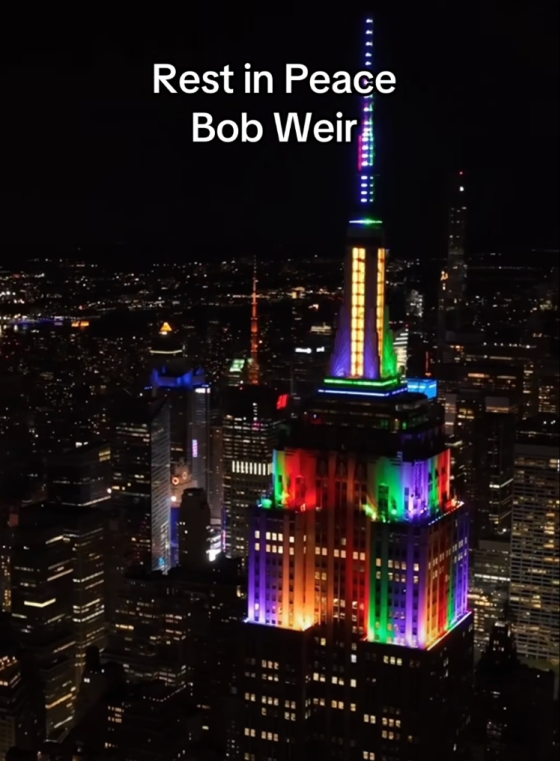
When the Empire State Building lit up in tie‑dye, it didn’t feel like a gesture. It felt like an acknowledgment.
It was New York saying:
This man shaped America.
This man bent culture toward wonder.
This man expanded what music could be, what community could be, what a life could be.
Very few individuals can claim that kind of impact.
Bob Weir can.
Goodnight, Bobby
As I write this, the initial shock is giving way to gratitude. Grief has a way of insisting on itself first — the punch, the hollowing, the confusion. But what remains after the initial wave is something quieter, more enduring.
Bob Weir lived a life of adventure, devotion, experimentation, love, and purpose. He lived long enough to become exactly what so many Deadheads — knowingly or not — needed him to be:
A living reminder that life is a jam.
You prepare.
You let go.
You open yourself to whatever comes.
And sometimes, if you’re lucky, you get to change the world along the way.
Fare thee well, Bob.
Thank you for everything.

Leave a Reply