


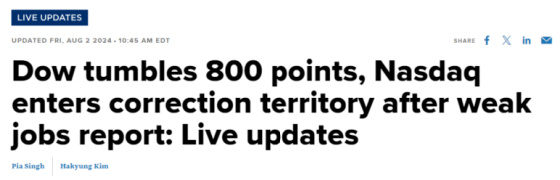
I think this headline last Friday from CNBC tells us much of what we need to know about the economy.
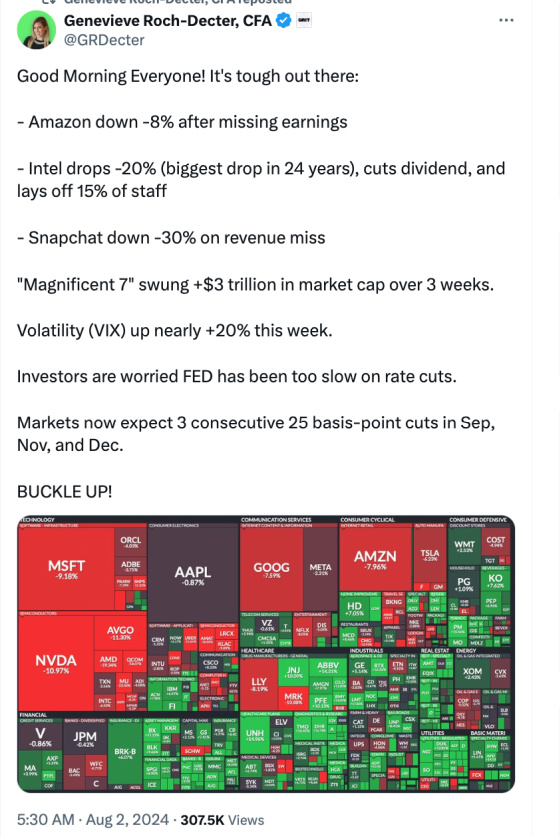
Up until recently disappointing economic news was generally good for the stock market because it has led to lower interest rates and more pressure on the Fed to cut rates. But, alas, as I have come to learn more and more as the years have gone by, what starts off as gradually can often morph into suddenly. Now the market is much more concerned that the Fed is behind the curve and that they will need to cut rates more quickly and deeper than they have been projecting in order to guide the economy into a soft landing versus a full blown recession. Earnings appear to be under pressure and investors are starting to punish companies that are not hitting their numbers or providing soft guidance as this tweet shows.
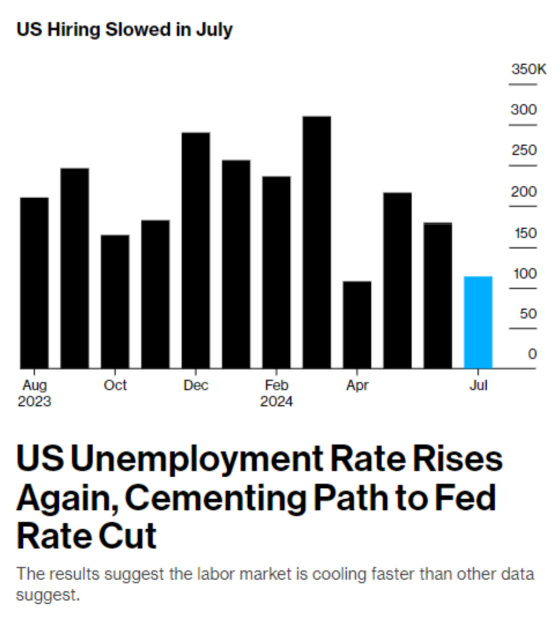
The jobs numbers really rocked the market and pushed stock prices lower as well as bond yields. The number (114,000) fell far short of forecasts, especially when factoring in prior months’ revisions. Here are some of the forecasts for the employment numbers that came out on Friday.

Here is a chart showing the slowdown in job growth during 2024.
And when accounting for revisions, the numbers were far worse as the summary below from Evercore shows.

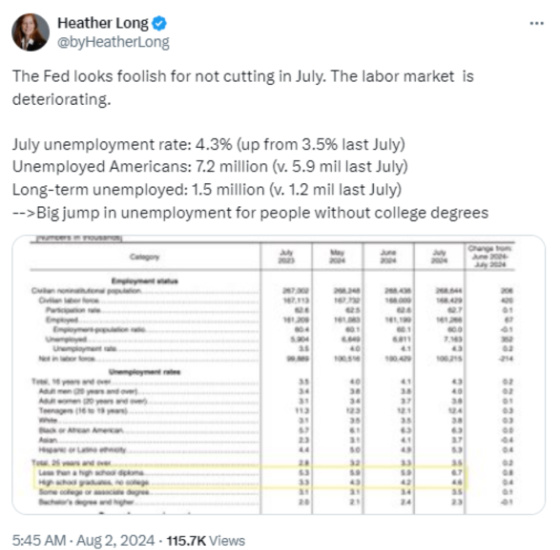
Looking at the data year over year, one can see from this tweet that the labor market has clearly been softening.
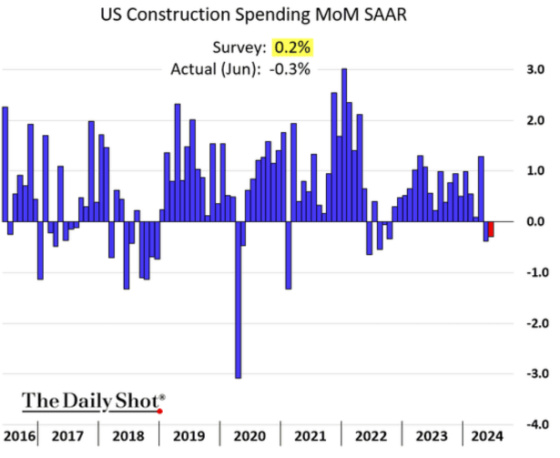
A major pillar of the economy has been construction spending, which has now started to slow materially as well.
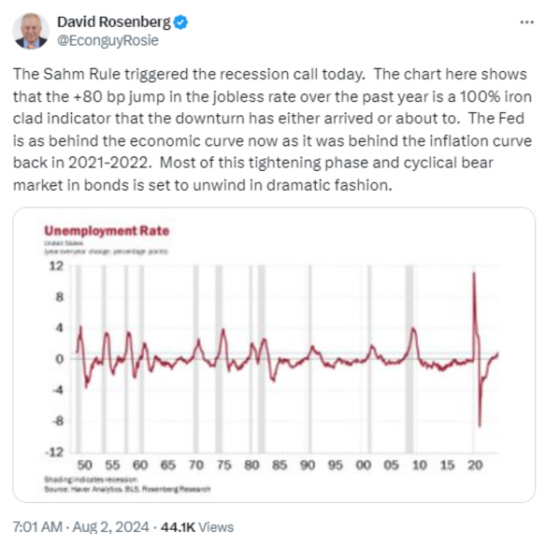
David Rosenberg has been labeled a ‘Perma-Bear”. He has been saying the Fed has been behind the curve for well over a year and that inflation was indeed transitory. Here he reiterates the degree to which he believes the Fed is behind the economic curve.
The combination of a weak jobs report and ISM survey, along with disappointing earnings and guidance, and a slow down in construction spending led to a ferocious bond market rally on Thursday and Friday that resulted in a big drop in yields of nearly 0.50% for the 2-Year Treasury.
The 2-Year Treasury is quite sensitive to Fed policy and one can see that we have gone from the gradually phase to suddenly as yields have come down by over 1% in approximately three months as the market is pricing in at least three cuts for the rest of 2024.

The long end of the curve has seen a meaningful drop in rates as well.

The 10-Year Treasury is within a hair of going below the December 26, 2023 closing low of 3.79%. If it breaks through this level that will be a strong indication that yields can keep going lower on the long-end. Because 2-Year yields are still higher than 10-Year yields and the Fed is going to be cutting rates, there is a high probability that 2-Year yields will continue to drop even more to start normalizing the yield curve.
Last week was a game changer.
The Fed is now in cutting mode as the economy is weakening and borrowers like CWS, who have had a large exposure to variable rate loans and have felt the sting of the financial squeeze from the incredibly rapid rise in short-term rates and the corresponding explosion in the cost of purchasing interest rate protections, will now start to feel much needed relief. Cap costs have dropped dramatically, which will help cash flow as less money will need to be diverted to reserve for the payment of future caps, and the inevitable drop in short-term rates that will start to take place as soon as September will reduce debt service and lessen the financial squeeze.
The suddenly phase couldn’t come fast enough for us at CWS and our very patient investors.

Leave a Reply