

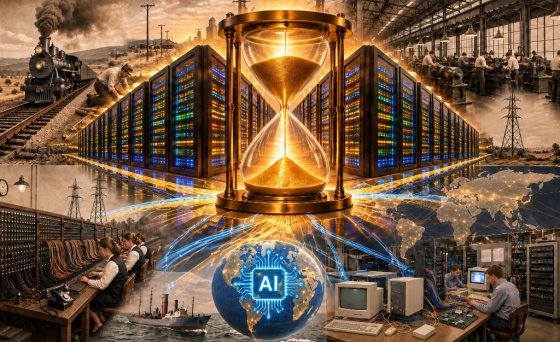
One of the great challenges of investing is resisting the temptation to reduce a complex world to a single explanation. We crave narratives because they make decision-making easier. Interest rates are rising because inflation is rising. Apartment values are falling because the Federal Reserve raised rates. Economic growth is strong because artificial intelligence is booming. Sometimes those explanations are directionally correct. More often, they tell only part of the story.
Lately, I have found myself wrestling with a question that, at first glance, may seem far-fetched: Is Larry Ellison becoming the most visible embodiment of the forces driving real interest rates higher across the economy? And if so, could the recent stress appearing in parts of the AI financing ecosystem represent one of the first signs that some of those forces may ultimately reverse? This is not a prediction. It is not even a high-conviction view. It is simply an attempt to connect a number of dots that may or may not ultimately form a coherent picture.
The older I get, the more respectful I become of uncertainty. Financial markets, geopolitics, demographic trends, technological innovation, energy markets, government policy, and human behavior all interact in ways that defy easy forecasting. Each variable influences the others, often producing outcomes that seem obvious only after they occur. Before they occur, however, the future usually feels far murkier. The temptation is to search for certainty. The reality is that certainty rarely exists.
What first captured my attention was the dramatic rise in long-term real interest rates. Inflation expectations have remained relatively anchored, yet long-term Treasury yields have risen materially. Most of that increase has not been attributable to expectations of higher inflation. Instead, it has come from rising real yields as reflected in Treasury Inflation Protected Securities, or TIPS. Put differently, investors are not necessarily demanding dramatically greater protection against inflation. They are demanding significantly greater compensation for parting with their capital.
That distinction is important because it suggests that what we are witnessing is not primarily an inflation story. It may instead be a capital scarcity story.
For much of the decade following the Global Financial Crisis, capital appeared abundant. Investors searching for yield often accepted remarkably low returns. Governments borrowed freely. Corporations refinanced with ease. Apartment owners could access debt at rates that today feel almost unimaginable. At times, real interest rates hovered near zero and occasionally dipped below it. The message from the bond market was clear: there was more capital available than there were compelling uses for it.
Today the message appears very different.
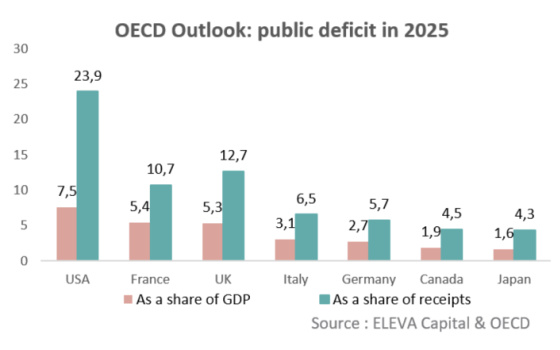
One explanation is the federal government’s continued appetite for borrowing. The United States is running deficits that historically might have been associated with recessions, wars, or major economic dislocations, despite an economy that has remained relatively healthy and an unemployment rate that remains low by historical standards. The Treasury’s financing needs alone require investors to absorb enormous amounts of debt. And to be fair, the debt always gets sold, as there are always global reserves to soak it up. The question is only at what rate? This chart may be an indication as to why the United States, with the exception of the U.K., has the highest government borrowing rates of all the countries it’s being compared to. And there’s only a small difference between the U.S. and U.K.
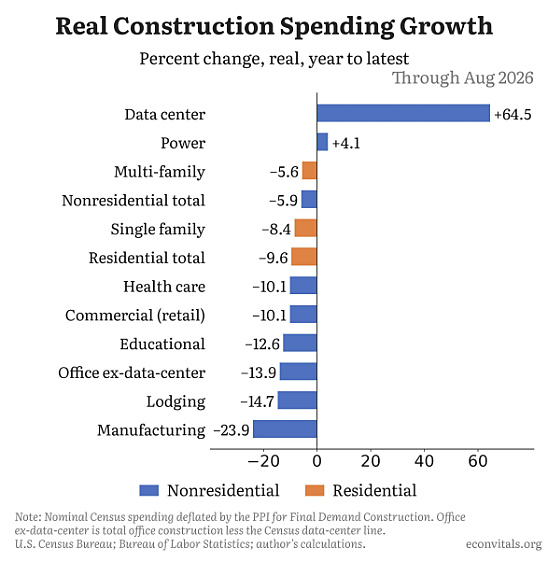
At the same time, a relatively small group of hyperscale technology companies is pursuing one of the most ambitious infrastructure buildouts in modern history. Data centers, power generation, transmission systems, cooling infrastructure, natural gas pipelines, networking equipment, semiconductor fabrication, and related investments require staggering amounts of capital. The remarkable thing is that many of these projects are competing for the same resources: debt financing, equity capital, engineering talent, construction labor, electrical capacity, and industrial equipment.
Viewed through that lens, perhaps higher real rates should not surprise us.
The federal government needs capital.
The AI ecosystem needs capital.
Infrastructure developers need capital.
Private equity firms need capital.
Consumers need capital.
Commercial real estate needs capital.
Everyone is effectively competing against everyone else.
This is where Larry Ellison enters the story. Not because I necessarily believe Oracle is in trouble. Nor because I think Ellison has suddenly lost the instincts that helped him build one of the world’s most successful technology companies. In fact, his extraordinary willingness to take calculated risks has been one of the defining characteristics of his career. What fascinates me is that he may have become one of the clearest embodiments of the optimism, ambition, and capital deployment that characterize the current era.
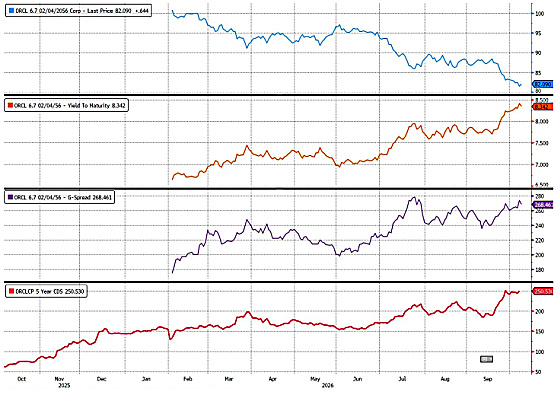
Whether through Oracle’s aggressive AI infrastructure strategy, the enormous capital commitments associated with data-center development, or his support of his son’s efforts to acquire Paramount through Skydance, Ellison seems to represent a broader willingness to place large bets on a particular vision of the future. Again, that does not make those bets wrong. Some may prove brilliant. But they reflect something larger that seems to be happening throughout our economy: a growing willingness to commit extraordinary amounts of capital in anticipation of transformative future growth. In fact, the market is showing increasing skepticism that these bets will prove to pan out.
Source: @zerohedge
History provides some interesting parallels.
Railroads transformed America.
Electrification transformed industry.
Telecommunications transformed global connectivity.
The internet transformed virtually every aspect of modern life.
Yet in each case, investors frequently overestimated the returns available from financing those transformations. The technology itself often changed the world. The investments supporting that technology frequently generated disappointing returns.
The railroad was a revolutionary innovation.
Many railroad securities were poor investments.
The internet transformed society.
Many telecom investors lost enormous amounts of money during the buildout phase.
The crucial distinction is that being right about the future is not always enough. Investors can correctly identify a transformational trend while simultaneously overestimating the returns available from financing it.
That may be the most important question confronting markets today.
The question is not whether AI will matter.
I believe it almost certainly will.
The question is whether every dollar currently being committed to AI infrastructure will generate an acceptable return.
Those are two entirely different questions.
What makes the current situation even more interesting is that this AI investment boom is occurring simultaneously with extraordinary government borrowing requirements. If either force existed independently, capital markets might absorb them relatively comfortably. Together, however, they may be creating a level of competition for capital that helps explain why real interest rates have risen so dramatically.
This matters enormously for multifamily real estate because of the wave of loan maturities approaching over the next several years. A substantial amount of debt will mature through the end of 2027, with even larger volumes scheduled to mature in 2028 and beyond. Much of that debt was originated when interest rates were lower, loan proceeds were higher, cap rates were tighter, and refinancing assumptions looked dramatically different from today’s reality.
As these loans mature, many owners are likely to discover significant gaps between loan balances and available refinancing proceeds. Certainly, debt funds can help bridge some of those gaps. New capital vehicles will emerge. Creative financing structures will undoubtedly develop. But the sheer magnitude of upcoming maturities raises important questions about whether sufficient capital will be willing and able to fill the void.
The challenge, of course, is that I can also construct a fairly logical argument for rates moving materially lower. If portions of the AI spending boom begin to moderate, if capital deployment becomes more disciplined, if geopolitical tensions ease, if energy markets stabilize, and if economic growth softens as a result, then real rates could decline meaningfully. Under that scenario, financing conditions improve, refinancing pressures ease, transaction activity recovers, and many of today’s concerns become substantially less severe.
I do not view that outcome as a zero-probability event.
In fact, I suspect its probability is higher today than it was a year ago.
The difficulty is that assigning a probability to an outcome is very different from having conviction that it will occur. I simply do not know. And candidly, neither does anyone else.
That uncertainty was a central theme of some remarks I delivered last week at the semi-annual dinner for Sherwood Scholars, a foundation established by Steven Sherwood to support primarily first-generation college students attending Texas Tech University. In addition to financial assistance, the program provides mentorship, encouragement, and guidance designed to help students persevere through college and graduate with minimal debt. Current scholars and graduates gathered for the event, and I was honored to be invited to share some observations and lessons learned from both investing and life.

One of the themes I returned to repeatedly was that successful people are often not significantly better forecasters than everyone else.
They are often better adapters.
They make decisions with incomplete information.
They learn.
They adjust.
They solve problems.
Most importantly, they stay in the game.
As I told the students, life is rarely experienced the way it appears when viewed in hindsight. Looking backward, careers often seem linear and intentional. Living forward is a much messier process. Serendipity plays a role. Unexpected opportunities emerge. Setbacks appear without warning. Relationships matter. Timing matters. Luck matters. Often the most important events in our lives are impossible to predict beforehand.
The same principle applies to investing.
The future is not a puzzle waiting to be solved. It is a landscape that gradually reveals itself as we move through it. The temptation is to wait for uncertainty to disappear before acting. The reality is that uncertainty never disappears. The objective therefore becomes less about prediction and more about preparation.
That has increasingly become my focus. I spend less time trying to determine precisely where interest rates will be in two years and more time thinking about how to solve today’s problems. How do we strengthen liquidity? How do we reduce downside risk? How do we preserve flexibility? How do we improve operations? How do we create enough optionality that we can survive unfavorable outcomes while retaining the ability to capitalize on favorable ones?
If rates remain elevated, those efforts should improve resilience.
If rates decline and opportunities emerge from widespread refinancing stress, those same efforts should position us to act.
Either way, preparation seems more valuable than prediction.
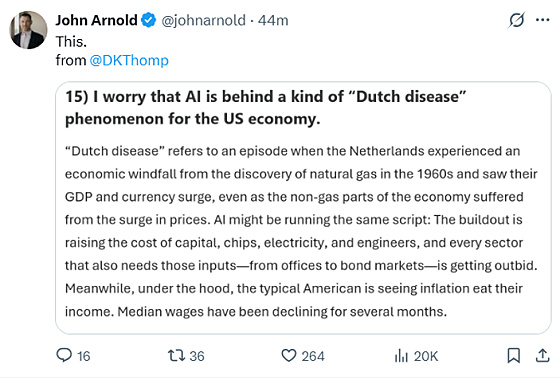
What continues to intrigue me is that some of the very forces pushing real rates higher today could ultimately become the forces that bring them lower. If AI infrastructure spending has become one of the largest consumers of capital in the world, then a meaningful moderation in that spending could reduce competition for capital, soften growth expectations, and lower real interest rates. Whether that ultimately happens remains uncertain. But when debt markets begin asking tougher questions about projects that only months earlier appeared unquestionably attractive, it is worth paying attention.
I found this tweet very interesting and quite germane to this topic.
Which brings me back to Larry Ellison.
I do not think he is necessarily a canary in the coal mine.
I think he may be something more interesting.
He has become one of the most visible embodiments of an era characterized by extraordinary optimism, massive ambition, and unprecedented capital deployment. He may ultimately prove entirely correct. The AI buildout may create economic value that exceeds even today’s extraordinary expectations. Or portions of the spending may eventually be viewed as premature, excessive, or incapable of generating the returns investors currently envision.
Only time will decide.
Or, as we titled our 2026 Annual Investor Report, Tempus Probat Omnia.
Time Proves All.
Of all the lessons investing teaches, that one may be the most enduring. Markets, technologies, strategies, and narratives eventually confront reality. Assumptions are tested. Predictions are tested. Convictions are tested. Some are validated. Others are not. Time is the ultimate auditor.
For now, I find myself returning to the same conclusion I shared with the Sherwood Scholars. None of us gets to know the future in advance. We only get to take the next step. The objective is not perfect foresight. The objective is making that next step as intelligently as possible, protecting against avoidable downside, preserving enough flexibility to adapt, and maintaining the patience and courage necessary to capitalize on opportunities when they eventually emerge.
In the end, whether we are discussing AI, interest rates, apartment investing, or life itself, perhaps the wisest posture is one of thoughtful preparation coupled with intellectual humility.
The future will reveal itself soon enough.
Tempus Probat Omnia. Time proves all.

Leave a Reply