

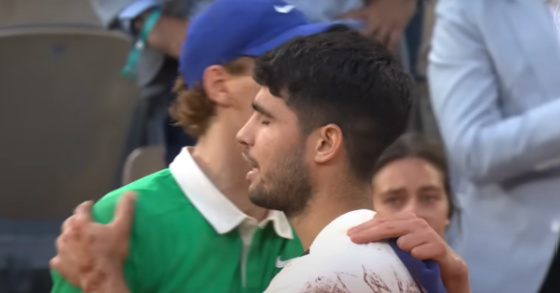
I’m still mesmerized by the nearly five and a half hour final at Roland Garros between Carlos Alcaraz and Jannik Sinner. Sinner was up two sets and only needed one more to win the tournament, but Alcaraz never gave up and fought back with incredible ferocity. He was down 3-5, love-40 in the fourth set and miraculously, won the next five points to win the game. He then broke Sinner’s serve, held his own, and won the set to stay alive. Fittingly, the match ended with a fifth set tie break as there was no other way it should have concluded. Alcaraz completely dominated the tie-break and won it 10-2 to claim his fifth victory in a tennis major. It’s yet another remarkable feat for the 22-year old Spaniard.
The physical toll Alcaraz and Sinner had to go through over 5.5 hours is incomprehensible to me, especially as this was the seventh match of the tournament for each. I’m hard pressed to find a more physically and mentally grueling sport than a men’s tennis Grand Slam that goes into five sets and lasts for more than four hours, let alone 5.5. There are no teammates to rely on, no weaknesses that can be shielded, and the incredible skill and intensity and diverse shot-making requirements and defense needed to prevail is mind boggling. And when you’re down two sets and knowing that to win it may require another three hours of grueling physical and mental exertion requires a level of mental fortitude and self-belief that I’m hard pressed to think of any other athletic endeavor requiring this. Of course that’s not to say that people who do the Iron Man or Tour De France are not incredible athletes. They are amazing. It’s just that they are generally doing fairly repetitive tasks for long periods of time which requires incredible endurance but not the diverse skills that tennis players need to prevail in a match.
Full disclosure. I really wanted Sinner to win. Not because I dislike Alcaraz. On the contrary, I’m a huge Alcaraz fan. It’s just that I’m a huge admirer of Sinner. I love the way he conducts himself both on and off the court and how well composed he is. He has such humility and his love for his family shines through. This is also the case for Alcaraz as well
Sinner acknowledged that this loss would be a hard one to process as he was one point away from victory and up a break. This would be one of those times in his life where he would have to take more from his family than he would be able to give back. There are other times when he is asked to give more than he takes. He made it abundantly clear that they will always be there for him and vice versa.
Sinner’s father was not able to go to the match, or chose not to, because of his work responsibilities as a chef. Sinner wasn’t even sure if he would be watching the match after his work day was over, And while some people might be shocked that a father chose not to take off work for the biggest match of his son’s life, that actually resonated with me. I remember growing up and admiring how hard my father worked and the responsibility he felt to support my mom and their four kids. And while there were some dads who never missed their kids’ games, my father was not one of those and it never bothered me in the slightest. I never felt disappointment when he didn’t go to my basketball games, only great appreciation when he found the time to do so. I mention this because Father’s Day just took place and Sinner’s discussion about his parents and my memories of my father made me think about what a strong father figure provides for their kids.
I think at the end of the day a father should do his best to model certain behaviors that his children can observe and, hopefully remember and internalize, so that they too will carry them out such that they can grow and evolve into adults who are caring, responsible, trustworthy, kind, empathetic, resilient, have agency, practice self-advocacy, learn how to be a good friend, and become financially responsible and hopefully independent.
I recently subscribed to copyowl.ai which provides deep research for virtually any topic. I was intrigued about the role of fathers and how they can make a positive difference in their children’s lives and as a way to see how many of the recommendations I carried out during my kids’ more formative years. I asked it to provide a summarized research report based on the following:
Fathers
How do fathers contribute to children such that they grow up to be responsible, emotionally healthy, and financially self-sufficient?
1. Fathers as Role Models for Responsibility
1.1 Building Trust and Accountability
Fathers play a crucial role in teaching children the value of responsibility through consistent and reliable behavior. Research highlights that when fathers keep promises—such as attending school events or spending quality time with their children—they model accountability and build a foundation of trust (Inclusive Teach, 2025). This trust enables children to develop confidence in themselves and others, fostering a sense of responsibility in their actions.
1.2 Encouraging Independence and Problem-Solving
Fathers often encourage children to take risks, solve problems, and make decisions independently. This approach helps children build self-confidence and resilience, essential qualities for navigating challenges in adulthood (ParentingPedia, 2025). By allowing children to explore and learn from their mistakes, fathers instill a sense of ownership and accountability for their choices.
1.3 Promoting Gender Equality
Fathers who challenge traditional gender norms by engaging in caregiving and household chores teach children that responsibilities are not confined to specific genders. This perspective encourages children to embrace diverse roles and pursue their unique interests, fostering a balanced and equitable approach to responsibility (ParentingPedia, 2025).
2. Fathers’ Contributions to Emotional Health
2.1 Providing Emotional Security
Fathers are instrumental in creating a nurturing environment that fosters emotional security. Studies show that children with loving and involved fathers are more likely to develop high self-esteem and emotional resilience (Motherhood Center, 2025). Emotional security enables children to explore their surroundings, take healthy risks, and build meaningful relationships.
2.2 Teaching Emotional Regulation
Fathers who model healthy emotional expression and coping mechanisms help children develop emotional intelligence. By providing a calm and supportive presence during stressful times, fathers teach children how to manage their emotions and navigate challenges effectively (Doing Dad Stuff, 2025).
Dr. Michael Thompson, a child psychologist, emphasizes that emotionally available fathers teach children that all emotions are acceptable and manageable, laying the foundation for lifelong mental health (Inclusive Teach, 2025).
2.3 Enhancing Social Skills and Empathy
Fathers often engage in play and interactions that promote risk-taking, boundary-testing, and social resilience. This unique approach enhances children’s social skills and empathy, enabling them to build robust connections with others (ParentingPedia, 2025; 1HappyKiddo, 2025).
3. Fathers’ Role in Financial Literacy and Sufficiency
3.1 Teaching Financial Responsibility
Fathers play a critical role in instilling financial literacy and responsibility in their children. By involving children in budgeting, saving, and decision-making, fathers teach essential life skills that contribute to financial sufficiency in adulthood (Motherhood Center, 2025).
3.2 Providing Economic Stability
Fathers who actively contribute to their family’s financial well-being create a stable environment that supports children’s growth and development. This stability enables children to focus on their education and personal growth, laying the groundwork for future success (Institute for Research on Poverty, 2025).
3.3 Modeling Work-Life Balance
Modern fathers often navigate work-family conflicts similar to mothers, demonstrating the importance of balancing professional and personal responsibilities. This modeling helps children understand the value of prioritizing family while pursuing career goals (SpringerLink, 2025).
4. Broader Impacts of Father Involvement
4.1 Academic and Cognitive Development
Research consistently links positive father involvement to higher academic achievement, stronger math and verbal skills, and greater school readiness. For example, a University of Oxford study found that children with involved fathers develop better social skills and higher self-esteem (Inclusive Teach, 2025; Institute for Research on Poverty, 2025).
4.2 Physical and Mental Health
Fathers influence their children’s physical and mental health through their own well-being and lifestyle choices. For instance, research indicates that a father’s weight status can significantly predict childhood obesity, highlighting the importance of modeling healthy habits (SpringerLink, 2025).
4.3 Intergenerational Impact
Children of involved fathers are more likely to become responsible and engaged parents themselves. This intergenerational effect underscores the long-term benefits of active fatherhood (Institute for Research on Poverty, 2025).
I thought what was generated was quite helpful in identifying a set of tools for fathers to engage with their kids. It’s always helpful to have an end in mind if one wants to do anything with forethought and strategy. In this case, helping to develop kids who are well functioning and strong contributors to society are powerful end states to help guide a father’s way of interacting with his kids and modeling behavior. Most people want to leave the world a little better than they found it and a powerful and profound way of helping to bring this about is by raising kids who are responsible, resilient, selfless, creative, and great contributors to their families, social network, companies, and societies overall.

Leave a Reply