

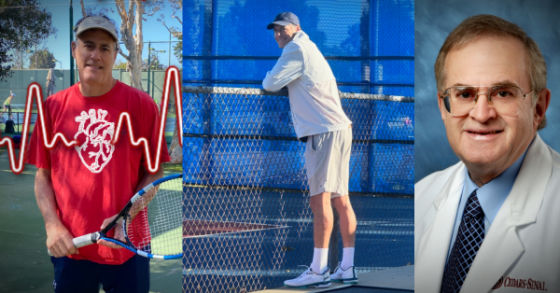
A couple of weekends ago, I played in a tennis tournament. Then on the following Monday evening, I played doubles from 5:00 to 6:30, followed by a clinic from 7:00 to 8:30. Proving there’s no rest for the weary, the next morning, I had a training session from 6 to 7 and then played singles from 8:00 to 9:30. I only bring this up because last week, only a couple of days later on February 9th it was the 2nd anniversary of my heart surgery to repair a leaky and damaged valve. I am so grateful for everyone that helped contribute to the success of the surgery and my ensuing recovery such that I’m able to be so active doing things that I enjoy. To exert my will and determination and push myself to test my limits is extremely satisfying and makes me feel so alive when I’m in that competitive zone. Visualizing being back on the court and competing with great determination was a huge motivator to do what was necessary to make a full recovery.
We get to a point in life where there are more yesterdays than tomorrows, so it’s important to do what we can to live life with joy, love, vigor, and vitality. Click To Tweet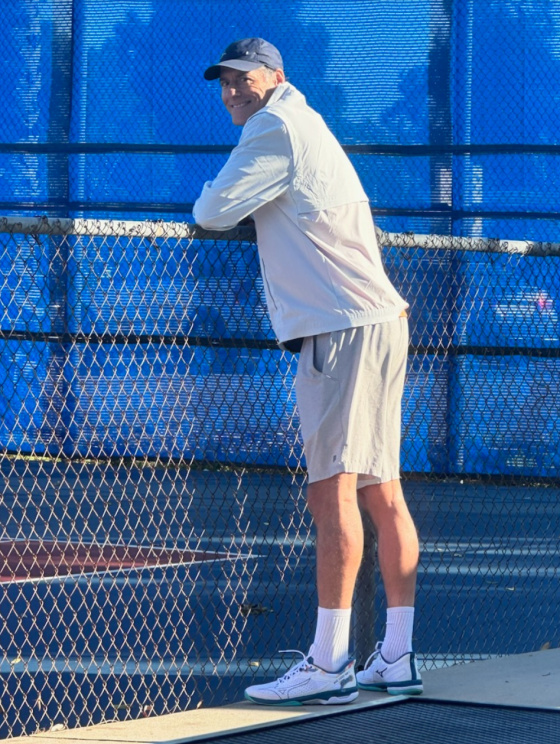
Milestones such as health scares, surgeries, and losses are often good opportunities to reflect on the time that has transpired since the event to identify lessons learned and how one’s life may have been altered since that time. Personally, I’m proud of how I’ve grown and how some of the actions I’ve taken have expanded my horizons. I’ve met interesting people, gone on some wonderful trips, taken on initiatives that were always in the very capable hands of my late wife, maintained a focus on health and a consistent commitment to my daily smoothie, worked out with my trainer twice a week, I’ve been playing tennis regularly, and I feel like my relationship with my kids is on solid ground, although there is always room for improvement. My relationship with Heather continues to grow and evolve in very healthy ways as well.
The capabilities of CWS have deepened, and we continue to do our utmost to serve our investors by providing them with competitive risk-adjusted rates of return. The operating environment has clearly changed, which is now making this more challenging for us, but we haven’t survived and prospered for 54 years without learning how to deal with adversity and economic and financial cycles.
The Power of Mindset
The more I go through life, the greater importance I assign to the power of mindsets. I know it was instrumental in helping me get through my surgery and recovery. I told myself that pain was inevitable and to “embrace the suck,” as a Navy Seal wrote about in his book. That was invaluable for me in getting through it, especially knowing that I was fully intent on returning to the tennis court in a competitive mental and physical state. 33 days later, I was back on the court.
One of the mindsets that I’ve been working on adopting more recently, and one that I hope will carry me through the rest of my tomorrows, is another lesson I have learned from tennis. The immediacy of tennis is like no other area of my life. This makes it an incredible laboratory to learn about my strengths and weaknesses. The immediacy and instant feedback make it very difficult to play so that your emotions don’t overwhelm you, especially if you’re a very competitive person like I am. My competitiveness is much more internally focused in that I’m striving to be a better version of myself.
Unfortunately, as I learned early on before, I became much more mindful and focused on controlling my emotions. When I fall short, it can be very frustrating and upsetting. In most areas of my life, I’m quite controlled and analytical, so the tennis court must be the outlet my psyche needs to release whatever is putting it in a state of dis-ease.
I recently watched the Netflix documentary called BreakPoint, which followed different tennis players on tour. It was interesting and helpful to see that even some of the great players have very fragile psyches. In every tournament, there can only be one winner, so the chances of coming out on top are quite low, especially over the last 15 years during the era of the Big Three of Federer, Djokovic, and Nadal, who thoroughly dominated the sport. As a result, if one has any hope of winning consistently, then one has to learn how to deal with frustration and setbacks. I have definitely improved in this regard, but I have more ground to gain.
I read something recently that Roger Federer said that really helped me shift my thinking and approach to playing, which I was able to use in the tournament I played recently. His belief was you play to win, so that’s what you should focus on.
“You always want to win. That is why you play tennis because you love the sport and try to be the best you can at it.” — Roger FedererClick To TweetJohn McEnroe, however, was the opposite, and he pointed this out during the 2014 Wimbledon Men’s Singles final on July 6, 2014. This is from a post about loving to win versus hating to lose.
He said he was always a player who hated to lose and wished he could have been more like his primary rival, Jimmy Connors, who loved to win. During the 2014 championship, Novak Djokovic vs. Roger Federer, he said that Djokovic plays like he hates to lose, and Federer plays like he loves to win. “On the surface, it sounds like the same thing, but it’s not,” he said.
There is a very fine line between the two, but there’s still an important and actionable distinction. For much of my life, I have fallen more into the camp of being geared toward hating to lose. And while this isn’t always bad, especially when it comes to investing, particularly when it involves other people’s money.
As Warren Buffett has said, he has two primary rules for investing: “Rule No.1: Never lose money. Rule No.2: Never forget rule No.1.” Click To TweetTo apply his rules, one needs to know what one is doing and to have a margin of safety to compensate for the inevitability that things won’t always work out as expected. After the downside is covered through preparation, patience, and discipline, then it would be a shame if one didn’t play to win and really go for it when the odds are in one’s favor as well as take great satisfaction in achieving one’s goals. With the hating-to-lose attitude, there is a tendency to brush off the victory and start immediately worrying about the next threat or challenge. And while it’s not really possible to win consistently without taking steps to avoid losing, it is possible to win and not derive joy and satisfaction from it. I’m not saying we should always look at our actions and performance through rose-colored glasses. On the contrary, we should be steely-eyed in being ruthlessly honest about where we fall short. But ideally, this should be embraced as a necessary process on the road to improvement and winning, however, we define it.
After reading Federer’s quote and seeing how he truly walked the talk when he played, I thought to myself, what a great way to focus the rest of my days, not just on the tennis court, but throughout all aspects of my life. Of course, winning is more easily determined in tennis than in other parts of one’s life that are not so black and white, but the attitude and mindset are still powerful nonetheless.
I decided to make a concerted effort to adopt this attitude for the tournament that I played. I easily won my first two matches and made it to the finals against a very challenging competitor. We played what is known as the Fast Four format, in which the first person to win four games wins the set. There are no deuces, only sudden death when the points are 3-3. And if the game score reaches 3-3, then there is a tiebreak whereby the first person to get five points wins. With no requirement to win by two points in regular games or tie breaks, there’s a lot of pressure because every point is really important. Sure enough, we went to a tiebreak in the first set when the score was four to four, so the set was determined by the next point. Unfortunately, I hit a shot out, and he won the set.
The older me would have been very upset with myself and taken this frustration to the next set. He played even better in the second set and made fewer mistakes, and he beat me 4-1, although I felt like I made him work very hard for the victory. And yet, during that less competitive second set, I hit one of the best forehands I had hit in a very long time. I can’t adequately express how satisfying that was, and as I reflected on the match, the older me would have said something like, “Great, now you’re finally hitting a great forehand? It’s too little too late.” The newer me left the match, savoring that forehand far more than feeling the sting of the missed point to lose the first set. I felt like that forehand was something I could build off of while I could also reflect on where I fell short to help me when I compete again in future tournaments.
I want to live more through savoring life’s victories and recognizing there will always be stumbles and setbacks and that those are just part of playing the game. One of my favorite quotes is, “No sh&t, no roses.” There is no growth without the setbacks and challenges that help fertilize our bodies, souls, and psyches to build resilience and wherewithal to handle whatever life throws at us. As the incredible Grateful Dead roadies used to say, “The situation is in charge.” Rather than take things personally, determine what the situation requires of us and bring our best selves to those situations to get to where we need and want to go. And if you get there, then savor the moment, effort, and accomplishment, knowing that you won and you have also lived to fight another day.
With a grateful (and healthy) heart, I encourage everyone to play to win versus playing not to lose and savor those victories and learn from those defeats.
I also want to acknowledge the passing of a family member on my late wife’s side, Asher Kimchi. Asher was a beloved cardiologist at Cedars-Sinai in Los Angeles, and he was instrumental in my having my surgery at Cedars-Sinai. He told me that it was the third-best cardiology department in the country, it was right in my backyard, and that was the only place I should have the surgery done. And while the surgeon is, of course, very important, the overall team is even more so because he said I might have up to 50 people caring for me. I ended up having an incredible surgeon fix what he said was one of the worst valves he’s ever seen while being nursed back to health by an extraordinary team. Thank you, Cedars, and thank you, Asher. You were such a warm and caring man, and you are already sorely missed.


Great Advise