


But the initiate must have the ability to judge every new experience wholly according to what is inherent in it, and let it react upon him, unobscurred by the past. We must be prepared at every moment that every object and every being can bring to us some new revelation. If we judge the new by the standard of the old we are liable to error. The memory of past experiences will be of greatest use for the very reason that it enables us to perceive the new. Had we not gone through a definite experience we should perhaps be blind to the qualities of the object or being that comes before us. Thus experience should serve the purpose of perceiving the new and not of judging it by the standard of the old. In this respect the initiate acquires certain definite qualities, and thereby many things are revealed to him which remain concealed from the uninitiated.
-Rudolf Steiner
I am always impressed by leaders who have the ability to attract top talent. Of course, from an organizational perspective it’s ideal if that talent is retained and coalesces into a fierce and dynamic team that produces extraordinary results. Not every stallion can be kept in the stable, however, as there are those who are called to do even greater things on their own path. Most successful people are able to think independently such that they are not easily swayed by popular opinion or conventional wisdom. This is not always easy to do because it requires questioning what we’re taught and feeling comfortable being alone and not having the security of a crowd sharing our opinions and points of view.
Masters of Independent Thinking
I want to focus on two people in this post to illuminate how important independent thinking was to them when making hiring decisions. These are Peter Thiel and Albert Einstein. The former was one of the founders of PayPal, the largest, early investor in Facebook, and the extremely successful venture capital investor via his Founders Fund. He is also considered a tremendous judge of talent. The second is Albert Einstein who is obviously so well known for his independent and brilliant insights that have changed the world through his Special and General Theories of Relativity, along with many other breakthroughs. What I didn’t know, however, was that he too was a great judge and discoverer of talent.
Both Thiel and Einstein used very specific interview and assessment techniques to help them determine if someone could think independently and have the potential to produce great work. Thiel’s focus is to ask prospective hires a very provocative and not so easy question which is as follows:
What important truth do very few people agree with you on?
Thiel likes this question and the reasons are conveyed in his book Zero to One: Notes on Startups, or How To Build the Future.
This question sounds easy because it’s straightforward. Actually, it’s very hard to answer. It’s intellectually difficult because the knowledge that everyone is taught in school is by definition agreed upon. And it’s psychologically difficult because anyone trying to answer must say something she knows to be unpopular. Brilliant thinking is rare, but courage is in even shorter supply than genius.
Thiel goes on to further elucidate why such independent (and courageous) thinking is so important for building the future. There is copying what has been done and building on it, which is horizontal progress, and then there is vertical progress which is creating something new.
Horizontal or extensive progress means copying things that work— going from 1 to n. Horizontal progress is easy to imagine because we already know what it looks like. Vertical or intensive progress means doing new things— going from 0 to 1. Vertical progress is harder to imagine because it requires doing something nobody else has ever done. If you take one typewriter and build 100, you have made horizontal progress. If you have a typewriter and build a word processor, you have made vertical progress.
Einstein was the epitome of vertical progress with his extraordinary theoretical breakthroughs that have been constantly proven in the real world in powerful ways. I was on X and came across a fascinating thread about Einstein that took a different approach to discussing his achievements. This one focused on his skill in identifying talent and the unusual method he used to separate the superstars from the mere mortal stars.
After arriving at Princeton in 1933 he was tasked with building a team that could advance his unified field theory. He kept on his desk purposely wrong answers to famous physics problems. When interviewing candidates he would carry out the following approach to ascertain whether they would not only be a good fit but whether they had the potential to produce groundbreaking work.
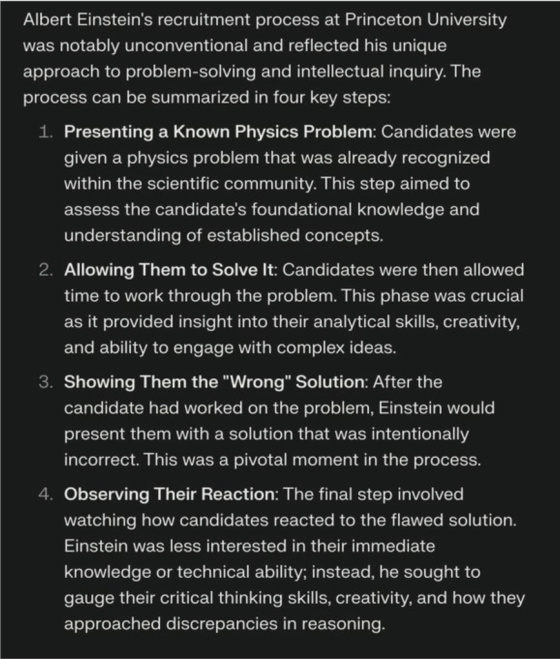
It turns out that most candidates would point out the errors and Einstein would never call them back. Before discussing the reasons why he moved on from them, this is what he valued in prospective collaborators. It sounds a lot like what Peter Thiel looks for as well.
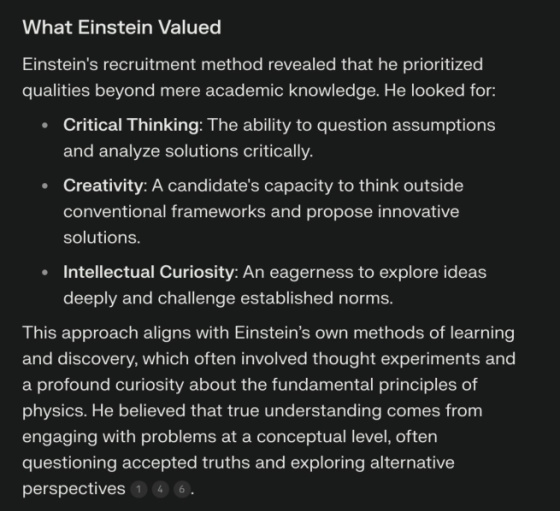
The rare candidate would study the solutions, even though they knew they were “wrong”, and ponder the implications of the “mistake” and consider the possibilities that these were not actually mistakes and maybe they were the ones approaching the problem incorrectly. Einstein described this wrestling with the implications of seemingly wrong answers as “productive confusion.” I can tell you from a personal perspective I have been going through this for the past few years when it comes to interest rates. I’m just not sure how productive it’s been so far 🙂
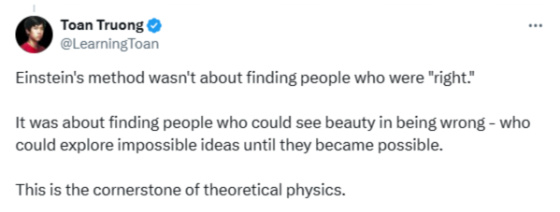
Einstein discovered John Wheeler and J. Robert Oppenheimer via this method, two game changing physicists who truly made a dent in the universe.
The excerpt from Rudolf Steiner’s book cited at the beginning of this post conveys how important it is to keep a fresh perspective even though what we have learned in the past may have served us well. And yet, the past is best applied in terms of how it can serve the new versus locking us into a fixed way of thinking. Always keep an open mind and recognize that any time we may be wrong. That is not to say one shouldn’t decide on a course of action after having some time to reflect and integrate one’s experience, analysis, common sense, and intuition and then pursue that path resolutely. Rather, we need to recognize that we are fallible human beings subject to poor judgment, flawed reasoning, biases, etc. so it’s best to recognize this and keep an open mind to signals that may tell us a course correction may be necessary.
I have recently been returning to a book that I have found extraordinarily insightful and useful. It’s called Day-to-Day Dante: Exploring Personal Myth through The Divine Comedy. Each daily entry starts with an excerpt from The Divine Comedy, how the author interprets it, and then ends the passage with a much more in depth analysis of how it applies to everyday living and perfecting of the human soul and spirit.
Over the last month the author has focused on the power of not knowing and in the search for knowledge and wisdom we learn so much about ourselves and the incredible benefits of keeping an open mind. Here is the referenced passage from The Divine Comedy for October 27th and then I will follow up with the author’s analysis.
“Take what I said with this distinction then; in that way it accords with what you thought of the first father of our Beloved…. he who decides without distinguishing must be among the most obtuse of men; opinion—hasty—often can incline to the wrong side, and then affection for one’s own opinion binds, confines the mind.” (Par. 13. 109-11; 116-20)
Clearly Dante is discussing the negative ramifications of confirmation bias and stubbornly clinging to one’s opinions and the dangers this can bring about. This is what the author has to say about the impact such a suboptimal approach can have on one’s decision-making specifically, and living more generally. It also has great applicability to what was discussed above in terms of the importance of independent thinking and having a flexible mind.
The soul requires time and patience to consider, to reflect, to be receptive to other impressions. Failing that, its decisions are defective, incomplete, not fully formed or considered. Thomas also points out a vicious cycle brewing. Unconsidered or too hasty responses can begin to enclose one in habits of thought that are narrow, self-referential and therefore lack any other persons’ or presences’ consideration. One sees only from one’s own point of view. Thus, one might begin creating one’s world in his/her own image. Options are foreclosed, other opinions or ideas discarded, other forms of imagery defeated. A form of tyranny of ideas and opinions can then begin to infect the person who refuses any options.
The author goes on to point out what he sees as the solution to this vexing challenge of ingrained opinions. The common theme throughout the book is the power of living from love and grace and, not surprisingly, it’s the antidote here as well. He ends every daily entry with a meditation that I think is appropriate to conclude this post on as well.
One avoids such sclerosis of the imagination by allowing the grace of others’ presence to inform one’s own beliefs. Empathy, as a form of love, allows one to remain malleable to others’ ideas and points of view. It allows for the presence of intellectual generosity. In learning, the egoic self cannot be center, for its impulse will be to protect itself against new thoughts and ways of seeing.
Meditation: What opinion do you hold that keeps you safe but narrow?
I hope you had a wonderful Thanksgiving!

Leave a Reply