

There is a distinct magic in stepping out of a world-class venue and into a global transit hub, reflecting on the sheer physical ambition it takes to make both exist in a world-class city. Sitting in the grandstands at the U.S. Open in Flushing Meadows and then heading home through John F. Kennedy International Airport offers a striking reminder of scale.
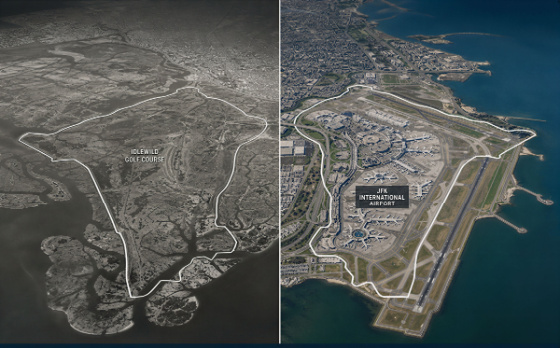
As real estate professionals, we spend much of our careers operating within the realm of the immediate—assessing current market yields, optimizing existing footprints, and navigating localized zoning constraints. But stepping onto the nearly 5,000-acre canvas of JFK Airport invites a different kind of reflection. How did a city as geographically tightly packed and land-constrained as New York secure nearly eight square miles of coastal property to build an international gateway?
The answer offers a masterclass in long-term strategic vision, bold land assembly, and the enduring compound interest of forward-looking infrastructure.
The Myth of Incremental Growth
When laypeople look at a massive asset like JFK, they often assume it was built through incremental, decades-long land acquisition. We see this in corporate expansions or suburban retail aggregations: start small, buy the adjacent parcel when it becomes available, and slowly piece together a portfolio.
In land-constrained metropolitan markets, however, piecemeal acquisition rarely works for mega-scale infrastructure.
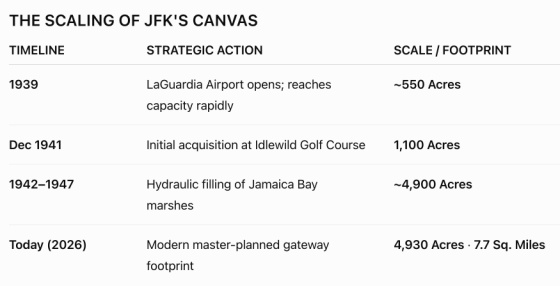
In the late 1930s, Mayor Fiorello LaGuardia opened LaGuardia Airport. Within two years, it was already bursting at the seams. Rather than trying to squeeze minor expansions out of a landlocked facility, city leadership recognized a fundamental truth of real estate development: When current constraints limit future trajectory, you don’t adjust the plan—you change the canvas.
In 1941, New York City took a bold leap. The city didn’t just acquire a few acres; it condemned and assembled thousands of acres of marshland and a local golf course around Jamaica Bay all at once.
Creating Canvas Where None Exists
For real estate developers, the most compelling part of JFK’s history isn’t just the acreage—it’s how that land was created. In a dense market, land isn’t always found; sometimes, it has to be engineered.
To transform marshy tidelands into a viable foundation for long runways and massive terminal loops, engineers pumped over 60 million cubic yards of sand and silt out of Jamaica Bay. Before a single commercial plane landed, the city had quintupled the project’s initial land area.
It was an audacious move that drew plenty of skepticism at the time. Critics questioned why a municipality would pour vast capital into filling a swamp for a commercial aviation industry that was still in its relative infancy.
Yet, comparing JFK to later post-war megaprojects puts that audacity into perspective:
- Sunbelt Sprawl vs. Urban Density: Airports built decades later in open landscapes—like Dallas/Fort Worth (17,200 acres) or Denver (33,500 acres)—had the luxury of endless horizontal land.
- The Coastal Constraint: Achieving nearly 5,000 acres within the official city limits of New York required a level of raw ambition that few municipal entities or private consortiums have ever attempted.
The High-Risk Calculus of Megaprojects
Bold vision in real estate does not guarantee immediate, frictionless execution. Pioneering projects frequently face early financial distress, cost overruns, or operational misalignments before their true value is unlocked.
Take London’s Canary Wharf in the late 1980s and early 1990s. The initial master plan aimed to transform derelict East London docks into a secondary financial district to rival the City of London. When it opened, early transport link delays and a broader commercial real estate downturn drove the original developer into administration.
To short-sighted observers, it looked like a monumental miscalculation. Today, however, Canary Wharf is a thriving, indispensable economic pillar of London, seamlessly connected by the Jubilee Line and the Elizabeth Line.
JFK faced its own turbulence. The massive site preparation costs placed a heavy strain on municipal finances, forcing the city to lease the property to the newly empowered Port Authority in 1947 to finish and manage the project. Opening as Idlewild in 1948, the airport took years to reach its full stride. But because leadership secured a vast 4,900-acre footprint upfront, the facility possessed the structural foundation required to seamlessly accommodate the arrival of the commercial Jet Age in the late 1950s—a revolution that would have completely paralyzed a smaller site.
Reimagining the Asset for the Next Half-Century
The ultimate test of a visionary real estate assembly isn’t just whether it solves an immediate need, but whether its structural envelope can adapt to future growth cycles.
Consider what is taking place at JFK right now. The airport is undergoing a massive $19 billion public-private transformation, replacing legacy infrastructure with state-of-the-art facilities like the new Terminal 1 and Terminal 6.
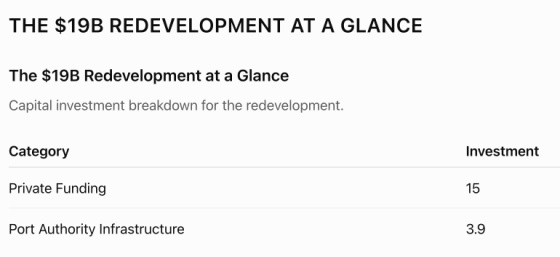
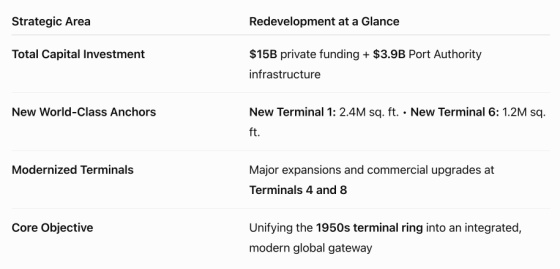
Because those 4,930 acres were secured over 80 years ago, modern developers and planners today have the physical volume necessary to execute a world-class, $19 billion overhaul within the existing airport boundary. They aren’t constrained by land acquisition costs; they are simply re-architecting the premier gateway of the financial capital of the world.
Key Takeaways for Modern Real Estate Strategy
- Option Value Over Short-Term Yield: Assembling land beyond immediate operational needs creates unmatched “option value.” Sizing a project solely for today’s demand guarantees premature obsolescence.
- Infrastructure Is the Ultimate Catalyst: Physical scale only works when paired with connectivity. From early roadway access to the modern AirTrain and regional transit links, access turns raw land into prime economic real estate.
- Patience Across Cycles: Transcendent real estate assets often experience bumpy beginnings. True value is captured by those who look past short-term market volatility and focus on structural, long-term macroeconomic tailwinds.
As real estate professionals look to the future, whether evaluating urban infill, master-planned communities, or complex adaptive reuse, the story of JFK serves as an inspiring reminder: Small plans lack the magic to stir men’s blood. When you build with genuine scale and long-term vision, time ultimately works in your favor.

Leave a Reply