

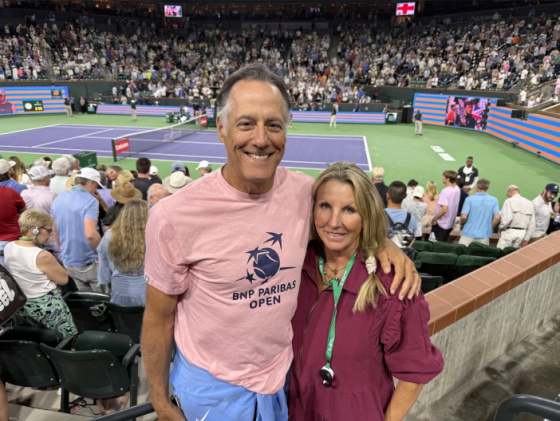
Heather and I had the great pleasure of seeing some incredible tennis at Indian Wells We saw 12 matches, including the best match of all, Djokovic versus Draper, which had what the announcers categorized as one of the best points they have ever seen It was an epic 26 shot rally with incredible, pace, athletic prowess, finesse, extraordinary lobs, and multiple drop shots. Please watch the video to see it for yourself:
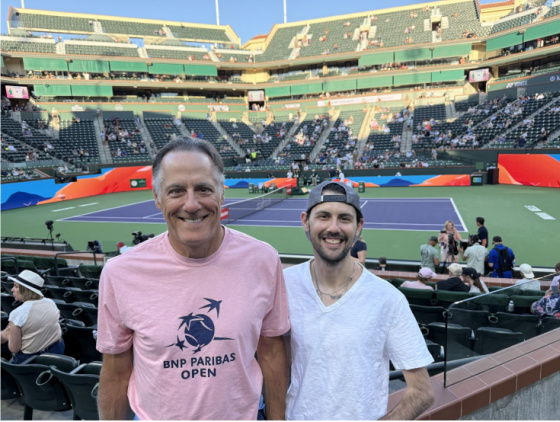
It was even more special as my son Jacob was there to see it as well.
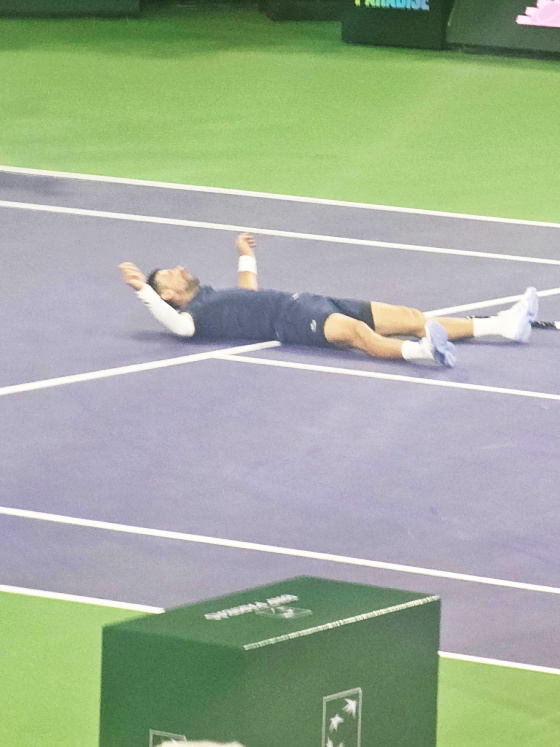
Here is Djokovic after the epic point came to an end in his favor.
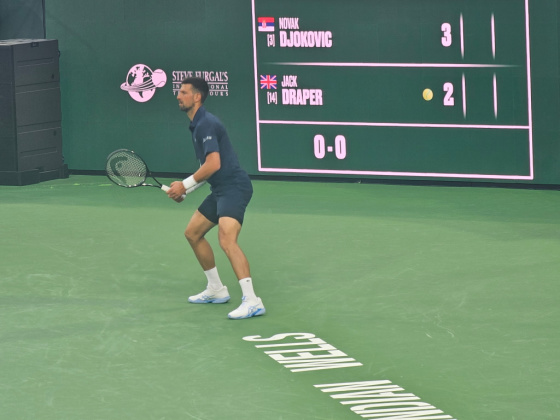
Here is a better picture of the person considered to be the best serve returner in tennis history, waiting to return Jack Draper’s serve.
I think there is so much to learn from watching great tennis players, especially when they are driven to their physical and mental limits, by observing how their emotions can either serve them (pun intended) or be their greatest obstacle. For example, I watched Learner Tien stay calm throughout a tight match and defeat an extremely volatile and less emotionally stable, but more experienced, Alejandro Davidovich Fokina when the latter probably should have won the match had he been more even-keeled. More on this later.
The night before the Djokovic match, we also got to see another titanic battle between two huge hitters, Jannik Sinner and 19-year-old Joao Fonseca. Sinner won 7-6, 7-6. The amount of power those two have is extraordinary, and we had a wonderful vantage point to see it in action as we were behind the baseline in great seats. One Fonseca forehand was clocked at a mind-boggling 119 miles per hour, and it also happened to be directed right at Sinner, who was lucky to get out of the way of the Fonseca missile.
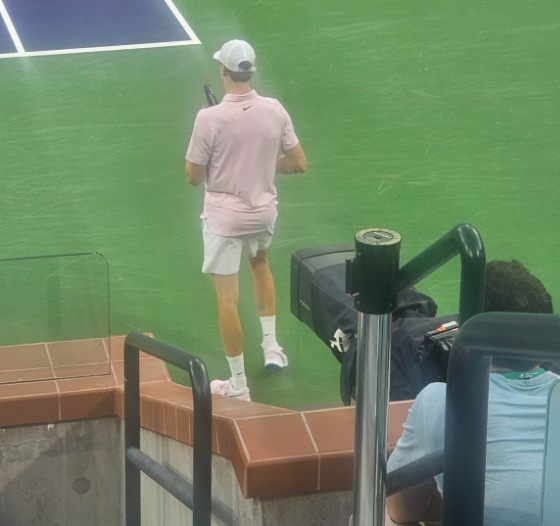
Here is a picture of Sinner standing so far back in preparation for Fonseca’s serve that reached 138 miles per hour during the match.
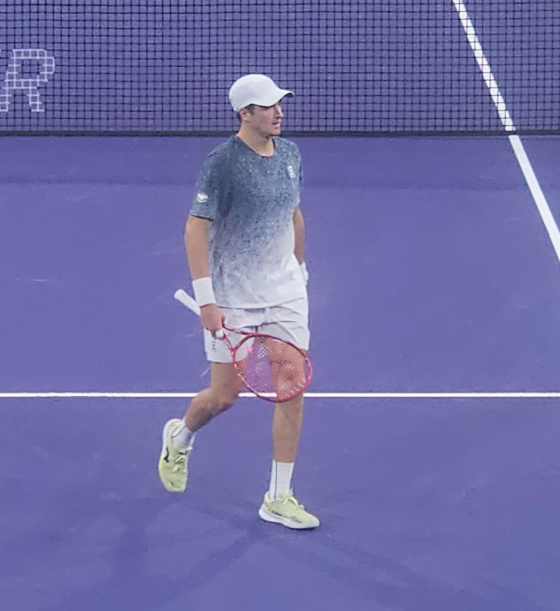
Here is a picture of Fonseca after blasting a forehand winner.
Off the court, Heather and I had the great pleasure to meet legendary tennis player Tracy Austin prior to the match between Carlos Alcaraz and Cam Norrie. She was so nice and personable.
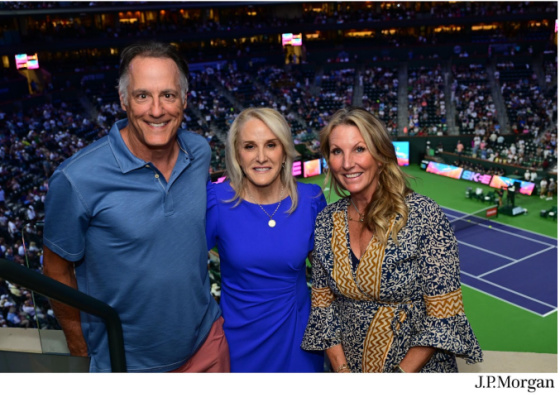
Gary Carmell, Tracy Austin & Heather Carmell
Beyond the Baseline: Lessons in Mindfulness from Indian Wells
As I reflect on my annual pilgrimage to the BNP Paribas Open at Indian Wells, I’m struck by the incredible talent emerging in the world of tennis. The desert sun, the pristine courts, and the electrifying energy always make it a highlight of my year. While seeing the established stars is a treat, my greatest impression this year was the abundance of young players excelling at the highest level.
But talent alone only gets you so far. The true separator, as it always has been, is the mental game. As much as we admire physical power, an enduring career is built on the foundation of emotional mastery—a concept I’ve been calling “Federerizing” as an approach to life on and off the court.
This brings to mind a powerful Zen story:
A student asked a Zen master, “Why do intelligent people still ruin their lives?”
The master lit a candle and placed it before the student. Then he suddenly blew it out. The room went dark.
The student asked, “Why did you do that?”
The master replied, “Knowledge is the flame. Emotion is the wind. Without learning to manage the wind, even a bright flame cannot stay lit.”
The Tale of Two Temperaments: Tien vs. Davidovich Fokina
I saw this “wind” in action during a thrilling match between 20-year-old Learner Tien and Spain’s Alejandro Davidovich Fokina. The contrast was jarring. Tien, an Orange County native coached by the legendary Michael Chang, exuded a “California cool” that was almost meditative. Despite his youth, he remained a pillar of calm.
Across the net, Davidovich Fokina was a fiery “emotional tsunami”—a volcano of passion that often erupted at the wrong moments. The stats tell a haunting story: Davidovich Fokina has now lost 13 matches in his career after holding a match point. It is a staggering example of how a brilliant flame can be extinguished by an unmanaged wind.
Tien, meanwhile, showed exactly why he has won nearly 70% of his tiebreaks lately. Facing two match points against him, he didn’t succumb to fear. He saved them both, stayed loose, and won the third-set tiebreak with a grace under pressure that felt far beyond his years.
Sinner and the Art of “Missing the Mark”
This same emotional management is what defines Jannik Sinner. To many, “to sin” implies a moral failure deserving of shame. But the word’s deeper etymological roots mean “to miss the mark” or to be “off track.”
If we view our mistakes—a double fault, a missed promotion, a sharp word—as simply being “off track,” it transforms our response. Instead of self-flagellation (which only feeds the emotional wind), we engage in self-reflection and course correction. Sinner’s success at such a young age stems from this ability to treat a “sin” as a data point rather than a character flaw.
Educating the Heart
We spend years teaching children mathematics and science, but almost no one teaches them how to calm anger, tolerate disappointment, or sit with uncertainty. As a result, many grow up educated in subjects but uneducated in their own emotions. It’s one thing to learn in a classroom; it’s another to have life be our teacher in the moment when we are in an environment we don’t control, and there is very little gap between stimulus and response. It’s not always easy to put what we learn into practice during moments when our emotions are running wild.
As I return from the desert, my takeaway isn’t just about the tennis. It’s a reminder that intelligence opens the door, but the ability to manage the wind determines how long our light stays lit. Whether you are on the courts at Indian Wells or navigating the challenges of daily life, the real victory lies in the inner game.

Very insightful and well spoken. Thank you.
Excellent discussion!!!
And really great people are approachable and gracious!
Thanks,
Chuck Bohle