

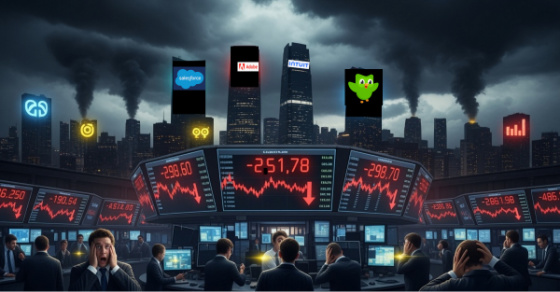
The last few weeks have been brutal for software stocks. Words like carnage, panic, and even “SaaSpocalypse” have crept into investor vocabulary as shares of companies long viewed as durable compounders—Salesforce, Intuit, Adobe, Duolingo, and others—have sold off sharply. The proximate cause hasn’t been earnings misses or accounting scandals. It’s fear. Specifically, fear that artificial intelligence has crossed a threshold where it doesn’t just augment software, but actively replaces large parts of what software companies sell.
The market reaction has been swift and unforgiving. After the release of new AI automation tools and models from Anthropic’s Claude platform, investors began dumping software stocks en masse. Broad software ETFs dropped double digits in weeks, and individual names fell even harder. Intuit, Salesforce, and Adobe each declined by more than 10% in short order, while the broader software complex suffered one of its worst starts to a year in decades.
That’s the macro story. But like most big shifts, it didn’t really land for me until I experienced it at the micro level.
A Different Kind of Life Update
Recently, I reconnected with some of my old Vistage group members. These are people I’ve known for years, and our catch-ups tend to follow a familiar pattern: health, family, work, and—inevitably—money. All of them are in strong financial positions. Most have retired or could comfortably do so.
When it came time for my update, I shared something different.
Over the past several years, I consciously traded traditional financial security for a Blue Zone–style life—one centered on tennis, wellness, social connection, and longevity. I made a massive investment in The TenniSphere. At the same time, higher interest rates compressed real estate distributions, and a much tougher apartment market reduced cash flow. Add in the opportunity cost of draining liquidity that could have been earning attractive risk‑free returns, and the result is simple: I’ll be working for the foreseeable future.
And honestly? I don’t see that as a bad thing.
It gives me purpose. It gives me fuel. It allows Heather and me to stay deeply engaged—playing tennis, hosting gatherings, supporting causes we care about, and remaining socially and physically active in an environment we love. Work, in this context, isn’t a burden. It’s a feature.
Tennis, Technology, and a 20‑Minute Revelation

As I was describing The TenniSphere over lunch and showing photos, one of the guys mentioned his half‑brother in Santa Monica—an avid tennis player. A connection was made. We scheduled a hit.
Before driving down, we jumped on a quick Teams call to get acquainted. It turned out he has a data science background and is a founder of a biotech startup that relies heavily on AI. The timing was perfect—or ominous, depending on your perspective. Claude had just released a new model, which had acted as a catalyst for the latest wave of selling in software stocks.
I asked him what he thought about the market reaction. Until recently, he said, he’d been skeptical that AI would truly dislocate software economics. That changed with the latest releases.
I told him I mostly use AI for research, queries, and writing. I’ve never really seen it code. I asked if he’d be willing to bring his laptop after tennis and show me how he actually uses it.
After a tough two‑hour match, we sat down at my dining table. He typed a prompt—part English, part code. I understood the intent, but much of the terminology was foreign. Then the screen started scrolling. And scrolling. The model generated code, tested it, iterated, corrected itself, and kept going.
After about 15–20 minutes, it produced an output that stopped him cold.
He said that what we were looking at would have taken him roughly a month to build. A great coder might have done it in a week. This took about twenty minutes.
Why Markets Are Repricing Software
Then came the line that connected tennis, AI, and the stock market in my mind.
He told me that when he originally modeled his startup, he assumed they’d be spending roughly $15 million annually on engineering within five years. Now? He doubts it will exceed $3 million.
That single statement explains a lot of what’s happening in software stocks.
If AI can collapse development timelines by an order of magnitude, the implications ripple everywhere:
- Fewer engineers required to build and maintain products
- Smaller, more nimble teams
- Dramatically lower operating costs
- Less justification for per‑seat SaaS pricing models
Large teams have always been a bottleneck. Coordination complexity scales faster than productivity. AI doesn’t just write code faster—it removes friction from the system itself. Investors are now confronting the possibility that decades of assumptions about software economics need to be rewritten.
Fear, Opportunity, and Human Flourishing
Of course, fears about technology destroying jobs are not new. Every major technological leap has triggered anxiety—and every time, humanity has adapted. New tools eliminate old problems, but they also create new ones. Human desires don’t plateau. Curiosity, ambition, and creativity continue to expand.
What I came away believing—both from the market turmoil and from that afternoon of tennis and code—is that we’re not witnessing the end of opportunity, but a redistribution of it.
Yes, some software business models will compress. Yes, certain roles will disappear. But an extraordinary number of talented people will learn to wield these tools to solve new problems more cheaply, more creatively, and more humanely. AI doesn’t end work; it changes what work is worth doing.
And maybe that’s the real connection between my life choices and this moment in markets. I chose a path optimized for vitality, connection, and meaning over one that maximizes financial optimization. The software market is now being forced to make a similar choice—moving away from scale for scale’s sake and toward leverage, efficiency, and real value creation.
Sometimes, the clearest macro insights come not from spreadsheets, but from a tennis court—and a laptop opened after the match.

Leave a Reply