


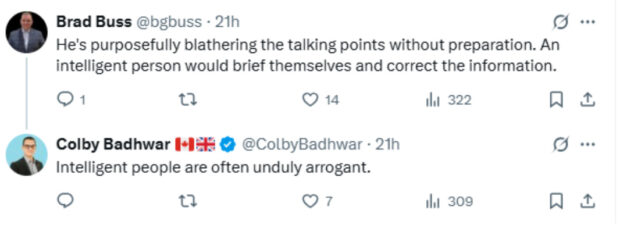
With this week’s blog, I will inevitably get drawn into the morass of politics by reposting this tweet from X.

Ignoring the typo in which “is” should have been “his” the post made me wonder about the paradoxical intersection between intelligence and ignorance. Unfortunately I have seen my share of those possessing both qualities. They are too smart for their own good and their intelligence can lead them to believe they have all of the answers. They are often wrong but never in doubt. They are possessed with a very high I.Q., an impressive resume, an elite education, prodigious academic success, and they are extremely articulate and quick on their feet. Yet they can also make decisions that can ruin them financially, businesswise, and in the realm of relationships. Their hubris is their achilles heel.
Intelligent Ignoramus
I scrolled through some of the comments to the post on X and one person couldn’t fathom how someone could be intelligent and poorly prepared and, similar to what I was saying, the author of the tweet responded that arrogance is often a fatal flaw in very intelligent people.
Last week I wrote about how I felt a little uneasy turning to A.I. assistants for generating content for my blogs because I don’t want to lose the discipline of writing and exercising that muscle. Not long after I wrote my blog I saw this brief tweet from Paul Graham, one of the founders of the start-up incubator Y Combinator and an extraordinary writer himself. His essays related to starting and scaling businesses are considered the Bible for VCs, entrepreneurs, and investors. I strongly encourage you to read some of them as some are so insightful and can have great applicability even if you’re not involved in a start-up or early stage company.
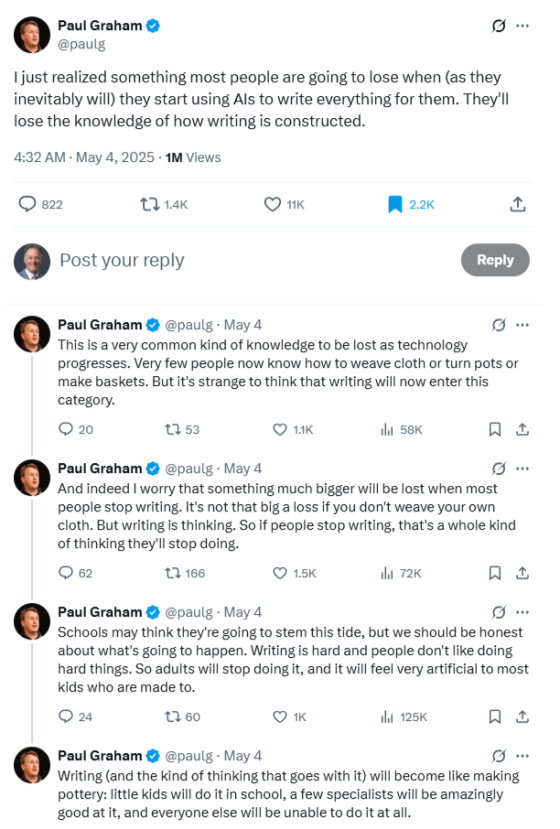
I think he is spot on but I’m clearly biased because writing has been so integral to my life. It has given me the ability to think more clearly and make better decisions than if writing were not a consistent endeavor for me. The pessimistic view is that it has frightening societal implications if the ability to write and, correspondingly, develop critical thinking skills, is lost because technology will allow it to be outsourced. The more optimistic, Machiavellian view, is that for those that see the immense value in it and invest in becoming capable, effective, and quality writers, then their ability to stand out and progress should be greatly enhanced because the pool of competitors will be shrinking. Overall I don’t see how this can be a net benefit for society but if I were to give career advice I would tell young people to double down on writing.
Back to A.I. assistants. I feel good that I have taken the time and made the effort to discuss a subject that I think is interesting, which is intelligence and ignorance, how they can coexist, and some of the negative ramifications of the presence of both in individuals. I wanted to dig a little more deeply so I felt compelled to turn to ChatGPT for more analysis. I feel like I have made the investment in writing and thinking up until this point to have earned a little A.I. dessert.
How is it possible to be both extremely intelligent and ignorant?
ChatGPT said:
It is entirely possible—and surprisingly common—for someone to be both extremely intelligent and profoundly ignorant, because intelligence and knowledge are not the same thing, and they operate in different ways.
Here’s how:
🧠 1. Intelligence ≠ Knowledge
- Intelligence is the ability to reason, analyze, and process information.
- Knowledge is what you actually know—facts, understanding, and experience.
- A person can be brilliant at solving abstract problems but know little about history, emotional dynamics, or real-world context.
Think of a chess grandmaster who can’t change a tire or manage personal relationships.
🧠 2. Intelligence Can Create Blind Spots
- Smart people often develop overconfidence in their own reasoning and assume they can think their way through anything—so they may not bother to learn or question assumptions outside their domain.
- This is known as the Dunning-Kruger effect in reverse: smart people underestimate how much they don’t know.
🧠 3. Specialized Genius = Broader Ignorance
- Deep expertise in one area can lead to narrowness. For example, a brilliant physicist may be clueless about politics, philosophy, or social dynamics.
- Cognitive resources are often allocated to one domain at the cost of others.
🧠 4. Emotional or Social Blindness
- High IQ doesn’t guarantee emotional intelligence, humility, or curiosity.
- A person might be intelligent but ignorant of their own biases, emotions, or the perspectives of others.
You can be a genius in logic and a novice in empathy.
🧠 5. Information Overload & Disconnection
- In today’s world, even very smart people can live in information silos or ideological bubbles, unaware of the breadth of available perspectives or facts.
- Intelligence can be used to rationalize existing beliefs rather than expand understanding.
🧠 6. Willful Ignorance
- Some people use their intelligence to justify or protect beliefs, rather than challenge them. They can rationalize ignorance because admitting they don’t know something may feel like weakness.
🌱 In Summary:
Being intelligent means you can think well. Being wise or informed means you’ve fed that intellect with humility, experience, and diverse knowledge. The gap between the two is where ignorance lives.
Charlie Munger was obsessed with being guided by rationality and building the world’s most rational organization, which is Berkshire Hathaway. Munger was famous for saying that everything has to sit on a latticework of theory and it’s critical that you use mental models to help draw parallels between diverse situations and to help guide decision making. He was also a huge proponent of inverting situations to help determine what not to do first and by avoiding bad outcomes the probability of generating favorable ones increases significantly. For example, if you want to live a good and fulfilling life, first ask yourself what a bad life looks like and describe it very specifically, and then work to avoid those behaviors, habits, actions, and mindsets. And hopefully what will result will be a good life because you don’t get dragged down by hubris, addiction, impulsive behavior, impatience, failed relationships, poor health, victimization, etc.
Dogmatic thinking should also be removed as it eliminates flexibility thinking which is vitally important because the world is too complex and evolving so quickly to think you have all of the answers and a monopoly on the truth. And while the following is a long quote from Munger regarding the dangers of holding onto extreme ideologies, I think it’s a must read.
“Another thing I think should be avoided is extremely intense ideology, because it cabbages up one’s mind. You’ve seen that. You see a lot of it on TV, you know preachers for instance, they’ve all got different ideas about theology and a lot of them have minds that are made of cabbage.
But that can happen with political ideology. And if you’re young it’s easy to drift into loyalties and when you announce that you’re a loyal member and you start shouting the orthodox ideology out what you’re doing is pounding it in, pounding it in, and you’re gradually ruining your mind. So you want to be very careful with this ideology. It’s a big danger.
In my mind I have a little example I use whenever I think about ideology, and it’s these Scandinavian canoeists who succeeded in taming all the rapids of Scandinavia and they thought they would tackle the whirlpools in the Grand Rapids here in the United States. The death rate was 100%. A big whirlpool is not something you want to go into and I think the same is true about a really deep ideology.
I have what I call an iron prescription that helps me keep sane when I naturally drift toward preferring one ideology over another. And that is I say “I’m not entitled to have an opinion on this subject unless I can state the arguments against my position better than the people do who are supporting it. I think that only when I reach that stage am I qualified to speak.” Now you can say that’s too much of an iron discipline… it’s not too much of an iron discipline. It’s not even that hard to do.”
— Charlie Munger
Clearly Buffett and Munger have consistently made many more good decisions than bad ones if the company you built and still running in your 90s (until the end of this year for Buffett) has grown to the point where it’s sitting on $350 billion in cash. They consistently put themselves in a position to do what was smart within their circle of competence and temperament. They have permanent capital with unlimited flexibility. They couldn’t care less what others think about their decisions because they have developed a set of skills and intuition that have guided them which is impervious to outside opinions and proven consistently right. And while Munger always espoused rationality over brilliance as the following exemplifies, Buffett and he possessed the unusual combination of brilliance and rationality.

I will sign off with something A.I. can never replace, which is Charlie Munger’s checklist for clear thinking. It’s one thing to know something and it’s another, as ChatGPT pointed out, to feed that intellect with humility, experience, and diverse knowledge.


But that can happen with political ideology. And if you’re young it’s easy to drift into loyalties and when you announce that you’re a loyal member and you start shouting the orthodox ideology out what you’re doing is pounding it in, pounding it in, and you’re gradually ruining your mind. So you want to be very careful with this ideology. It’s a big danger.
Well said!
Great post today! Avoiding the pitfalls of our own arrogance and biases can be very harmful to our own success. I love the Charlie Munger checklist and have posted it right next to my computer to remind myself to remain curious and diligent.
Thank you for continuing to write!
Intelligence has to do with the brain capacity to process information; but a high IQ does not necessarily lead to wisdom. Each of us processes information differently. We choose to favor certain inputs likely to the exclusion of others. Brains are quite diverse in how they function.
Wisdom is created from life experiences. Mistakes are inevitable and have the virtue of making us aware of the consequences. When we learn what not to do, it can free us up to other directions.
Vance’s mistakes may be the result of two different conditions. (a) Lack of information or (b) Poor judgment. Vance needs to use the resources that are available to provide an input.
Taking no risks is likely to be the biggest business risk. The challenge is to choose wisely regarding what to accept and when to quit. My last General Manager at Convair never had enough information to make a decision. He was so risk-averse that he worked prodigious hours plodding along on 3 hours/night devoted to sleeping.
Good preparation can partially offset brilliance. And your IQ has nothing to do with your level of persistence and perseverance—-
which are often the most important attributes.
Cheers
Chuck