


A little while back there was a tennis tournament in the Palm Springs area where we have a second home. A number of people were playing in the tournament who we knew and we had some of them over during one of the evenings. Heather loves games and she pulled out Jenga. Our version has large blocks.
A few people started playing, including my son, and as I watched it unfold it occurred to me that Jenga has some interesting parallels with life. As we grow up one of the unfortunate byproducts is the inevitable adoption of the comparative mind. We become so susceptible to measuring ourselves against others in terms of success, monetary rewards, career advancement, looks, skills, achievement, health, spouse,or lack thereof, material possessions, popularity, experiences, stability, well-being, etc.
Here is a picture of a very solid and well designed set of blocks that represents how the comparative mind tends to view others we want to be more like.

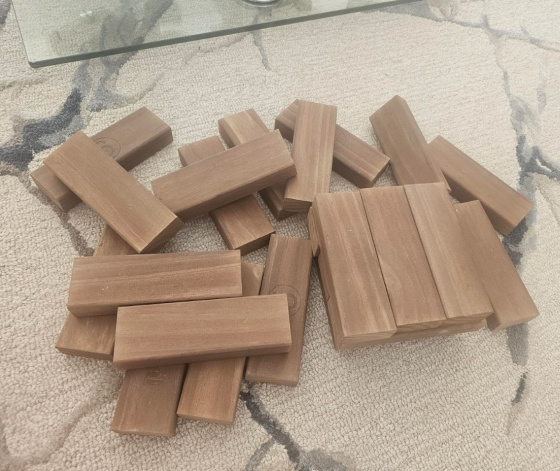
And yet we all know that this is a very rare exception. It is by no means the norm as life is far more messy than this picture conveys. I thought it would be fun to position the blocks in ways that I thought would be more reflective of life’s Jenga evolution. There is a belief many of us share that when we are born we are a pile of scrambled blocks just waiting to be formed, shaped, and built into a solid structure that can be the foundation for a happy, healthy, and successful life.

The formation and building come from our interests, how we are raised and directed, the values we are taught and retain, as well as the energy, effort, and determination we use to see things through. This is the Tabula Rasa theory of life in which we are blank pages, just ready to be shaped by our parents to become just what they want us to be.
After raising two kids, I do not subscribe to this theory of human development. I am much more of a believer in nature having as much of a role as nurture. People are born with innate characteristics and instincts that guide their choices as much as how they are directed. Nurture and nature are both vitally important.
This next picture shows some blocks with a rudimentary formation and the rest scattered. This is designed to show our innate inclinations while there is still an opening to be influenced by the direction of others as well as through curiosity, experimentation, discovery, and play.
In this next picture an individual is now more fully formed as represented by the solid block tower along with some non-Jenga objects I have added. These are included to show the potential for parental influence for direction or strong interests that have already developed. This is represented by tennis balls, as this is my bias.
The top row of the tower is missing a block showing that there is more room for growth. There are also random blocks in the foreground that represent the potential to develop other skills and interests as well as the possibility that these can become distractions that would be better off if they were discarded or transformed into something more additive to the person’s health, well being, and productive capacity.

Once the freestyling phase is over, life imposes rules on us to influence our behavior and choices. Most of us adhere to those rules to allow for societal order and economic progress, just to name two of the most important goals. Since Jenga is a game, it by definition has rules as well. And what’s interesting about Jenga Is that it has some interesting parallels with human development and regression, Charlie Munger said the following:

Keeping yourself glued together, and in a way that is right, Is key, and that is not a given for most people. Jenga players build up a structure, but every move ultimately requires removing a piece and placing it in a different location without collapsing the structure. Each block removal is incredibly risky, so each choice should be carefully calibrated and requires visualizing the impact of removing the piece and where it should be repositioned.
Life unfolds in similar ways. It’s messy and we move forward and backwards as we live and learn and fall prey to our compulsions that can lead to suboptimal outcomes. Hopefully, they are not catastrophic leading to our collapse, but are ones from which we can recover. We should also come to learn that certain behaviors, mindsets, and thought patterns should be removed or transformed so we ultimately have to take pieces out because even though we have come to rely on them, they no longer serve us and they risk collapsing our structure. This is where we have to develop new habits and eliminate harmful ones.

Here is my son evaluating his options with a smile on his face knowing how perilous the situation has become.
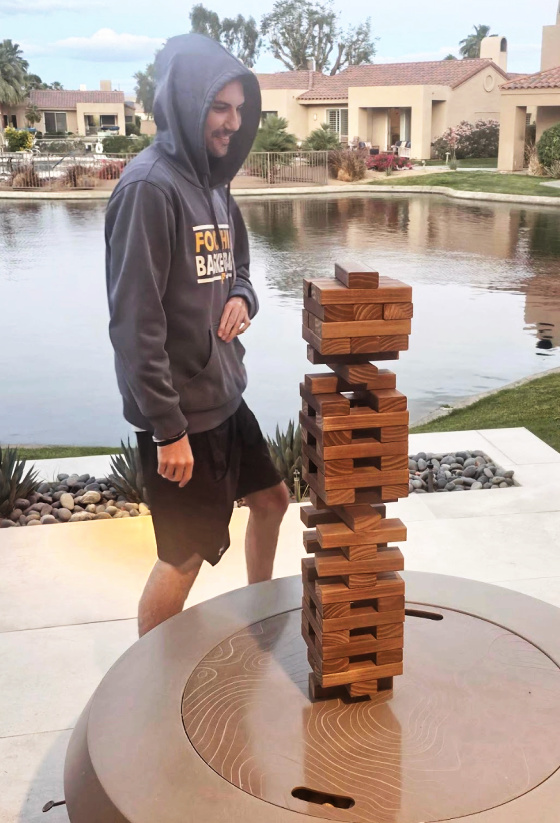
In the picture that follows one can see the final structure. The players got to a point where no more moves could be made without causing the structure to collapse. They had reached a fragile equilibrium. One can see that it’s a very jagged structure, but it is still solid. Life is very similar in that while we may be glued together, it’s often a fragile equilibrium as this is a byproduct of a life of growth, setbacks, and learning. The Jenga structure is kept together but it was done so actively and consciously. It also wasn’t done alone as everyone needed others to succeed via input, encouragement, and previous correct moves. And similar to life, the construction of the Jenga tower was far more enjoyable when others were involved in its development.
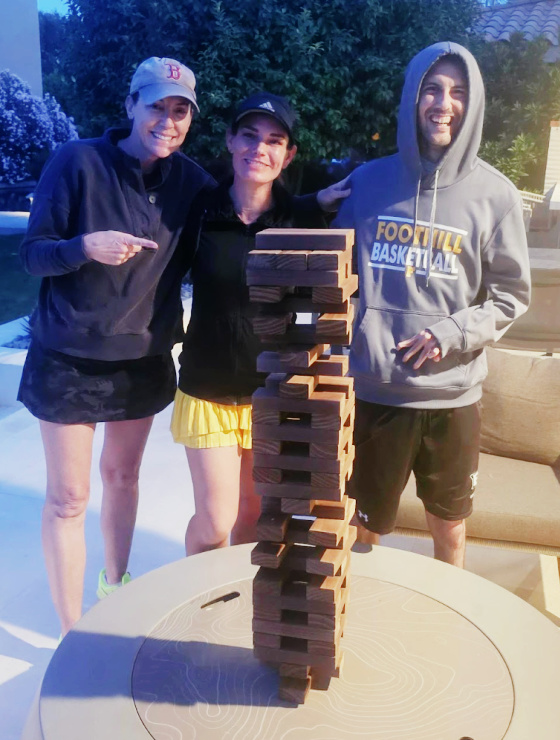
We improve our lives as much by eliminating the behaviors and mindsets that are harming us as we do by adding new ones that serve us. It’s messy, challenging, and painful but the rewards are well worth it. We can experience immense and deep satisfaction commensurate within our unique gifts all while having very little concern about how we compare with others.
Keep working on constructing your own personal Jenga towers. Be mindful of what to eliminate, what to add, and enjoy the journey and development by including others.

Leave a Reply