


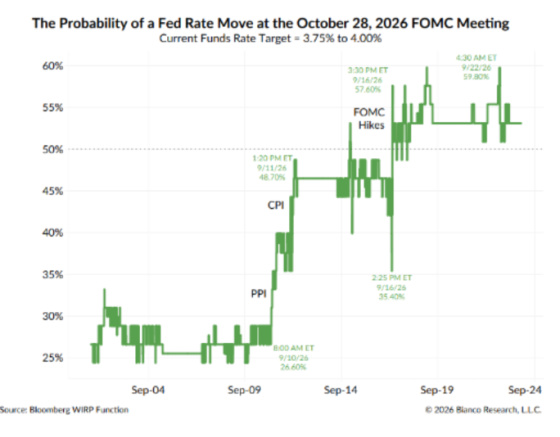
For much of the past decade, investors and borrowers became conditioned to believe that interest rates were primarily a function of Federal Reserve policy. If the Fed lowered short-term rates, longer-term borrowing costs would eventually follow. If inflation moderated, bond yields would decline. That framework was never completely accurate, but it was directionally useful during an era characterized by subdued investment, modest government borrowing relative to available savings, and a seemingly limitless global appetite for U.S. financial assets. We may now be living in a very different world. The Federal Reserve raised its benchmark rate by 25 basis points on September 16, bringing the federal funds target range to 3.75% to 4.00%, its first increase since 2023. Yet the more consequential development has been the material rise in long-term interest rates, much of which appears to be attributable not to higher inflation expectations, but to a dramatic increase in real rates. [cnbc.com], [federalreserve.gov]
That distinction is enormously important. A nominal interest rate can be thought of as consisting of an expected inflation component and a real return component. Inflation compensation protects lenders against the erosion of purchasing power, while the real rate represents the return demanded for postponing consumption, assuming investment risk, and committing capital for a long period of time. The chart included in my backup material shows the long-term TIPS yield approaching 3.2%, a remarkable change from the zero and even negative real yields that prevailed around 2020 and 2021. In other words, lenders are not simply demanding protection from inflation. They are demanding a much higher return after inflation. That is the capital market’s way of saying that money has become scarcer relative to the number and size of the claims being placed upon it. [Blog Charts | Word]
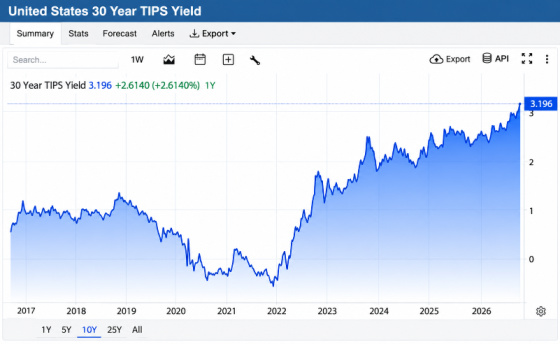
There are at least two powerful explanations for this repricing. The first is the federal government’s continuing need to finance very large deficits despite an economy that remains relatively strong. Ordinarily, deficits of this magnitude are associated with recessions, wars, or severe financial distress. Today, however, the government is borrowing heavily while households continue to spend, employment remains resilient, and private-sector demand for capital is unusually large. The Treasury must therefore compete with businesses, homeowners, real estate investors, and infrastructure developers for the available pool of savings. Investors will absorb enormous quantities of government debt, but only at a price, and that price increasingly appears to be a higher real yield.
The second explanation is the historic scale of the artificial intelligence investment boom. AI is frequently discussed as a software revolution, but its physical requirements are immense. Data centers require land, specialized buildings, semiconductors, transmission capacity, cooling systems, natural gas, renewable generation, backup power, and, increasingly, dedicated power infrastructure. One estimate in the accompanying material describes AI infrastructure as potentially requiring more than $10 trillion of investment through 2032, while another estimates approximately $4.2 trillion of capital spending by five major hyperscalers and Oracle between 2026 and 2029. Whether those estimates prove precisely correct is less important than the direction and magnitude of the change. A small group of exceptionally large companies is attempting to absorb an extraordinary amount of capital in a relatively compressed period. [Blog Charts | Word]
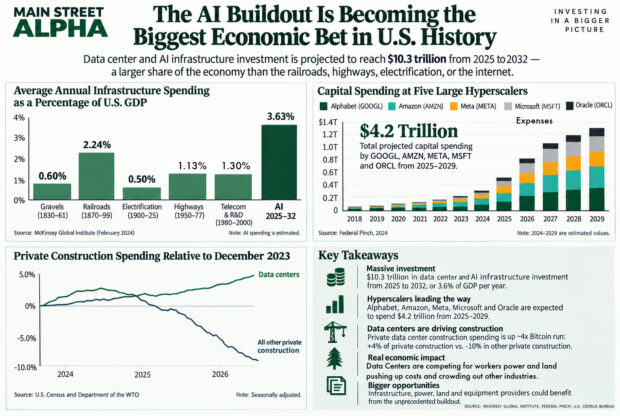
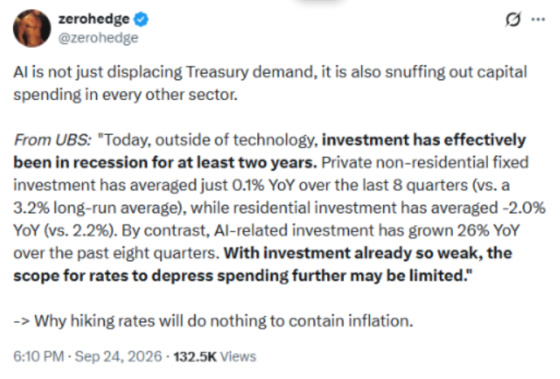
This is crowding out other investment. Capital is not literally fixed, but it is not infinitely elastic either, particularly when so many projects require the same engineers, electrical equipment, construction labor, turbines, transformers, power-generation capacity, and debt financing at the same time. The attached research notes that, outside of technology, private nonresidential fixed investment has effectively been in recession for at least two years, while residential investment has also been weak. AI-related investment has been one of the conspicuous exceptions. The danger is that the capital requirements of AI, combined with federal borrowing, are raising the required return for virtually everyone else. Apartment owners, homebuyers, manufacturers, smaller businesses, and infrastructure projects must all compete in the same capital market, even though few possess the balance sheets or perceived growth prospects of the hyperscalers. [Blog Charts | Word]
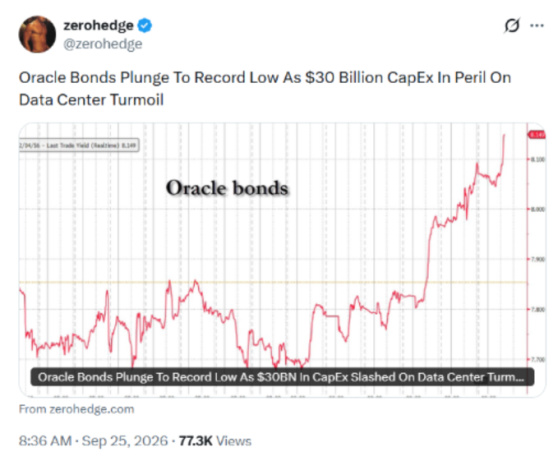
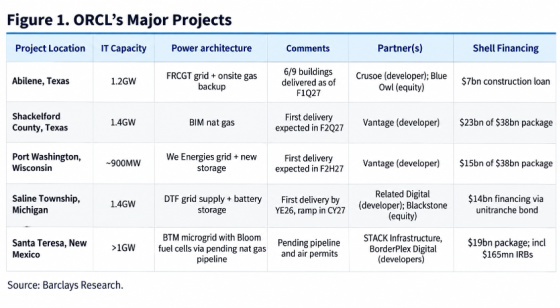
We may now be seeing the capital markets push back. Oracle recently sent a force majeure notice concerning Project Jupiter, its enormous planned data-center campus in New Mexico. It is important not to overstate what happened. Oracle has said that the project remains on schedule and that the notice does not itself establish a delay or alter delivery expectations. Blue Owl has likewise said the notice does not change the project’s financial commitments. According to current reporting, Oracle is seeking to preserve its ability to defer payments if the campus does not come online in 2028, rather than attempting to abandon the project. Nevertheless, the notice matters because approximately $18 billion of debt connected to the campus has reportedly been trading at stressed levels. The market is signaling that contractual protections, permitting delays, power availability, construction risk, and the sheer quantity of required capital can no longer be treated as incidental details. [finance.yahoo.com], [cnbc.com], [insurancejournal.com]
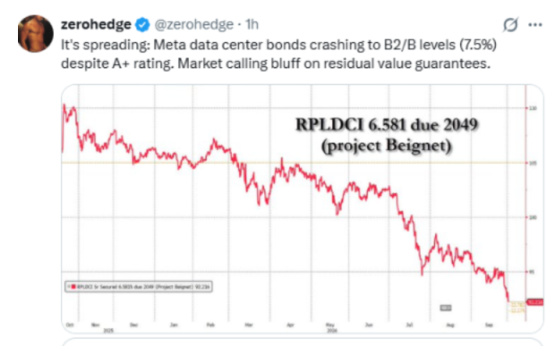
The pressure may also be spreading beyond Oracle. The backup material shows a Meta-related data-center bond falling sharply despite carrying an investment-grade rating, with its yield moving materially higher. That does not mean Meta is in financial distress, nor does one project bond represent the company’s entire credit profile. It does suggest that bondholders are beginning to differentiate between the creditworthiness of a hyperscaler and the risks embedded in a highly leveraged, long-duration infrastructure project connected to that company. A financially powerful tenant can still occupy a project whose bonds decline because construction costs, timing, refinancing exposure, power commitments, or expected residual value have become less attractive at prevailing real rates. [Blog Charts | Word]
This leads to an intriguing, although still unproven, possibility. The rise in real rates may eventually contain the very investment boom that helped produce it. If bond investors demand materially higher yields, some proposed data centers will no longer generate adequate returns. Projects may be delayed, resized, repriced, or canceled. Hyperscalers may become more selective about where and how quickly they deploy capital. A reduction in AI-related construction would weaken demand for equipment, labor, electricity, and financing. Economic growth could then slow in sympathy with the sectors already struggling under higher rates. In that scenario, today’s credit-market stress would not simply be a consequence of higher real rates. It could become the mechanism through which real rates eventually come back down.
Time will tell whether that theory holds water. The AI investment boom may prove durable enough, and its ultimate productivity benefits large enough, to support today’s capital commitments. It is equally possible that recent bond-market weakness represents a necessary repricing rather than the beginning of a major retrenchment. What is not theoretical is the immediate squeeze facing borrowers with loans coming due. They borrowed in a world in which capital was abundant, real yields were near zero, and lenders competed aggressively to put money to work. They are refinancing in a world where the federal government and the largest technology companies are absorbing capital on an extraordinary scale, lenders are demanding greater protection, and long-term real yields are at levels few underwriting models contemplated several years ago.
For real estate owners, the central issue is therefore not simply whether the Fed raises or lowers its overnight rate at its next meeting. It is whether the economy’s aggregate demand for capital begins to moderate and whether investors’ required real return follows it lower. Until that happens, borrowers should assume that capital will remain expensive, refinancing proceeds will be constrained, and lenders will apply much more conservative assumptions. The bond market may now be warning that the AI buildout is approaching its financial limits. If so, the resulting slowdown could ultimately provide relief to borrowers. Unfortunately, the transition from capital scarcity to lower rates is unlikely to be painless. Before relief arrives, the economy may first have to absorb the consequences of investments that no longer pencil, and loans that can no longer refinance on their original terms.

Leave a Reply