

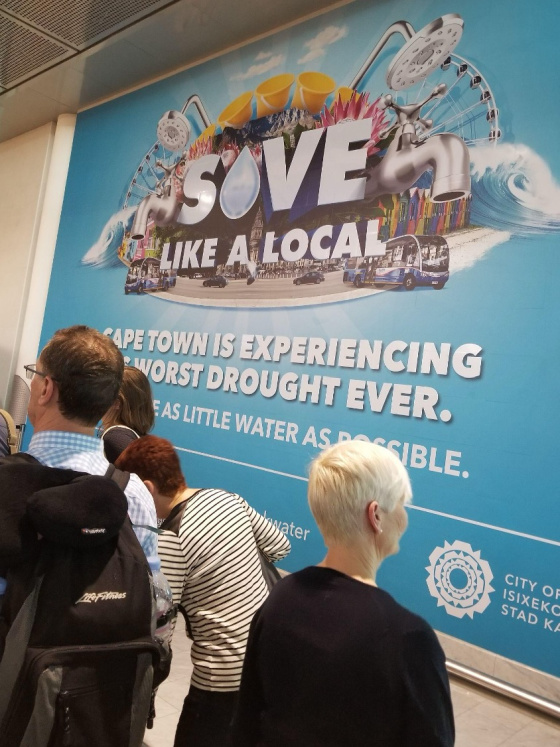
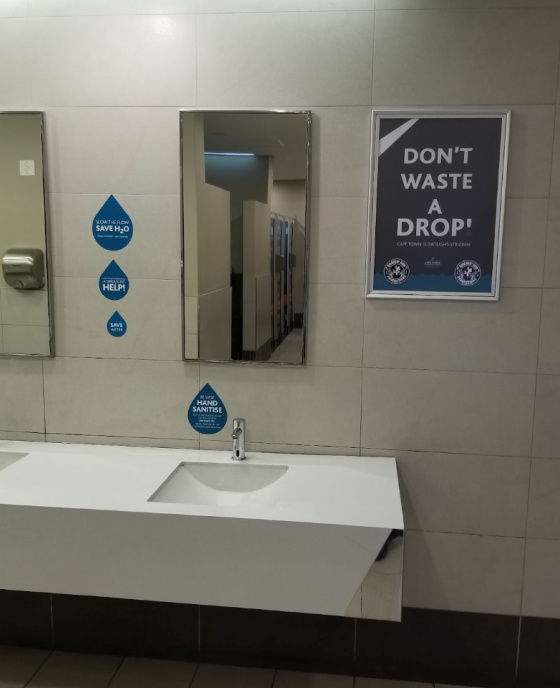
In 2018 I was on a cruise that took us to eastern Africa, two stops in India, as well as Myanmar, Malaysia, and Singapore. The cruise departed from Cape Town, South Africa. Upon arriving there we were immediately struck by how dire the water situation was. The city was projected to run out of water within two months. As a result, there was an intense focus on communicating how important conservation was. Here are a couple of pictures I took related to this. The first one was in the airport in the passport control section while the second photo was taken in one of the airport bathrooms.
I bring this up because I have been following the awful water situation in Tehran specifically, and Iran more generally. Cape Town was able to get through its crisis. Unfortunately, the prospects for Tehran are far more dire. Some of what follows comes from a very interesting and informative article I read about the situation in Iran.
Iran’s Looming Water Bankruptcy and the Global Geopolitics of Scarcity
Introduction: Why Water Is the New Geopolitical Flashpoint
Water is no longer just a resource—it’s becoming a driver of instability, migration, and even war. From Cape Town’s near “Day Zero” to Syria’s drought-linked upheaval, and now Iran’s existential crisis, the story is clear: water security is inseparable from national security.
Iran: The Mother of All Water Problems
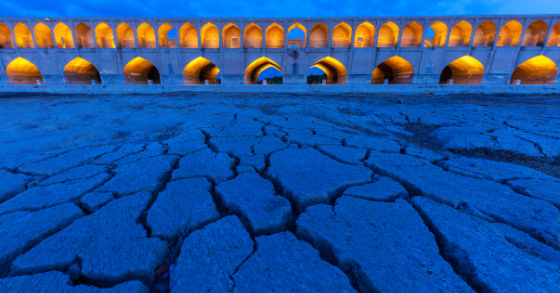
Iran faces what hydrologists call “water bankruptcy.” After five consecutive years of extreme drought, Tehran is on the brink of becoming uninhabitable. President Masoud Pezeshkian recently warned that Iran may have “no choice” but to relocate its capital to wetter coastal regions—a move estimated to cost $100 billion and take decades.
The roots of this crisis run deep:
- Destruction of Qanats: Tens of thousands of ancient underground tunnels—once the envy of the arid world—were abandoned in favor of modern engineering.
- Dam Mania: Iran became one of the world’s top dam-builders in the late 20th century. Dozens of dams were built on rivers too small to sustain them, accelerating evaporation and drying wetlands.
- Overpumping & Mismanagement: Decades of disintegrated planning and short-term fixes depleted aquifers and destabilized ecosystems.
As a result, Tehran’s 10 million residents now live in a city where water scarcity is more threatening than sanctions or military strikes. Experts argue that climate change is only the accelerant—the real fire was lit by governance failures and unsustainable development. [e360.yale.edu]
Cape Town: Lessons from Avoiding Day Zero
Cape Town’s 2018 crisis showed how close a modern city can come to running dry. The city’s success in averting disaster offers key lessons:
- Demand Management: Residents cut usage by nearly 50%, aided by strict restrictions and public campaigns.
- Infrastructure Diversification: Emergency desalination plants and pressure management zones reduced losses.
- Behavioral Change: “Save water like a local” became a civic mantra, proving that collective action matters.
Yet Cape Town also exposed vulnerabilities: inequality in water access and the limits of conventional supply-side thinking. These lessons are vital for cities worldwide facing climate-driven variability. [thestar.co.za], [edges.site…olt.ubc.ca], [brookings.edu]
Syria: A Case Study in Complexity
The Syrian civil war is often portrayed as a “climate conflict” triggered by drought. But recent research debunks this simplistic narrative. While a severe drought between 2007–2009 stressed rural livelihoods, the real culprits were governance failures and abrupt subsidy cuts that left farmers defenseless. Migration patterns predated the drought, and cropland actually rebounded before the war.
This matters because oversimplifying water conflicts as climate-driven obscures the systemic issues—poor governance, inequitable resource allocation, and maladaptive policies—that turn environmental stress into political instability. [phys.org]
The Geopolitics of Water: A Global Risk Map
Water scarcity is emerging as a strategic fault line:
- Middle East: Control of dams on the Tigris and Euphrates has been weaponized in conflicts involving ISIS and regional powers.
- South Asia: India and Pakistan’s tensions over the Indus Waters Treaty illustrate how rivers can become flashpoints.
- Global Trends: By 2050, nearly 5.7 billion people will live in water-scarce areas. Transboundary rivers and shared aquifers will test diplomacy like never before.
UNESCO warns that water crises are now among the top threats to global peace, urging urgent cooperation and transboundary agreements. [unesco.org], [geographical.co.uk], [geopolitika.it]
Conclusion: From Scarcity to Strategy
Iran’s predicament is a wake-up call. Water security must be treated as a core element of national and international strategy—not an afterthought. Solutions will require:
- Restoring Traditional Systems: Reviving qanats and sustainable groundwater management.
- Regional Cooperation: Shared river basins demand diplomacy, not unilateral dam-building.
- Resilience Planning: Cities must integrate climate adaptation, equity, and infrastructure diversification into long-term water governance.
Water is life—but in the 21st century, it is also power, politics, and peace.
Economic Implications for Investors: Water as a Strategic Asset
Water scarcity is not just an environmental or humanitarian issue—it’s an economic disruptor with profound implications for global markets and investment strategies.
- Agriculture and Food Security:
Iran’s crisis foreshadows what could happen across other water-stressed regions. Agriculture accounts for roughly 90% of Iran’s water use, and as aquifers collapse, crop yields plummet. This drives up food prices globally, creating inflationary pressures and volatility in commodity markets. Investors exposed to agribusiness, fertilizers, and food supply chains must factor in water risk as a core variable. - Energy and Infrastructure:
Hydropower-dependent economies face declining generation capacity as rivers dry. In Iran, dam failures and reduced flow have already impacted energy reliability. For investors, this means stranded assets in water-intensive energy projects and rising demand for alternative technologies like solar and desalination. - Real Estate and Urban Migration:
Tehran’s potential $100 billion relocation plan underscores a new frontier risk: water-driven urban migration. Cities with secure water supplies will see property values surge, while those in high-risk zones could experience steep declines. Real estate investors should integrate water stress indices into due diligence. - Geopolitical Risk Premiums:
Water scarcity amplifies political instability, sanctions risk, and conflict exposure. Sovereign bonds and emerging market equities in water-stressed nations may carry hidden risk premiums. ESG-focused funds increasingly treat water security as a material factor in country-level risk assessments. - Opportunity in Water Tech:
On the flip side, scarcity creates demand for solutions—desalination, wastewater recycling, leak detection, and smart irrigation. Companies innovating in these areas are positioned for long-term growth. Water is becoming the “new oil” for infrastructure investors.
I encourage everyone to read the article much of this post was based on. In addition, Americans should not be complacent about our water security, as there is significant overpumping of groundwater happening here, particularly in the agricultural regions of California. Water security is, without question, one of the world’s most pressing issues and can lead to unfathomable destabilization and conflicts. The trend is not our friend, as it takes a tremendous amount of money and talent, as well as time, to reverse the terrible damage that has already taken place. Be grateful for every drop of water you have access to, as it is becoming an even more precious commodity.

Leave a Reply