


Last week Heather and I made our annual pilgrimage to the BNP Paribas Open at Indian Wells near Palm Springs. We also have the great pleasure of being members there as well so we truly understand why it’s known as Tennis Paradise. For the past 14 years in a row the players have picked Indian Wells as their favorite tournament. If you have the opportunity to attend, you will immediately see why. One can see from this picture how beautiful the setting is there.

And yet, we all know there can also be trouble in paradise from time to time. The conditions at Indian Wells can change quite significantly, not only over the nearly two weeks the tournament runs, but during the course of a day and night as well. This is what Andre Ruble had to say about playing there.
“It’s like there’s one tournament but four different kinds of conditions,” he said.
“If you play during the day, in the heat, that’s one thing but if you play at night, it’s completely different, nowhere near.
“Then it might get cold the next day, another factor for you, plus there’s always strong wind here.
“One tournament, four different kinds of conditions, that’s why everyone struggles here every year.”
To show you how conditions changed dramatically here is a picture of Heather and I watching Carlos Alcaraz play last Thursday night.
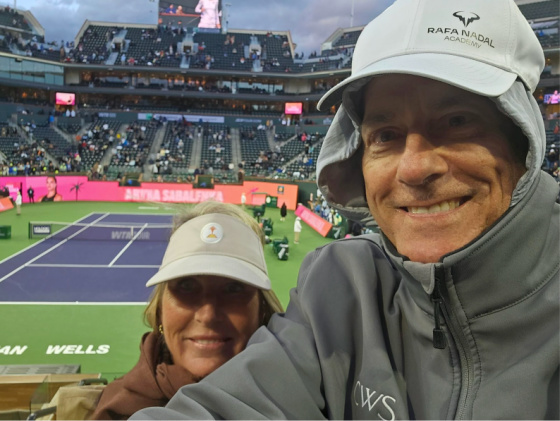
It was freezing, especially when the wind was blowing. Our smiles were more because of how fortunate we felt to be there versus how we were physically feeling being there.
Recently we were so excited to have Brandon Nakashima, who is ranked number 33, practice at The TenniSphere. Although he lost in the Dallas Open after leaving our place, he was on a bit of a hot streak after that. He won the men’s doubles and made it to the quarterfinals in singles in Delray Beach and he reached the semifinals in Mexico. At Indian Wells he also played very well. He won his first two matches and lost a heartbreaking first set tie break to Ben Shelton in the round of 16 and then Shelton took care of business in the second set. Overall he should be very proud of his performance and progression.
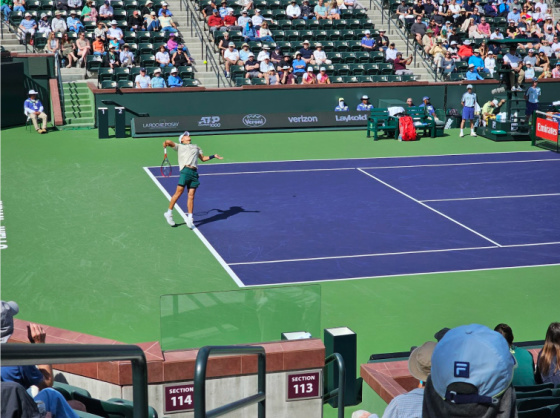
The tournament attracts nearly 500,000 people so there are a lot of other opportunities to socialize, eat, and drink when not inside one of the venues watching tennis.
Here I am enjoying the vibe between matches.

We saw some great matches with one of them being an epic thriller. It was between Daniil Medvedev and Arthur Fils, a 20-year old from France who seems destined to be a top 10 player within the next couple of years.

The match went into a third set tie break. A tie break requires the victor to win by two and get at least seven points. Thus, if the score is 6-6, the winner must get the next two points to win by two, even though it exceeds seven.
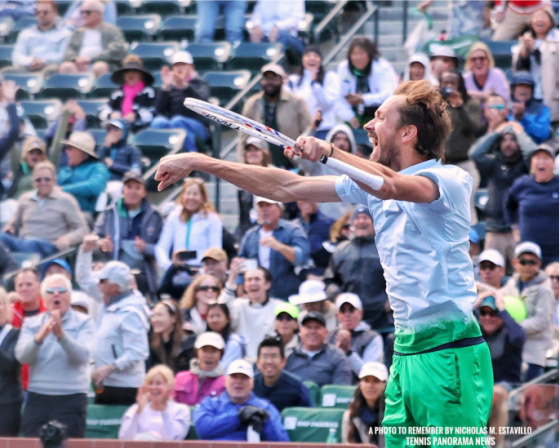
The tie break went back and forth with some amazing points. Fils saved two match points and was now facing a third. He came to the net to attack a short shot by Medvedev and had a very easy shot to a wide open court to tie the score once again and shockingly he hit it long. Medvedev’s reaction was unlike anything anyone has ever seen who has followed his career closely.

The sheer joy and rapture he expressed was incredible and a sight to behold. Here are some photos capturing his reaction but. It’s a beautiful thing to watch. There are several more, I suggest you search for them.
Here’s the Tweet where I discovered the photos of Medvedev’s celebration:

So that you can see each shot in all of it’s joyful glory, I’ve separated out each shot:

I love the contrast between the two fans in this picture. One of them is elated while the other is in utter shock, which was my reaction.

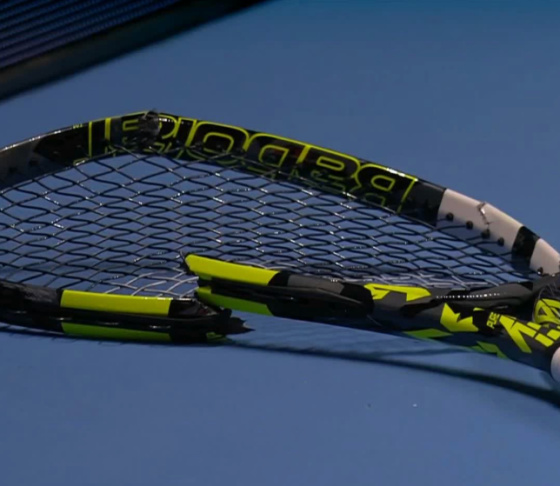
And this is how Fils took out his frustration at the end of the match. He slammed his racket so hard into the ground that the head flew off onto the court. The juxtaposition between a celebratory Medvedev and Fil’s destroyed racket is so representative of the power of sports, especially in an individual battle like a singles match in tennis with so much at stake.
I came to learn that Medvedev’s extraordinary display of emotion was a result of his utter futility in winning third set tie breaks over the last year or so. Prior to Indian Wells he was 1-9 so he came into this tie break not only lacking confidence, but snakebitten wondering if history was going to repeat itself yet again. Although I was leaning towards wanting Fils to win I was very happy for Medvedev, especially after learning afterwards about his 1-9 third set tie break record.
I always try to take away life lessons when watching and playing tennis. A couple of insights for me centered around the downside of caring too much and how important it is to find joy in one’s life, particularly in one’s craft.
Earlier I wrote about watching Brandon Nakishima play. His mother was kind enough to get Heather and I two great tickets to watch his match. Because I feel a connection to Brandon after meeting him and hosting him at our house, I was fully invested in his performance and cared a great deal about how he played. I was surprisingly nervous and there were times I didn’t even want to watch because of the pressure. That is not typical for me but that’s what happens when you care. It’s a similar feeling I sometimes get when I’m playing, but with negative ramifications. It is possible to care too much and be too invested in the outcome. If you can’t keep the situation in perspective and focus on the now, then you set yourself up for being overcome by emotion and losing patience and making poor decisions as well as being more error prone.
I kept telling myself to stay in the now. In fact I was reminded of the Eckhart Tolle quote from his very influential book The Power of Now. This is what he wrote that helped get me recentered.
Nothing ever happened in the past; it happened in the Now. Nothing will ever happen in the future; it will happen in the Now. What you think of as the past is a memory trace, stored in the mind, of a former Now. When you remember the past, you reactivate a memory trace — and you do so now. The future is an imagined Now, a projection of the mind. When the future comes, it comes as the Now. When you think about the future, you do it now. Past and future obviously have no reality of their own. Just as the moon has no light of its own, but can only reflect the light of the sun, so are past and future only pale reflections of the light, power, and reality of the eternal present. Their reality is “borrowed” from the Now.
Each time I started to feel like I wanted to turn away from reality or hope it would be different I kept reminding myself there is only this current point and that is all that matters. This helped me to become less anxious and more grounded and more able to enjoy the match.
With the other matches, on the other hand, I was not nearly as invested and I just wanted to see great tennis, even if the person I wanted to win did not prevail. This allowed me to stay more present, focused, and able to enjoy the full experience.
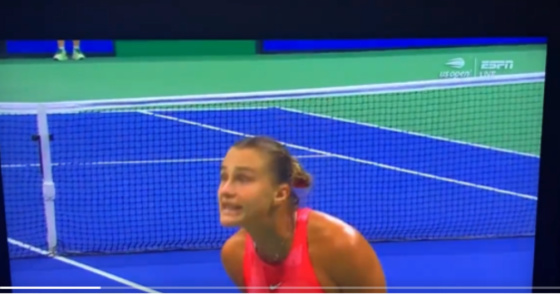
And speaking of joy, this is my last point. It is such a delight to see players who are so clearly enjoying themselves on the court. And while it’s not as obvious and evident when they’re experiencing setbacks, one can also see how a great effort and shot can respark their innate joy and love for the game. Conversely, it is not so great to see players who are perpetually negative while competing. The prime example of this is Aryna Sabalenka, who is one of the top women’s players in the world. When I watch her play I never see one ounce of joy or positivity. Even when she does well her reaction is as if she expected nothing less than perfection so there’s no reason to celebrate and when she makes a mistake she is so hard on herself and her body language and facial expressions convey such negativity as well. It also translates into impatience with the ball kids which I think crosses the line. She has been overtly rude to them as if they are her servants. And yet, with all of that being said, when the match is over she is such a delightful, happy, joyful person who is seemingly so fun to be around. She radiates positivity and great energy. It just goes to show we all have different parts of our personality that reveal themselves under different types of circumstances and situations. It also shows how important it is to find joy in one’s craft since we will be spending so many waking hours investing in our careers.

The epitome of joy on the court is Carlos Alcaraz, the 21-year old phenom from Spain, who absolutely loves to play tennis and entertain and delight the audience with his incredible court coverage and shot making ability. You can see from this picture how he radiates joy.

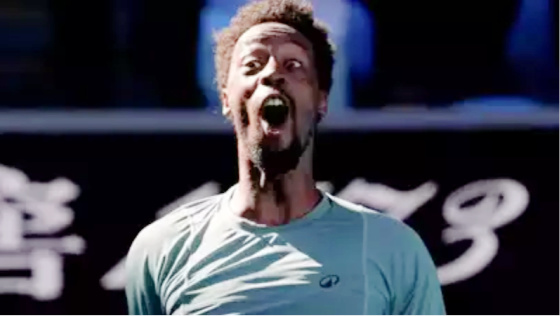
One player I really wanted to see but wasn’t able to was 38 year old Frenchman Gael Monfils. He too is the epitome of joy but on the other side of the spectrum from Alcaraz. He is at an age where so few players are able to play and yet, he still soldiers on knowing that every minute he can play the sport he loves and has given him so much is an incredible gift. His energy, court coverage, and overall flair are incredible, particularly for someone his age. I sure hope I can see him the next time around. Alcaraz has a love for a sport that he hopefully has many more years to enjoy and become one of the great players in history while Monfils is at the end of his career cherishing every minute it affords him. I would argue that the joy each experiences and feels while playing tennis has been a key contributor to Monfil’s longevity and it will be for Alcaraz as well, on top of contributing to his extraordinary success.

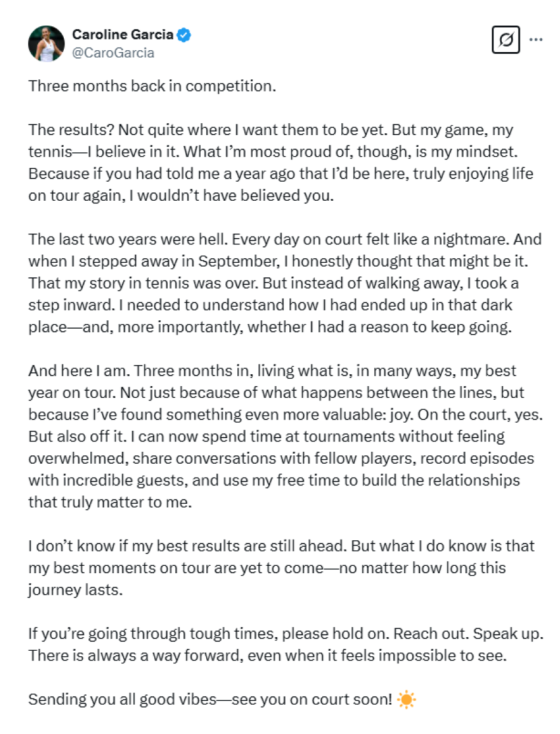
Tennis is a very difficult sport both physically and mentally. The toll it can take on one’s body and mental health can be very high. That’s why a number of players have psychologists as part of their teams. And if they don’t it’s vitally important for them to find ways to stay positive and engaged and put setbacks in perspective. One player who was really struggling with her mental health was Caroline Garcia from France. I was so happy to read this the other day on X that she too is finally able to find the joy in her life.
Even Bob Dylan, the great poet, writer, musician, and singer seems to agree with this sentiment after living like few others have in his 83+ years.

There are a lot of obstacles on the road to joy. We may be impacted by trauma, our internal chemistry, habits, repetitive mindsets, physical limitations, and a whole host of other factors that make it a challenge to cultivate and sustain joy in our lives. On the other hand, if our default state is one of frustration, anxiety, impatience, and being prone to anger, then we have nothing to lose in trying to get on the road to joy and everything to gain.
So why not start now? After all, the journey of a thousand miles begins with a single step.

Leave a Reply