

At least six months ago, Heather saw something on Instagram that she knew would get my attention. Andy Roddick was going to host an immersive tennis experience. I was immediately intrigued.
There were two reasons. First, I’ve always thought Andy was an incredibly bright and cerebral person. His tennis IQ is off the charts, and I’ve loved listening to the way he analyzes the game via his Served podcast. Here was an opportunity to spend three days around someone who had reached the pinnacle of a sport I love and learn how he sees the game from the inside.
But there was another thought lurking in the back of my mind.
The TenniSphere
Heather and I have put an enormous amount of our time, talent, treasure, imagination, and love into creating The TenniSphere. It has grown into something far more meaningful to us than a tennis court. We are always thinking about the people we might bring there, the experiences we might create, and how an unusual place sometimes creates unusual possibilities.
And I thought: Wouldn’t it be interesting if somehow, some way, Andy Roddick learned about The TenniSphere?
Highly unlikely? Absolutely.
Impossible? No.
And I’ve lived long enough to know that there is a very large difference between those two things.
Putting My Hat in the Ring
I’m not going to lie, the event was very expensive, and apparently the organizers anticipated far more demand than available spots, so you couldn’t simply sign up. You had to apply, after which a smaller group would be interviewed and ultimately selected.
I figured, why not? I viewed it as a once-in-a-lifetime experience with great optionality attached to it.
In my application, I told them about our passion for tennis and about what Heather and I had created with The TenniSphere. Then I submitted it and went on with my life.
Some time passed.
Eventually it occurred to me that I hadn’t heard anything. Around the same time, we had reorganized the way my emails were being routed, with many messages that previously would have landed in my inbox ending up in a Promotions folder. I decided to search my email for “Andy Roddick.”
And there it was. They had written back.
In fact, the April 20 email said that after reading my submission, they thought I “could be a great fit” and wanted me to arrange an interview with Vanessa from Amphora, the company putting on the event.
I explained why I had taken so long to respond, scheduled the interview, and had a delightful conversation with Vanessa. We ended our exchange with her telling me there was a place for me if I wanted it. Her subsequent email confirmed that they were “thrilled” to have me join.
My calendar happened to be open, and I was intrigued.
And while it was a significant financial commitment, I could see multiple forms of potential return. I could improve my tennis. I would meet other people who were passionate about the sport. I’d have a memorable experience. And maybe, somehow, it might open a door for The TenniSphere.
So I said yes.
I subsequently learned that approximately 4,500 people had applied, around 300 were selected to be interviewed, and only 60 were ultimately chosen. Suddenly, I realized just how unlikely it had been that I would end up there.
And that made me think about something much bigger than tennis.
The Adjacent Possible
A surprising number of the most important events in my life began as relatively low-probability occurrences.
You can’t manufacture all of them. You can’t model them in a spreadsheet. And you certainly can’t know their ultimate consequences beforehand.
But you can increase the probability that something unexpected happens by putting yourself in places where unexpected things can happen.
I think of this as entering the adjacent possible.
Submitting the application didn’t guarantee anything. Attending the experience didn’t guarantee anything either. Andy Roddick may never set foot at The TenniSphere. Nothing commercially meaningful may ever emerge from my attendance.
But none of those things could happen if I hadn’t first raised my hand.
There is an enormous difference between chasing outcomes and creating optionality. The former can make us transactional. The latter simply requires us to get on the field.
And once I was on the field (or court to be more precise) at Rancho Valencia, I remembered why I had wanted to be there in the first place.
The Warren Buffett and Charlie Munger of Tennis
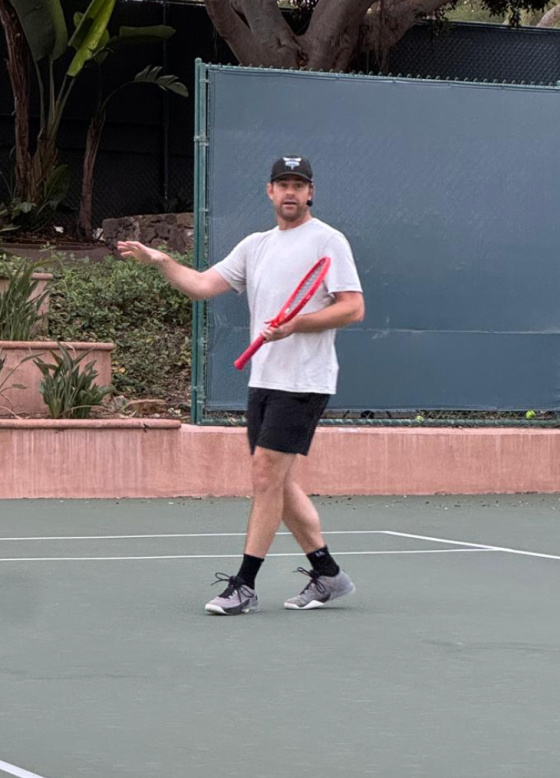
Watching Andy teach was fascinating because beneath the extraordinary athletic ability is an extraordinarily analytical mind.
If I had to describe his philosophy, it might be reduced to one word:
Margin.
Margin. Margin. Margin.
In that sense, I came to think of him as the Warren Buffett and Charlie Munger of tennis.
Don’t make the game more complicated than it needs to be. Keep the ball in play. Prepare early. Move your feet. Get the racket back. Understand the geometry of the court. Use your body efficiently. Don’t attempt a spectacular low-probability shot when a less spectacular high-probability shot continually improves your position.
And, very Munger-like, invert.
Instead of constantly asking, “How do I hit a winner?” ask, “What makes my opponent most uncomfortable?”
What don’t they want to hit?
Where don’t they want to move?
What patterns produce errors?
And then avoid doing the opposite.
It reminded me of General George Patton’s famous maxim that the object of war isn’t to die for your country but to make the other bastard die for his.
Translated into considerably less consequential terms: you don’t get extra points in tennis for making the highlight reel.
Stay alive in the point. Protect your margins. Keep shifting the probabilities slightly in your favor until your opponent gives you an opportunity or eventually makes a mistake.
You don’t have to win every point beautifully. You just have to win enough of them.
Winning When You Don’t Have Your Best Stuff
One of Andy’s observations particularly stayed with me.
Looking back on his professional career, he said that he probably played great only 15% to 20% of the time. He played terribly another 15% to 20% of the time. Most of the time, he was somewhere in the middle.
I found that wonderfully liberating because that’s tennis.
Actually, that’s life.
We spend so much energy trying to get ourselves into some ideal state before we perform. We want to feel rested, confident, inspired, focused and physically perfect. But most days aren’t like that.
Andy said some of his most satisfying wins came when he played terribly and still found some way to win.
That surprised me. Andy is famously demanding of himself, so I might have expected him to view such a victory as fortunate or somehow undeserved. Quite the opposite.
There was satisfaction in solving the problem without having access to his best solution.
There is something profound in that. Excellence isn’t just seeing how well you perform when everything is working. Sometimes excellence is discovering what remains available to you when very little is.
Fantasy Camp
The experience had plenty of pinch-me moments.
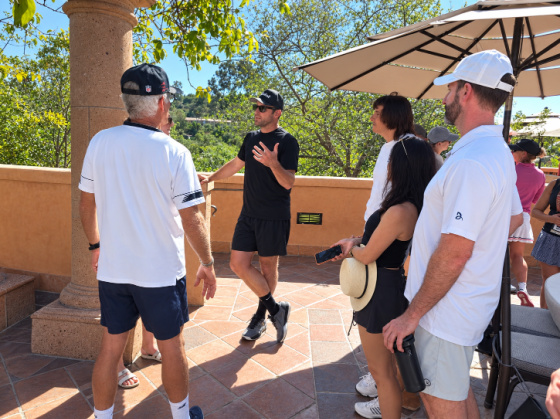
Andy brought in legendary tennis coach Larry Stefanki, who seemed to have an endless reservoir of stories about the great players he had coached while bringing tremendous enthusiasm to teaching those of us who simply love the game.
Here is a picture with Larry’s back to the camera after holding court with people who loved hearing his stories and incredible tennis wisdom.
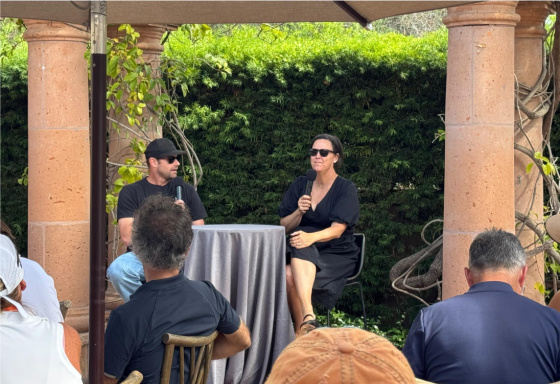
Lindsay Davenport joined Andy for a conversation and it was terrific to learn about her journey and how humble she is.
And then there was James Blake.
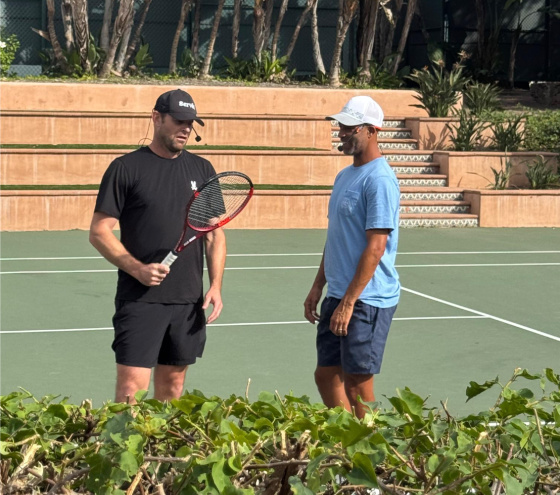
Andy and James played doubles against all 30 teams assembled from the 60 participants. My partner and I got to play around 15 points against them, and happily, they weren’t merely patting balls back to make us feel good.
We saw real pace. Placement. Topspin. Slices. Movement. It felt like a fantasy camp.
What I particularly loved was hearing that Andy had told James how much fun he was having. You could see it. Even in this setting, years removed from playing professionally, he would get pissed at himself when he missed.
The competitor was still there.
And then Andy and James left the court and suddenly it was our turn to compete.
Finding a Way to Win
The participants had been divided into five groups of 12 based on skill level, and I was fortunate to be placed in the highest group.
That was gratifying for another reason. Of the 32 men attending, I was one of four in their 60s. The average age was 46 and the youngest participant was 30. At one point I was playing alongside guys who were 30, 31 and 34, and aside from a sore lower back, I felt my conditioning allowed me not only to keep up with them, but occasionally to make them keep up with me.
Even better, I was paired for the tournament with someone whose game I had admired earlier. He was 49, lives in Nashville with his wife, and we hit it off immediately.
The scoring format was unusual. The first team to 20 won, provided it won by at least two, with each player serving four consecutive points before rotating. More importantly, points accumulated across four matches, so even in defeat every point mattered. The maximum possible cumulative score was 80.
We won our first two matches.
Then we lost our third, 20-17.
We won the fourth.
77 out of a possible 80 points.
Now we had to wait.
The team that beat us needed 17 points in its final match to tie us and, presumably, take the title through the head-to-head tiebreaker. Eighteen would win it outright.
They scored 14.
We had won.
And after three days of hearing Andy talk about margins, consistency, staying alive and finding ways to win when you don’t have your best stuff, there was something particularly satisfying about winning in exactly that way.
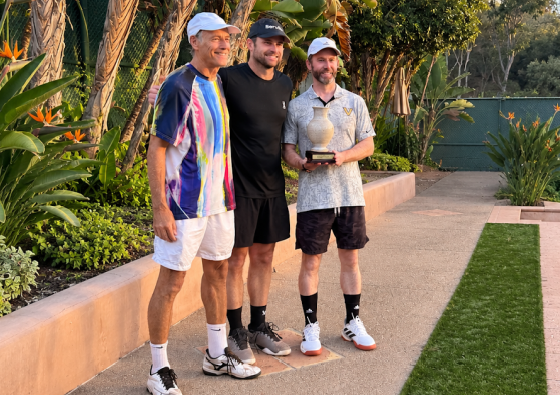
We got our picture with Andy.
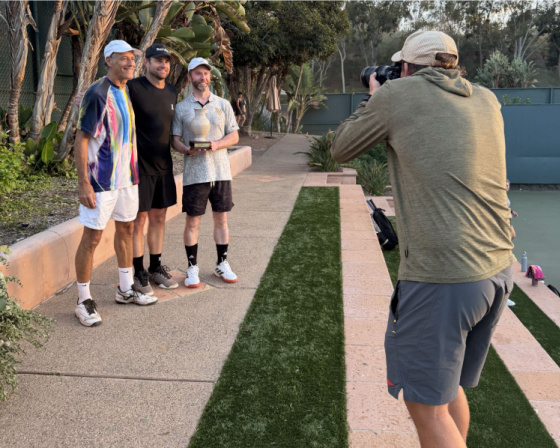
We got the bragging rights.
And perhaps even more meaningfully, I enjoyed playing with my partner enough that I’ve subsequently asked whether he’d consider joining me for the Three Surfaces tournament in the Palm Springs area.
He said he’s interested.
Another adjacent possible.
The Power of a Platform
But perhaps my biggest takeaway from the experience had little to do with my forehand, backhand or tournament victory.
It had to do with platforms.
Years ago, when I was beginning the process of writing my book, someone told me something I’ve never forgotten:
You cannot overestimate the power of a platform.
Heather and I think about this frequently with The TenniSphere. We can create beautiful experiences. We can come up with interesting ideas. We can host fascinating people.
But then comes the perennial question:
How do people learn about it?
Andy doesn’t have that problem.
Through his tennis career, personality, reputation and now the tremendous reach of his Served podcast, he has accumulated something much more powerful than fame.
He has accumulated attention joined with trust.
That’s a platform.
And a platform changes the economics of almost everything attached to it.
You can create the greatest experience imaginable, but if nobody knows it exists, you face an enormous distribution problem. Conversely, when someone has built a community of people who not only know who they are but actively care about what they have to say, something interesting happens:
Demand can precede the product.
That was on display at Rancho Valencia.
A highly curated experience. Sixty participants. A substantial price. And, based on what I was told, approximately 4,500 applicants.
The scarcity wasn’t manufactured. There simply weren’t enough spots.
But Someone Still Had to Send the Email
And this is where the story becomes even more interesting.
Because apparently none of this began with Andy.
It began with a cold email.
The owner of Amphora, the company putting on the experience, reached out to him. Andy said that something about the message intrigued him enough to respond, which led to a Zoom conversation. Afterward, Andy apparently told his wife something along the lines of: I don’t know whether I’m crazy or naive, but I really vibe with this guy and I want to do it.
An entrepreneur sends a cold email to one of the greatest American tennis players of his generation.
Andy answers.
They talk.
They connect.
And eventually 60 people are at Rancho Valencia with Andy Roddick and James Blake playing doubles against them.
That’s a pretty astonishing chain of events from hitting Send.
And it’s precisely why I don’t think the lesson of this experience is simply that platforms matter.
It’s that platforms and possibility feed each other.
The Amphora founder had the initiative to approach Andy.
Andy had the platform to attract thousands of interested people.
Amphora had the operating capability to transform that demand into an exceptional luxury experience.
And the participants supplied something else Andy hadn’t necessarily anticipated.
Perspective.
Seeing Tennis Through Other People’s Eyes
At the closing dinner, Andy said something I found especially meaningful.
Professional players experience tennis as a vocation. Rankings, prize money, injuries, travel, expectations and careers become attached to what started as a game.
For us, tennis is an avocation.
We don’t have to play.
We get to play.
Andy said how much he’d enjoyed experiencing the joy people have for tennis through the eyes of those of us who play it simply because we love it.
That struck me.
The platform may have drawn us there.
But the experience gave something back to the person who possessed the platform.
Andy said he hoped he’d be invited back and that it was by far the best organized experience of this kind he’d participated in. The owner of Amphora later told me that his aspiration is to do this with Andy for the next 20 years.
Why not?
They appear to have found a compelling intersection among platform, passion, scarcity, trust, execution, and experience.
And if they can preserve what made the first one special, there is tremendous potential in that.
Just Get on the Field (or Court)
I went to Rancho Valencia hoping to improve my tennis.
I did.
I hoped to meet interesting people.
I did.
I hoped I might find some way to introduce Andy Roddick to The TenniSphere.
We’ll see.
But perhaps I learned something more important.
We dramatically underestimate the value of repeatedly placing ourselves in the path of possibility.
Submitting an application.
Sending an email.
Accepting an invitation.
Starting a podcast.
Building a tennis court.
Writing a book.
Creating a place.
Introducing yourself to someone.
None of these guarantees an outcome.
That’s precisely the point.
Optionality doesn’t guarantee anything. It simply makes things possible that were previously impossible.
Platforms magnify that optionality. They create gravitational fields around people, ideas and experiences. Once you’ve earned people’s attention and trust, possibilities that previously required enormous energy can suddenly come toward you.
But here’s the paradox I keep coming back to:
Before you have a platform, you have to be willing to step onto someone else’s.
The owner of Amphora did that when he cold-emailed Andy Roddick.
I did it when I submitted an application that had roughly a 1-in-75 chance of ultimately being selected.
My tournament partner may do it by flying from Nashville to Palm Springs to play Three Surfaces with a guy he met at tennis camp.
And perhaps someday Andy will do it by walking through the gates of The TenniSphere.
Who knows?
That’s the beauty of the adjacent possible.
You don’t have to know where every road leads before deciding to travel down it.
Sometimes it’s enough to put yourself on the field, keep the ball in play, protect your margins, and see what opens up.
And every once in a while, you end up with 77 points, a picture with Andy Roddick, a new doubles partner, and a story you never could have written beforehand.
That’s a pretty good return on putting your hat in the ring.

Leave a Reply