

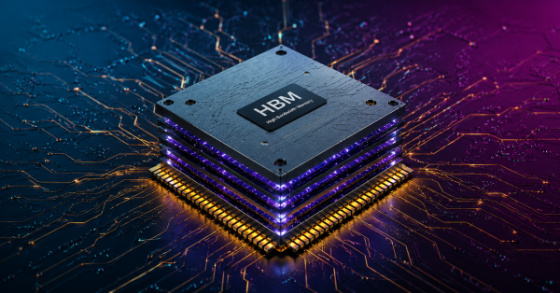
The Memory Bottleneck: When the Cheapest Component Became the Most Expensive Constraint
For decades, memory was the quiet enabler of technological progress.
It got cheaper every year.
Faster every year.
More abundant every year.
It was the invisible tailwind beneath every device we used—phones, laptops, servers—never the story, always the support.
Until now.
Today, memory has become the constraint.
And when the cheapest input in a system becomes the scarcest, the entire system resets.
You can see that reset most clearly in two places:
- Apple raising prices—and seeing its stock fall
- Micron Technology is surging—becoming one of the biggest winners in the market
Those two observations are not disconnected.
They are the same story told from opposite sides of the equation.
A Picture Worth 800%: The Micron Signal
Below is a simple way to visualize the shift:
Micron Technology (MU) — 1-Year Stock Performance (Illustrative Trend)
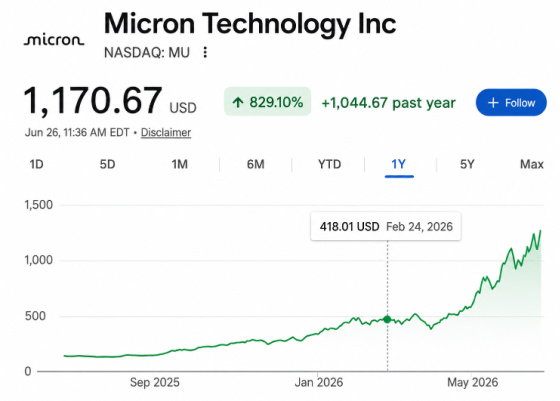
Micron’s rise is not just a stock story.
It is a pricing power story.
And pricing power, in markets, is the cleanest signal of scarcity.
From Abundance to Scarcity
So what changed?
In a word: AI.
But more precisely, it’s the type of AI we are building.
Modern artificial intelligence systems aren’t just compute-heavy—they are memory-intensive to a degree we’ve never seen before.
- Large language models require enormous memory to store parameters and context
- High-bandwidth memory (HBM) is now essential to feed GPUs fast enough
- Without sufficient memory, even the most advanced chips sit idle
This is what engineers call the “memory wall”—a point where compute grows faster than the ability to move and store data. [trendforce.com]
And once you hit that wall, the bottleneck shifts.
From compute… to memory.
The Quiet Reallocation That Broke the System
What makes this cycle different isn’t just demand—it’s supply behavior.
The memory industry has effectively made a rational decision:
Follow the highest-margin demand.
That means:
- Redirecting capacity toward AI data centers
- Prioritizing high-bandwidth memory (HBM) over conventional DRAM
- Entering multi-year supply agreements with hyperscalers
At the same time:
- More than 50% of DRAM capacity has been shifted toward AI memory [icallin.com]
- Production of standard memory for consumer devices has effectively been constrained
This creates a paradox:
The world is not running out of chips.
It is running out of the right chips, in the right places, at the right prices.
Apple: When Even the Best Can’t Escape the System
Historically, Apple is the master of supply chains.
If anyone could navigate a shortage, it would be them.
And yet:
- Memory and storage costs have surged dramatically
- Apple has begun raising prices across key product lines [cnbc.com]
- Its stock dropped roughly 6% following those price hikes [cnbc.com]
Tim Cook called the situation a “hundred-year flood”—a striking admission.
Why is Apple vulnerable?
Because:
- It designs its own chips—but not its memory
- Memory is a commoditized input with concentrated supply
- When pricing power shifts upstream, Apple becomes a price taker
This is the first time in years that Apple cannot fully shield its customers—or its margins—from input costs.
That’s not a company story.
That’s a system story.
The Ghost of 2023: Underinvestment Comes Due
Every shortage has a backstory.
This one traces to 2022–2023:
- Memory prices collapsed
- Margins fell sharply
- Capital investment slowed
Even industry executives now acknowledge that low prices discouraged capacity investment, which directly contributed to today’s shortage. [9to5mac.com]
And in memory, timing is everything:
- New fabs take years to build
- Supply responses lag demand—sometimes by half a decade
So the industry is now paying for yesterday’s pessimism.
The Response: Massive Capital, Slow Relief
The response is now underway—but it will take time.
Consider Samsung:
- Planning a ~$646 billion investment over the next decade [econotimes.com]
- Spending $73B+ in 2026 alone on semiconductors [tech-insider.org]
Across the industry:
- Micron is expanding capacity aggressively
- SK Hynix is scaling HBM production
- New fabs are being built globally
But most of these won’t come online until the late 2020s.
Which means:
The shortage is not a spike.
It is a multi-year environment.
Could Technology Break the Cycle?
There is an important counter-question:
Could innovation reduce the need for memory?
There are early signs:
- Compute-in-memory architectures (bringing processing closer to data) [weforum.org]
- Model efficiency improvements (smaller, optimized AI systems)
- Lower precision computing reduces the memory footprint
But the dominant trend remains:
- Larger models
- Longer context windows
- More real-time inference
In other words:
Efficiency gains may slow demand growth—but they are unlikely to reverse it.
Memory is not becoming less important.
It is becoming the defining constraint.
From Silicon to Cities: A Real Estate Lens
This is where the story becomes particularly interesting from your world.
Because this isn’t just a chip story.
It’s a physical world buildout story.
Massive semiconductor investments are reshaping cities:
Phoenix, Arizona
- Anchored by TSMC’s multi-fab buildout
- Tens of thousands of jobs
- Entire mixed-use ecosystems forming around fabs [signalscv.com]
Austin / Taylor, Texas
- Samsung’s advanced manufacturing push
Boise, Idaho & Upstate New York
- Micron’s long-term fabrication investments
Ohio, Oregon, and beyond
- Intel-led expansion
These are not incremental developments.
They are generational industrial clusters.
Once a fab goes in:
- Supply chains follow
- Talent relocates
- Housing demand rises
- Infrastructure expands
From a real estate perspective, this has all the characteristics you look for:
- Long-duration capital investment
- High-skilled job creation
- Supply-constrained development
Lessons for Investors (and Operators)
This cycle offers several enduring lessons:
- The Bottleneck Moves
The highest-value constraint in a system is where pricing power resides.
Today, that bottleneck is memory.
- Cycles Become Structural
What begins as a cyclical shortage can become a multi-year supercycle when driven by structural demand (AI).
- Capital Allocation Has Long Shadows
Underinvestment in down cycles creates outsized returns in up cycles.
- Physical World Still Matters
Even in the AI era, value is being created through real assets—fabs, power, land, and labor.
Closing Thought: The Invisible Has Become the Decisive
Memory used to be invisible.
Now it is decisive.
It is shaping product pricing, driving equity returns, influencing geopolitics, and reshaping cities.
And perhaps most importantly:
It is reminding us that even in a digital world, progress is still constrained by the physical.

Good insight for CWS’s forward looking evaluation of markets with a growing high income population increases.