

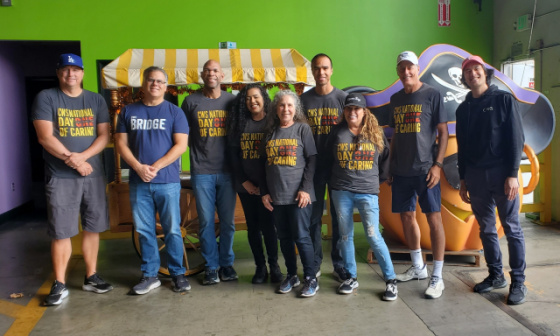
Last week, I had the privilege of participating in our National Day of Caring alongside a wonderful group of Newport Beach associates at a local Orange County food bank. Together, we filled 400 boxes of food—well over 1,200 pounds—destined for needy families. Something remarkable happened as we worked side by side, lifting, packing, and organizing. The physical labor became a kind of meditation, and the warehouse transformed into a space where colleagues became a community.
It was gratifying work, no question. It was also an excellent workout and a chance to connect with coworkers outside the usual conference rooms and email threads. But as I reflected on the experience afterward, I realized something deeper was at play. The sense of fulfillment I felt wasn’t just about the tangible impact of those 400 boxes. It was about touching something more fundamental—something that spiritual traditions and social movements have understood for millennia.
The Universal Call to Service
Across vastly different belief systems and practices, a common thread emerges: service to others is not merely a good deed—it is essential nourishment for the soul.
Christianity places service at its very heart. Jesus washed the feet of his disciples, demonstrating that true leadership means humble service to others. “Whatever you did for one of the least of these brothers and sisters of mine, you did for me,” he taught (Matthew 25:40). This isn’t abstract philosophy—it’s a call to see the divine in every person we encounter, especially those who are suffering or marginalized. When we serve others, we are serving something infinitely greater than ourselves.
In Judaism, this principle is embodied in the concept of mitzvot—commandments that guide righteous living. These aren’t simply rules to follow; they are pathways to holiness and connection with the divine. The Chabad movement, guided by the teachings of the Rebbe, Rabbi Menachem Mendel Schneerson, takes this even further. The Rebbe taught that every act of kindness creates a ripple effect in the world, bringing light into darkness. He emphasized that we must not wait for perfect circumstances or complete understanding before we act. “A little light dispels much darkness,” he would say. Service, in this tradition, is both a spiritual practice and a practical necessity—it transforms the giver as much as it helps the receiver.
Buddhism teaches the practice of karuna—compassion—and emphasizes that our own liberation is intertwined with the wellbeing of all sentient beings. The Bodhisattva vow commits practitioners to postponing their own final enlightenment until all beings can be freed from suffering. Through service, we practice letting go of ego and self-centeredness, recognizing the fundamental interconnection of all life. Each act of generosity is a step toward awakening.
Alcoholics Anonymous and the broader recovery community have built an entire philosophy around service. The 12th Step—”Having had a spiritual awakening as the result of these steps, we tried to carry this message to alcoholics, and to practice these principles in all our affairs”—recognizes that helping others is not just charitable; it’s essential to maintaining one’s own sobriety and spiritual health. In AA, service keeps you sober. It gets you out of your own head, connects you to something larger than yourself, and reminds you that your experience—even your suffering—has value and purpose.
Why Service Cares for Our Souls
What do all these traditions understand that our modern, individualistic culture sometimes forgets? They know that the human soul withers in isolation and self-absorption. We are not meant to live purely for ourselves. When we serve others, several profound things happen:
We transcend the prison of self. Our everyday worries and anxieties, which can feel all-consuming, suddenly shrink to their proper size when we’re focused on meeting someone else’s need.
We remember our interconnection. Filling those food boxes reminded me viscerally that we are all part of one human family. The food insecurity that affects our neighbors could affect any of us under different circumstances.
We discover meaning. Purpose isn’t found by looking inward endlessly; it’s found by looking outward and asking, “How can I help? What needs doing?”
We experience gratitude. Service naturally cultivates thankfulness—for our own circumstances, yes, but more importantly, for the opportunity to make a difference.
We grow in humility and humanity. Working alongside others in service, whether they’re colleagues or complete strangers, breaks down the walls we build between ourselves and others. In that Orange County warehouse, titles and hierarchies melted away. We were simply humans helping humans.
A Practice, Not Just an Event
Our National Day of Caring was powerful precisely because it pulled us out of our normal routines and placed us in direct contact with need and the opportunity to address it. But the spiritual traditions remind us that service cannot be a once-a-year event if we want it to truly nourish our souls. It must become a practice—a regular part of how we move through the world.
This doesn’t mean we all need to volunteer at food banks every week (though that would be wonderful). It means cultivating an orientation toward service in our daily lives. It means asking, “How can I help?” more often. It means seeing opportunities to lighten someone else’s burden and taking them. It means recognizing that our time, energy, and resources are gifts meant to be shared, not hoarded.
The Rebbe taught that every person has a unique mission in this world—something only they can accomplish. Perhaps our task is to discover not just what we can do for ourselves, but what we alone can do for others.
As I think back on those 400 boxes—now in homes across Orange County, feeding families, easing worry, bringing relief—I’m reminded that the real gift wasn’t the food itself.
It was the human connection, the caring, the message that says:
You matter.
We see you.
You’re not alone.
And in giving that message, we receive it ourselves.
That’s the miracle of service. In caring for others, we care for our own souls.

Leave a Reply