


I have been listening to Carl Jung’s Memories, Dreams, Reflections, and it reinforces for me the power of the subconscious in driving human behavior as well as the importance of myths to guide societies, cultures, and individuals. Joseph Campbell wrote The Power of Myth, which goes more deeply into the subject and is well worth reading. If you’re not inclined to read the book, then I encourage you to watch the series of interviews he did on PBS with Bill Moyers shortly before his death in 1987. The book is based on those interviews.
Myth
Myths have played a vital role in human history. I am touching on this subject because I think it can be extremely helpful to find a powerful myth which can help guide one’s life. At the end of this post I’ll show an example of how someone applied a myth to tennis great Jannik Sinner. And on a more personal level, next week I will share mine that was formulated with the help of Copilot that was remarkably accurate and inspiring.
James Carse wrote, “myths are not stories that have meanings, but stories that give meanings”—they generate the frameworks through which we interpret events and experiences, touching the “genius in each of us” and enabling us to make sense of the world around us. Without the ability to tell our own story, nothing truly happens to us on a deep level.
According to Joseph Campbell, myths act as “clues to the spiritual potentialities of the human life” and can “enlarge our psychological thinking to include the mysteries at work in human life that will never be fully explained”.
Myths arise from universal patterns—Jung called these “archetypes”—that connect us “with the instinctive bases of our existence” and appear in the stories, dreams, and visions across all cultures and times. By engaging with myths, we enter a dialogue with the deep forces of the psyche, gaining access to wisdom borne of the human experience across millennia.
Myths provide life models and ceremonies that mark the various stages of human development—initiation, adulthood, marriage, responsibility—thus offering guidance for how to live a human life “under any circumstances”.
Myths are not relics of a primitive past, but living processes central to our development. They support our psychological health, structure societies, provide guidance through life’s stages, and keep us connected to the great mysteries of existence. Without them, the replacement of myths with mere scientific information can leave us with a sense of personal meaninglessness. This is why mythology remains vital for humans of every era.
I asked Claude.ai the following:
What are the benefits of identifying a powerful myth from which to live one’s life as a guide?
Here is the response which I found to be quite enlightening and helpful.
Living from a powerful personal myth can provide several profound benefits that shape how we navigate life’s complexities and challenges.
Coherence and meaning-making emerge as perhaps the most significant advantage. A guiding myth helps integrate disparate experiences into a coherent narrative, transforming random events into meaningful chapters of a larger story. This coherence reduces existential anxiety and provides a framework for understanding both successes and setbacks as part of a meaningful journey rather than arbitrary occurrences.
Decision-making clarity flows naturally from this coherence. When faced with choices, a powerful myth acts as an internal compass, helping you evaluate options against your deeper values and long-term vision. Instead of making decisions based solely on immediate circumstances or external pressures, you can ask whether a choice aligns with your mythic identity and purpose.
Resilience during adversity becomes more accessible when challenges are viewed through the lens of your personal myth. Difficult periods transform from meaningless suffering into necessary trials, learning opportunities, or calls to growth. Heroes’ journeys, for instance, reframe obstacles as essential elements of character development rather than evidence of failure or bad luck.
Authentic self-expression emerges when you identify with a myth that resonates with your true nature. Rather than conforming to others’ expectations or cultural defaults, you can express your unique qualities and pursue paths that align with your mythic identity. This authenticity tends to generate more energy and satisfaction than living according to external scripts.
Motivation and purpose gain deeper roots when connected to archetypal patterns. A personal myth provides not just goals but a sense of calling or destiny that can sustain effort through difficult periods. The myth becomes a source of intrinsic motivation that doesn’t depend on external validation or immediate rewards.
Connection to something larger develops as you recognize how your personal story relates to universal human patterns. This connection can reduce feelings of isolation and provide perspective on your place in the broader human experience. Your struggles and triumphs become part of timeless themes rather than purely individual concerns.
The key lies in choosing or discovering a myth that genuinely resonates with your deepest values and aspirations, rather than adopting one that sounds appealing but doesn’t reflect your true nature.
I mentioned earlier that I would show an example of a mythological character and his attributes applied to Jannik Sinner. I came across the following thread on X from @dvonpalm that does just this.
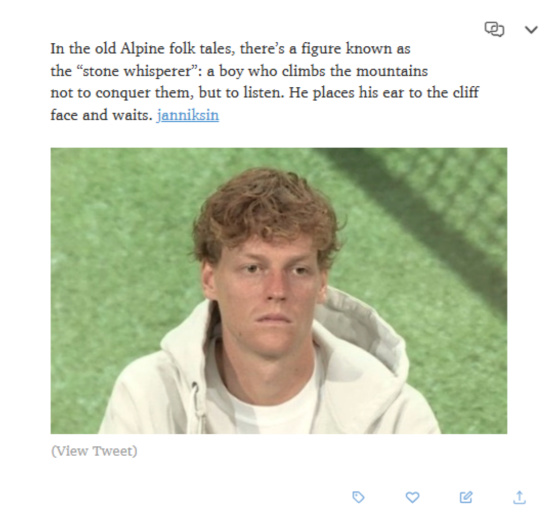
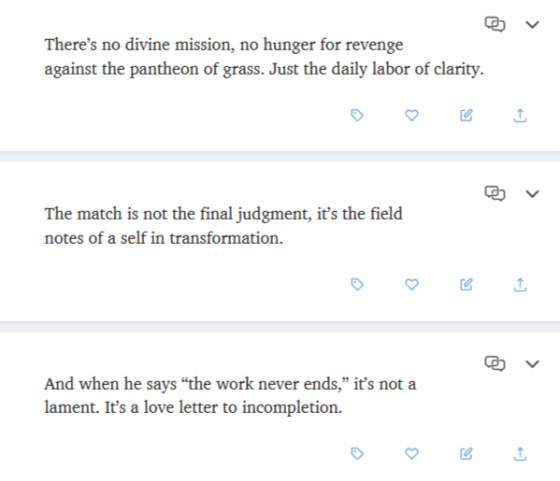
I found that to be so insightful and inspiring. A powerful myth, correctly applied to an individual, can explain a lot of that person’s choices, behaviors, and way of seeing the world. This articulates what I have been seeing with my own eyes and feeling when I watch Sinner play and when he speaks to the media, but I have never been able to convert what I have seen and heard into a coherent narrative based on a mythical figure. This series of tweets does just that for me.

As tennis fan’s know, Jannik Sinner won the men’s singles title at Wimbledon July 13, 2025. He is the 1st Italian to ever win this title at Wimbledon. Defeating Carlos Alcaraz in a 3 hour 4 minute match.
Stay tuned for my personal myth in next week’s blog. I hope after reading this week’s post and next week’s you will strongly consider exploring what personal myth you’ve been living. And if it’s one that has not brought you joy and satisfaction then you might come to the radical determination that perhaps finding a new myth to live by may just be the answer.
If finding a powerful myth is either too daunting due to lack of knowledge of myths or just not very interesting, then another approach is to find an alter ego. This is a little more concrete and can be applied situationally rather than throughout all aspects of your life like a powerful myth can do. One may have multiple alter egos which are applied tactically and situationally versus a myth that helps craft our personal narratives tying major aspects of our lives together in a powerful and compelling narrative. Both have huge benefits so I recommend following the advice of Deng Xiaoping who said, “Black cat, white cat, whatever gets the rat.” Choose the approach you think will provide you with the most value.
If one is more interested in learning about the power of alter egos then I strongly recommend reading or listening to The Alter Ego Effect.
Hopefully you’ll return next week for the unveiling of my personal myth and the associated narrative.

Leave a Reply